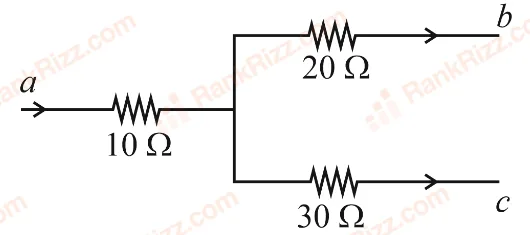
The figure below shows a part of an electric circuit. The potentials at points , and are 30 V, 12 V and 2 V respectively. The current through the 20 resistor will be,
- A
1.0 A
- B
0.4 A
- C
0.6 A
- D
0.2 A
Every Current Electricity question JEE Main has set, grouped by the idea it tests rather than the order of the syllabus. 386 questions across 10 distinct ideas. Free to read, answer key on every one.
Questions
386
Distinct ideas
10
Share of marks
5.6%
Difficulty
MEDIUM
A chapter is not one subject — it is a handful of procedures the examiner reuses. These are the ones Current Electricity questions actually test.
121–140 OF 386 · NEWEST FIRST
The figure below shows a part of an electric circuit. The potentials at points , and are 30 V, 12 V and 2 V respectively. The current through the 20 resistor will be,

1.0 A
0.4 A
0.6 A
0.2 A
The length of a metallic wire is increased by 20% and its area of cross-section is reduced by 4%. The percentage change in resistance of the metallic wire is ______.
A potential is applied across a uniform wire of resistance . The power dissipation is . The wire is then cut into two equal halves and a potential of is applied across the length of each half. The total power dissipation across two wires is . The ratio of is . The value of is _____.
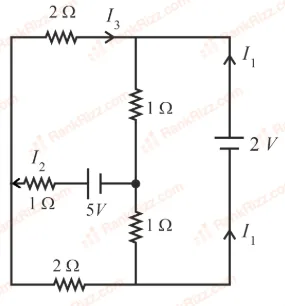
In the following circuit, the magnitude of current , is ______ A.

The current flowing through a conductor connected across a source is A and A at C and C respectively. The current flowing through the conductor at C will be _____ mA.
If a copper wire is stretched to increase its length by 20%. The percentage increase in resistance of the wire is _____%.
When a resistance of is shunted with a moving coil galvanometer, it shows a full scale deflection for a current of mA, however when resistance is connected with it in series, it gives full scale deflection for volt. The resistance of galvanometer is _____ .
A null point is found at cm in potentiometer when cell in secondary circuit is shunted by . When a resistance of is used for shunting null point moves to cm. The internal resistance of the cell is ______ .
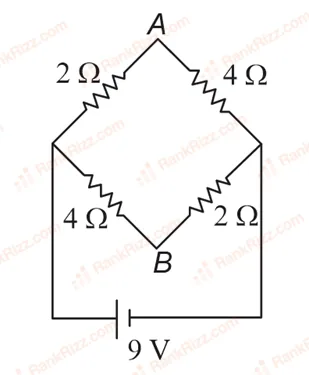
A network of four resistances is connected to V battery, as shown in figure. The magnitude of voltage difference between the points and is _____ V.

The number density of free electrons in copper is nearly m. A copper wire has its area of cross-section m and is carrying a current of 3.2 A. The drift speed of the electrons is _______ m s.
In an experiment to find emf of a cell using potentiometer, the length of null point for a cell of emf 1.5 V is found to be 60 cm. If this cell is replaced by another cell of emf , the length-of null point increases by 40 cm. The value of is V. The value of is _____.
10 resistors each of resistance 10 can be connected in such as to get maximum and minimum equivalent resistance. The ratio of maximum and minimum equivalent resistance will be _______.
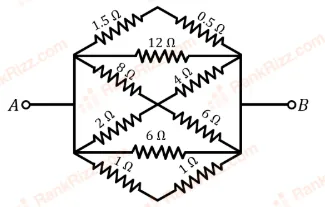
The equivalent resistance between and is ______ .

Ω
Ω
Ω
Ω
A current of 2 A flows through a wire of cross-sectional area 25.0 mm. The number of free electrons in a cubic meter are . The drift velocity of the electrons is ______ ms
(given, charge on electron = C).
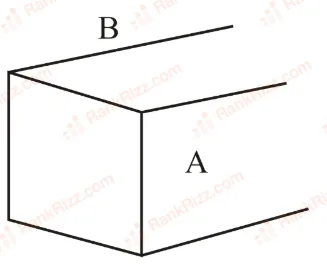
A rectangular parallelopiped is measured as 1 cm 1 cm 100 cm. If its specific resistance is m, then the resistance between its two opposite rectangular faces will be _______ .

A hollow cylindrical conductor has length of 3.14 m, while its inner and outer diameters are 4 mm and 8 mm respectively. The resistance of the conductor is . If the resistivity of the material is m. The value of n is _____.
A hollow cylindrical conductor has length of 3.14 m, while its inner and outer diameters are 4 mm and 8 mm respectively. The resistance of the conductor is . If the resistivity of the material is m. The value of is _____.
Two identical cells, when connected either in parallel or in series gives same current in an external resistance 5 . The internal resistance of each cell will be ______ .
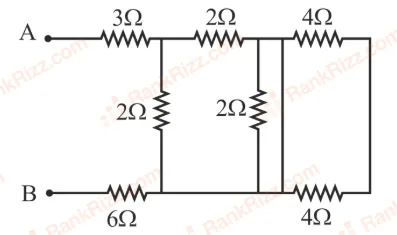
In the given circuit, the equivalent resistance between the terminals A and B is _____

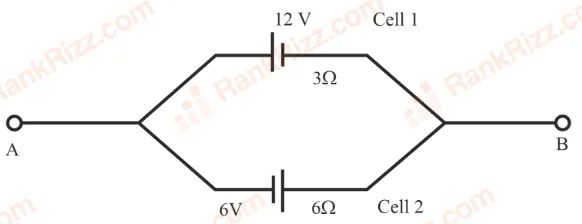
Two cells are connected between points A and B as shown. Cell 1 has emf of 12 V and internal resistance of 3 . Cell 2 has emf of 6 V and internal resistance of 6 . An external resistor R of 4 is connected across A and B. The current flowing through R will be _____ A.

OTHER PHYSICS CHAPTERS