RankRizzStart free

Current Electricity — JEE Main Previous Year Questions

Every Current Electricity question JEE Main has set, grouped by the idea it tests rather than the order of the syllabus. 386 questions across 10 distinct ideas. Free to read, answer key on every one.

Questions

386

Distinct ideas

10

Share of marks

5.6%

Difficulty

MEDIUM

The ideas inside Current Electricity

A chapter is not one subject — it is a handful of procedures the examiner reuses. These are the ones Current Electricity questions actually test.

01Electric current, current density and drift velocityset 24×
02Ohm's law, resistance, resistivity and colour codeset 51×
03Combination of resistors and equivalent resistanceset 49×
04Cells: emf, internal resistance and combinationsset 27×
05Kirchhoff's laws and circuit analysisset 49×
06Wheatstone bridgeset 14×
07Meter bridgeset 23×
08Potentiometerset 29×
09Electric power and heating effect of currentset 60×
10Galvanometer conversion to ammeter and voltmeterset 60×

Every Current Electricity question

281–300 OF 386 · NEWEST FIRST

JEE MAIN 2019 · 11 JAN S2Galvanometer conversion to ammeter and voltmeterTRANSCRIBED

A galvanometer having a resistance of and 30 division on both sides has figure of merit 0.005 ampere/division. The resistance that should be connected in series such that it can be used as a voltmeter upto 15 volt, is:

  1. A

  2. B

  3. C

  4. D

JEE MAIN 2019 · 08 APR S2PotentiometerTRANSCRIBED

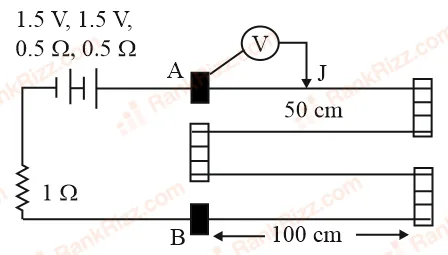
In the circuit shown, a four-wire potentiometer is made of a 400 cm long wire, which extends between A and B. The resistance per unit length of the potentiometer wire is r = 0.01 /cm. If an ideal voltmeter is connected as shown with jockey J at 50 cm from end A, the expected reading of the voltmeter will be:

  1. A

    0.50 V

  2. B

    0.25 V

  3. C

    0.75 V

  4. D

    0.20 V

JEE MAIN 2019 · 10 JAN S1Combination of resistors and equivalent resistanceTRANSCRIBED

A uniform metallic wire has a resistance of 18 and is bent into an equilateral triangle. Then, the resistance between any two vertices of the triangle is:

  1. A

    2

  2. B

    12

  3. C

    8

  4. D

    4

JEE MAIN 2019 · 12 JAN S1Electric power and heating effect of currentTRANSCRIBED

Two electric bulbs, rated at (25 W, 220 V) and (100 W, 220 V), are connected in series across a 220 V voltage source. If the 25 W and 100 W bulbs draw powers and respectively, then:

  1. A

    W, W

  2. B

    W, W

  3. C

    W, W

  4. D

    W, W

JEE MAIN 2019 · 09 APR S1Combination of resistors and equivalent resistanceTRANSCRIBED

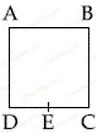
A wire of resistance R is bent to form a square ABCD as shown in the figure. The effective resistance between E and C is: (E is mid-point of arm CD)

  1. A

    R

  2. B

  3. C

  4. D

JEE MAIN 2019 · 12 APR S1Galvanometer conversion to ammeter and voltmeterTRANSCRIBED

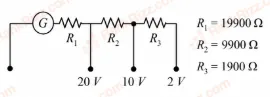
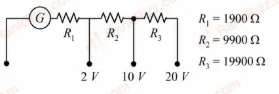
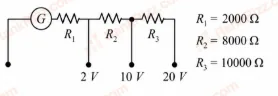
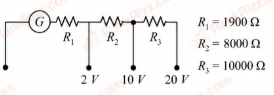
A galvanometer of resistance 100 Ω has 50 divisions on its scale and has sensitivity of 20 μA/division. It is to be converted to voltmeter with three ranges, of 0 - 2 V, 0 - 10 V and 0 - 20 V. The appropriate circuit to do so is:

  1. A
    image
  2. B
    image
  3. C
    image
  4. D
    image
JEE MAIN 2019 · 12 JAN S2Kirchhoff's laws and circuit analysisTRANSCRIBED

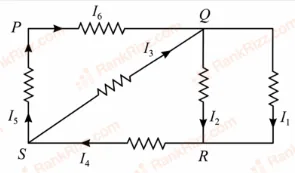
In the given circuit diagram, the currents, A, A and A, are flowing as shown. The currents , and , respectively, are:

image
  1. A

    0.4A, 1.1A, 0.4A

  2. B

    1.1A, -0.4A, 0.4A

  3. C

    1.1A, 0.4A, 0.4A

  4. D

    -0.4A, 0.4A, 1.1A

JEE MAIN 2019 · 09 APR S2Galvanometer conversion to ammeter and voltmeterTRANSCRIBED

The resistance of a galvanometer is 50 ohm and the maximum current which can be passed through it is 0.002 A. What resistance must be connected to it in order to convert it into an ammeter of range 0 - 0.5 A?

  1. A

    0.2 ohm

  2. B

    0.5 ohm

  3. C

    0.002 ohm

  4. D

    0.02 ohm

JEE MAIN 2019 · 12 APR S2Galvanometer conversion to ammeter and voltmeterTRANSCRIBED

A moving coil galvanometer, having a resistance G, produces full scale deflection when a current I flows through it. This galvanometer can be converted into (i) an ammeter of range 0 to I (I > I) by connecting a shunt resistance R to it and (ii) into a voltmeter of range 0 to V (V = GI) by connecting a series resistance R to it. Then,

  1. A

    RR = G and

  2. B

    RR = G and

  3. C

    RR = G and

  4. D

    RR = G and

JEE MAIN 2019 · 08 APR S2Electric power and heating effect of currentTRANSCRIBED

A cell of internal resistance r drives current through an external resistance R. The power delivered by the cell to the external resistance will be maximum when:

  1. A

    R = 2r

  2. B

    R = r

  3. C

    R = 1000 r

  4. D

    R = 0.001 r

JEE MAIN 2019 · 10 JAN S1Ohm's law, resistance, resistivity and colour codeTRANSCRIBED

A 2 W carbon resistor is color coded with green, black, red and silver respectively. The maximum current which can be passed through this resistor is:

  1. A

    100 mA

  2. B

    0.4 mA

  3. C

    20 mA

  4. D

    63 mA

JEE MAIN 2019 · 12 APR S1Electric power and heating effect of currentTRANSCRIBED

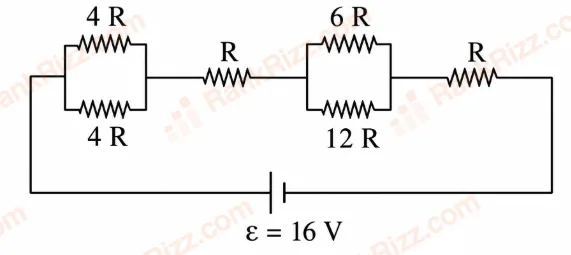
The resistive network shown below is connected to a D.C. source of 16 V. The power consumed by the network is 4 Watt. The value of R is:

image
  1. A

    16 Ω

  2. B

    8 Ω

  3. C

    6 Ω

  4. D

    1 Ω

JEE MAIN 2019 · 10 JAN S2Galvanometer conversion to ammeter and voltmeterTRANSCRIBED

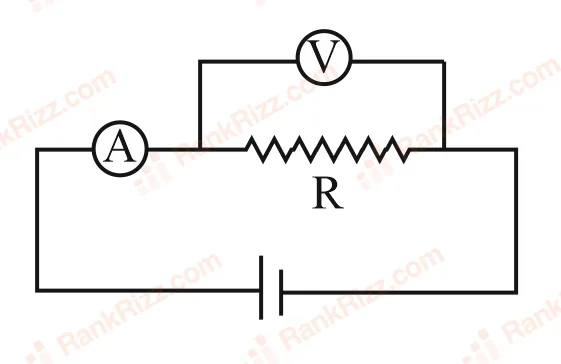
The actual value of resistance , shown in the figure is 30. This is measured in an experiment as shown using the standard formula , where V and I are the readings of the voltmeter and ammeter, respectively. If the measured value of is 5% less, then the internal resistance of the voltmeter is:

  1. A

    35

  2. B

    600

  3. C

    570

  4. D

    350

JEE MAIN 2019 · 09 APR S2Ohm's law, resistance, resistivity and colour codeTRANSCRIBED

In a conductor, if the number of conduction electrons per unit volume is m and mean free time is 25 fs (femto second), it's approximate resistivity is: ( kg)

  1. A

    m

  2. B

    m

  3. C

    m

  4. D

    m

JEE MAIN 2019 · 09 JAN S1Ohm's law, resistance, resistivity and colour codeTRANSCRIBED

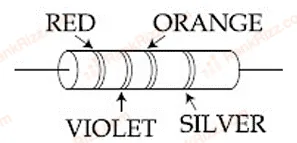
A resistance is shown in the figure. Its value and tolerance are given respectively by:

  1. A

    27 k, 10%

  2. B

    270 , 5%

  3. C

    270 , 10%

  4. D

    27 k, 20%

JEE MAIN 2019 · 08 APR S2Kirchhoff's laws and circuit analysisTRANSCRIBED

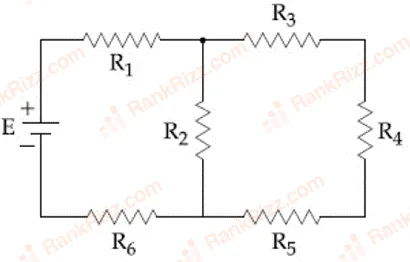
In the figure shown, what is the current (in Ampere) drawn from the battery? You are given: , , , , , , V

  1. A

    9/32

  2. B

    7/18

  3. C

    13/24

  4. D

    20/3

JEE MAIN 2019 · 10 APR S2Ohm's law, resistance, resistivity and colour codeTRANSCRIBED

Space between two concentric conducting spheres of radii a and b (b > a) is filled with a medium of resistivity . The resistance between the two spheres will be:

  1. A

  2. B

  3. C

  4. D

JEE MAIN 2019 · 09 APR S1Galvanometer conversion to ammeter and voltmeterTRANSCRIBED

A moving coil galvanometer has resistance 50 and it indicates full deflection at 4 mA current. A voltmeter is made using this galvanometer and a 5 k resistance. The maximum voltage, that can be measured using this voltmeter, will be close to:

  1. A

    40 V

  2. B

    15 V

  3. C

    20 V

  4. D

    10 V

JEE MAIN 2019 · 10 JAN S2Ohm's law, resistance, resistivity and colour codeTRANSCRIBED

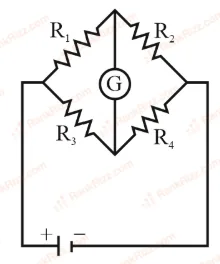
The Wheatstone bridge shown in the figure below, gets balanced when the carbon resistor used as has the colour code (orange, red, brown). The resistors and are 80 and 40 , respectively. Assuming that the colour code for the carbon resistors gives their accurate values, the colour code for the carbon resistor, used as , would be:

image
  1. A

    brown, blue, black

  2. B

    brown, blue, brown

  3. C

    grey, black, brown

  4. D

    red, green, brown

JEE MAIN 2019 · 10 JAN S2Electric power and heating effect of currentTRANSCRIBED

A current of 2 mA was passed through an unknown resistor which dissipated a power of 4.4 W. Dissipated power when an ideal power supply of 11 V is connected across it is:

  1. A

    W

  2. B

    W

  3. C

    W

  4. D

    W