RankRizzStart free

Laws of Motion & Friction — JEE Main Previous Year Questions

Every Laws of Motion & Friction question JEE Main has set, grouped by the idea it tests rather than the order of the syllabus. 151 questions across 5 distinct ideas. Free to read, answer key on every one.

Questions

151

Distinct ideas

5

Share of marks

3%

Difficulty

MEDIUM

The ideas inside Laws of Motion & Friction

A chapter is not one subject — it is a handful of procedures the examiner reuses. These are the ones Laws of Motion & Friction questions actually test.

01Newton's laws, free-body diagrams and equilibrium of a particleset 57×
02Connected bodies, pulleys and constraint relationsset 25×
03Spring force and spring combinations in dynamicsset 5×
04Pseudo force: lifts and accelerating framesPractice questions coming soon
05Motion on inclined planes and wedgesset 15×
06Static and kinetic frictionset 49×
07Friction in multi-block systemsPractice questions coming soon

Every Laws of Motion & Friction question

1–20 OF 151 · NEWEST FIRST

JEE MAIN 2026 · 28 JAN S2Motion on inclined planes and wedgesTRANSCRIBED

A small block of mass m slides down from the top of a frictionless inclined surface, while the inclined plane is moving towards left with constant acceleration . The angle between the inclined plane and ground is θ and its base length is L. Assuming that initially the small block is at the top of the inclined plane, the time it takes to reach the lowest point of the inclined plane is ___ .
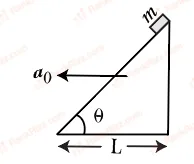
image
  1. A

  2. B

  3. C

  4. D

JEE MAIN 2026 · 04 APR S1Static and kinetic frictionTRANSCRIBED

The time taken by a block of mass to slide down from the highest point to the lowest point on a rough inclined plane is 50% more compared to the time taken by the same block on identical inclined smooth plane. Both inclined planes are at with the horizontal. The coefficient of kinetic friction between the rough inclined surface and block is :

  1. A

  2. B

  3. C

  4. D

JEE MAIN 2026 · 04 APR S2Newton's laws, free-body diagrams and equilibrium of a particleTRANSCRIBED

At , a body of mass g starts moving under the influence of a force N. After s, its  position is m. The ratio is ______.

  1. A

  2. B

  3. C

  4. D

JEE MAIN 2026 · 06 APR S1Connected bodies, pulleys and constraint relationsTRANSCRIBED

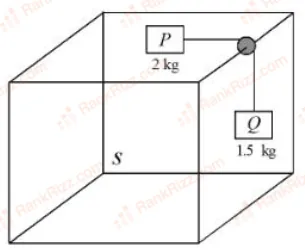
Two blocks (P and Q) with respectively masses 2 kg and 1.5 kg are joined by a massless thread. These blocks are mounted on a frictionless pully which is fixed on the edge of a cube (S), as shown in the figure below. Block P is positioned on the top surface which has no friction and block Q is in contact with side-surface, having coefficient friction . The cube (S) moves towards the right with acceleration of , where g is gravitational acceleration. During this movement the block P and Q remain stationary. The value of is _______.
(take g = 10 m/s)

image
  1. A

    0.33

  2. B

    0.67

  3. C

    1

  4. D

    0.5

JEE MAIN 2026 · 05 APR S1Connected bodies, pulleys and constraint relationsTRANSCRIBED

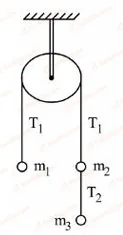
Three masses kg, kg and kg are suspended from a fixed smooth frictionless pully as shown in the figure below. The value of is _______. (take m/s)

image
  1. A

    5/3

  2. B

    2/3

  3. C

    3/5

  4. D

    2/5

JEE MAIN 2026 · 05 APR S1Motion on inclined planes and wedgesTRANSCRIBED

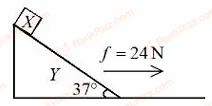
A wedge Y with mass of 10 kg and all frictionless surfaces and the inclined surface making 37° with horizontal. A block X with mass 2 kg is placed at the highest point of the wedge as shown in figure is at rest. At wedge (Y) is pulled toward right with constant force () of 24 N. Taking the block X at rest at , the time taken by it to slide down 8.8 m on the slope, while Y is on the move, is _______ s. (take and m/s)

image
  1. A


  2. B


  3. C


  4. D


JEE MAIN 2026 · 28 JAN S1Newton's laws, free-body diagrams and equilibrium of a particleTRANSCRIBED

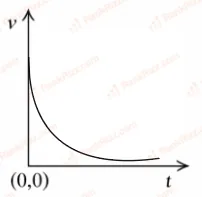
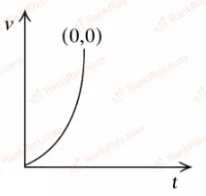
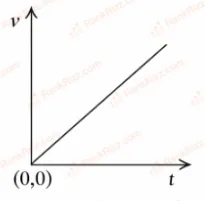
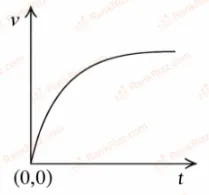
A particle of mass m falls from rest through a resistive medium having resistive force, F = -kv, where v is the velocity of the particle and k is a constant. Which of the following graphs represents velocity (v) versus time (t)?

  1. A
    33-1
  2. B
    33-2
  3. C
    33-3
  4. D
    33-4
JEE MAIN 2026 · 21 JAN S1Newton's laws, free-body diagrams and equilibrium of a particleTRANSCRIBED

A 4 kg mass moves under the influence of a force where t is the time in second. If mass starts from origin at t= 0, the velocity and position after t= 2 s will be:

  1. A

  2. B

  3. C

  4. D

JEE MAIN 2026 · 24 JAN S2Newton's laws, free-body diagrams and equilibrium of a particleTRANSCRIBED

A flexible chain of mass m hangs between two fixed points at the same level. The inclination of the chain with the horizontal at the two points of support is . Considering the equilibrium of each half of the chain, the tension of the chain at the lowest point is __________.

  1. A

  2. B

    mg

  3. C

  4. D

JEE MAIN 2026 · 23 JAN S2Motion on inclined planes and wedgesTRANSCRIBED

A block is sliding down on an inclined plane of slope and at an instant t = 0 this block is given an upward momentum so that it starts moving up on the inclined surface with velocity u. The distance (S) travelled by the block before its velocity become zero, is ______.
(g = gravitational acceleration)

  1. A

  2. B

  3. C

  4. D

JEE MAIN 2026 · 28 JAN S1Motion on inclined planes and wedgesTRANSCRIBED

A block of mass 5 kg is moving on an inclined plane which makes an angle of 30° with the horizontal. Friction coefficient between the block and inclined plane surface is . The force to be applied on the block so that the block will move down without acceleration is _______N

  1. A

    15

  2. B

    12.5

  3. C

    25

  4. D

    7.5

JEE MAIN 2026 · 06 APR S2Connected bodies, pulleys and constraint relationsTRANSCRIBED

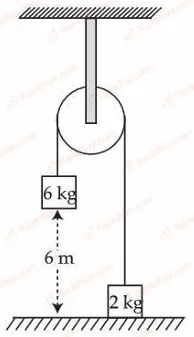
The velocity at which 6 kg mass (shown in figure) strikes the ground when it is released from a height of 6 m above the ground is __________ m/s. Assume pulley is massless and string is light and inextensible. (Take m/s)

image
  1. A

    7.74

  2. B

    7.20

  3. C

    6.55

  4. D

    4.50

JEE MAIN 2026 · 24 JAN S1Static and kinetic frictionTRANSCRIBED

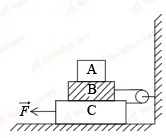
In the given figure, the blocks A, B and C weigh 4 kg, 6 kg and 8 kg, respectively. The coefficient of sliding friction between any two surfaces is 0.5. The force F required to slide the block C with constant speed is __ N. (Use ) 

image
JEE MAIN 2026 · 06 APR S2Static and kinetic frictionTRANSCRIBED

A block takes time to slide down a plane inclined at 45° to the horizontal. If the surface is made smooth (frictionless), the block takes time to slide down the plane. The coefficient of friction between the block and the inclined plane is . The value of is __________.

JEE MAIN 2026Static and kinetic frictionTRANSCRIBED

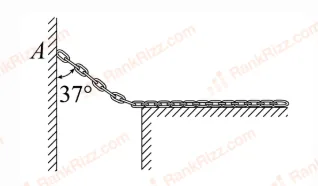
A uniform chain of length l\ has one of its end attached to the wall a point A, while of the length of the chain is lying on table as shown in figure. Find the minimum co-efficient of friction between table and chain so that chain remains in equilibrium is.

image
  1. A

  2. B

  3. C

  4. D

JEE MAIN 2025 · 23 JAN S2Spring force and spring combinations in dynamicsTRANSCRIBED

A massless spring gets elongated by amount under a tension of 5 N . Its elongation is under the tension of 7 N . For the elongation of ,the tension in the spring will be,

  1. A

    39 N

  2. B

    15 N

  3. C

    11 N

  4. D

    20 N

JEE MAIN 2025 · 04 APR S1Newton's laws, free-body diagrams and equilibrium of a particleTRANSCRIBED

A body of mass m is suspended by two strings making angles and with the horizontal ceiling with tensions and simultaneously. and are related by . The angles and are

  1. A

    , with

  2. B

    , with

  3. C

    , with

  4. D

    , with

JEE MAIN 2025 · 07 APR S1Motion on inclined planes and wedgesTRANSCRIBED

A cubic block of mass m is sliding down on an inclined plane at with an acceleration of , the value of coefficient of kinetic friction is

  1. A

  2. B

  3. C

  4. D

JEE MAIN 2025 · 08 APR S2Newton's laws, free-body diagrams and equilibrium of a particleTRANSCRIBED

A body of mass 2 kg moving with velocity of ms enters into a constant force field of 6N directed along positive z-axis. If the body remains in the field for a period of seconds, then velocity of the body when it emerges from force field is

  1. A

  2. B

  3. C

  4. D

JEE MAIN 2025 · 28 JAN S2Newton's laws, free-body diagrams and equilibrium of a particleTRANSCRIBED

A balloon and its content having mass is moving up with an acceleration 'a'. The mass that must be released from the content so that the balloon starts moving up with an acceleration '3a' will be (Take ' g ' as acceleration due to gravity)

  1. A

  2. B

  3. C

  4. D