JEE MAIN 2025 · 03 APR S2Electric power and heating effect of currentTRANSCRIBED
A motor operating on 100 V draws a current of 1 A. If the efficiency of the motor is 91.6%, then the loss of power in units of cal/s is
- A
4
- B
8.4
- C
2
- D
6.2
Every Current Electricity question JEE Main has set, grouped by the idea it tests rather than the order of the syllabus. 386 questions across 10 distinct ideas. Free to read, answer key on every one.
Questions
386
Distinct ideas
10
Share of marks
5.6%
Difficulty
MEDIUM
A chapter is not one subject — it is a handful of procedures the examiner reuses. These are the ones Current Electricity questions actually test.
41–60 OF 386 · NEWEST FIRST
A motor operating on 100 V draws a current of 1 A. If the efficiency of the motor is 91.6%, then the loss of power in units of cal/s is
4
8.4
2
6.2
Which of the following resistivity temperature (T) curves is most suitable to be used in wire bound standard resistors?
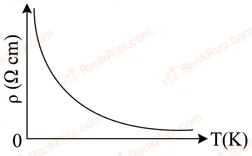
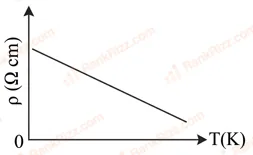
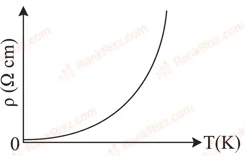
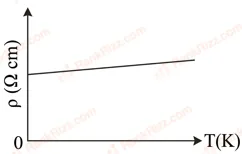
The net current flowing in the given circuit is_______ A.
image
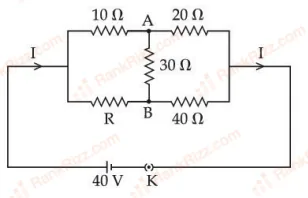
The value of current I in the electrical circuit as given below, when potential at A is equal to the potential at B, will be ____ A.
Two cells of emf 1V and 2V and internal resistance 2 and 1 , respectively, are connected in series with an external resistance of 6 . The total current in the circuit is . Now the same two cells in parallel configuration are connected to same external resistance. In this case, the total current drawn is . The value of is . The value of x is ________.
A wire of resistance is bent to form an equilateral triangle. Then the equivalent resistance across any two vertices will be
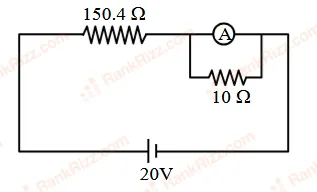
In the figure shown below, a resistance of 150.4 is connected in series to an ammeter A of resistance 240 . A shunt resistance of 10 is connected in parallel with the ammeter. The reading of the ammeter is _________ mA.
Two conductors have the same resistances at but their temperature coefficients of resistance are and . The respective temperature coefficients for their series and parallel combinations are :
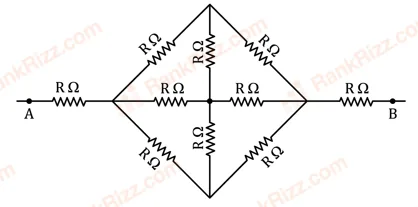
The effective resistance between and , if resistance of each resistor is , will be
A wire of resistance and length is cut into equal parts. If these parts are joined parallely, then resultant resistance will be :
Wheatstone bridge principle is used to measure the specific resistance of given wire, having length , radius . If X is the resistance of wire, then specific resistance is : . If the length of the wire gets doubled then the value of specific resistance will be :
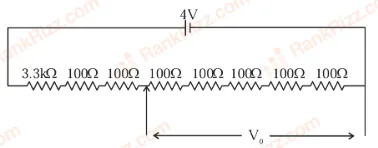
A potential divider circuit is shown in the figure below. The output voltage is
When a potential difference is applied across a wire of resistance , it dissipates energy at a rate . If the wire is cut into two halves and these halves are connected mutually parallel across the same supply, the energy dissipation rate will become:
By what percentage will the illumination of the lamp decrease if the current drops by 20%?
46%
26%
36%
56%
A galvanometer of resistance when connected in series with measures a voltage of upto V. The value of resistance required to convert the galvanometer into ammeter to read upto A is . The value of is :
2
800
20
200
The number of electrons flowing per second in the filament of a bulb operating at is : (Given )
The reading in the ideal voltmeter shown in the given circuit diagram is:
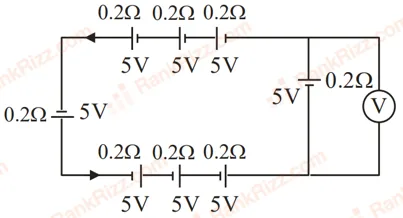
V
V
V
V
In a metre-bridge when a resistance in the left gap is and unknown resistance in the right gap, the balance length is found to be 40 cm. On shunting the unknown resistance with , the balance length changes by:
22.5 cm
20 cm
62.5 cm
65 cm
A wire of length cm and radius m connected across the right gap of a meter bridge. When a resistance of is connected on the left gap by using a resistance box, the balance length is found to be at cm from the left end. If the resistivity of the wire is m, then value of is :
63
70
66
35
A current of 200 A deflects the coil of a moving coil galvanometer through 60°. The current to cause deflection through radian is
30 A
120 A
60 A
180 A
OTHER PHYSICS CHAPTERS