RankRizzStart free

Current Electricity — JEE Main Previous Year Questions

Every Current Electricity question JEE Main has set, grouped by the idea it tests rather than the order of the syllabus. 386 questions across 10 distinct ideas. Free to read, answer key on every one.

Questions

386

Distinct ideas

10

Share of marks

5.6%

Difficulty

MEDIUM

The ideas inside Current Electricity

A chapter is not one subject — it is a handful of procedures the examiner reuses. These are the ones Current Electricity questions actually test.

01Electric current, current density and drift velocityset 24×
02Ohm's law, resistance, resistivity and colour codeset 51×
03Combination of resistors and equivalent resistanceset 49×
04Cells: emf, internal resistance and combinationsset 27×
05Kirchhoff's laws and circuit analysisset 49×
06Wheatstone bridgeset 14×
07Meter bridgeset 23×
08Potentiometerset 29×
09Electric power and heating effect of currentset 60×
10Galvanometer conversion to ammeter and voltmeterset 60×

Every Current Electricity question

361–380 OF 386 · NEWEST FIRST

JEE MAIN 2010Ohm's law, resistance, resistivity and colour codeTRANSCRIBED

Two conductors have the same resistance at C but their temperature coefficients of resistance are and . The respective temperature coefficients of their series and parallel combinations are nearly

  1. A

  2. B

  3. C

  4. D

JEE MAIN 2009Ohm's law, resistance, resistivity and colour codeTRANSCRIBED

This question contains Statement-1 and Statement-2. Of the four choices given after the statements, choose the one that best describes the two statements. 

Statement-1: The temperature dependence of resistance is usually given as . The resistance of a wire changes from to when its temperature is increased from to . This implies that . 

Statement 2: is valid only when the change in the temperature is small and .

  1. A

    Statement-1 is true, Statement-2 is false

  2. B

    Statement-1 is true, Statement-2 is true; Statement-2 is the correct explanation of Statement-1.

  3. C

    Statement-1 is true, Statement-2 is true; Statement-2 is not the correct explanation of Statement-1.

  4. D

    Statement-1 is false, Statement-2 is true

JEE MAIN 2008Ohm's law, resistance, resistivity and colour codeTRANSCRIBED

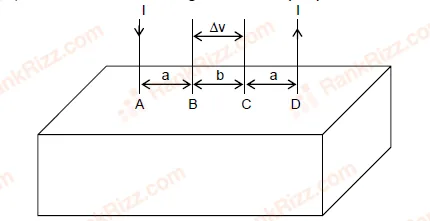
Paragraph: Consider a block of conducting material of resistivity '' shown in the figure. Current '' enters at '' and leaves from ''. We apply superposition principle to find voltage '' developed between '' and ''. The calculation is done in the following steps: (i) Take current '' entering from '' and assume it to spread over a hemispherical surface in the block. (ii) Calculate field at distance '' from by using Ohm's law , where is the current per unit area at ''. (iii) From the '' dependence of , obtain the potential at . (iv) Repeat (i), (ii) and (iii) for current '' leaving '' and superpose results for '' and ''.
Question: measured between and is

  1. A

  2. B

  3. C

  4. D

JEE MAIN 2008Electric current, current density and drift velocityTRANSCRIBED

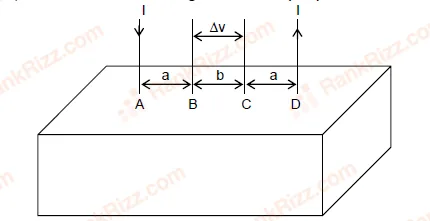
Paragraph: Consider a block of conducting material of resistivity '' shown in the figure. Current '' enters at '' and leaves from ''. We apply superposition principle to find voltage '' developed between '' and ''. The calculation is done in the following steps: (i) Take current '' entering from '' and assume it to spread over a hemispherical surface in the block. (ii) Calculate field at distance '' from by using Ohm's law , where is the current per unit area at ''. (iii) From the '' dependence of , obtain the potential at . (iv) Repeat (i), (ii) and (iii) for current '' leaving '' and superpose results for '' and ''.
Question: For current entering at , the electric field at a distance '' from is

  1. A

  2. B

  3. C

  4. D

JEE MAIN 2008Kirchhoff's laws and circuit analysisTRANSCRIBED

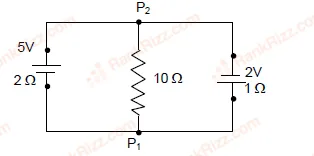
A 5 V battery with internal resistance and a 2 V battery with internal resistance are connected to a resistor as shown in the figure. The current in the resistor is

  1. A

    to

  2. B

    to

  3. C

    to

  4. D

    to

JEE MAIN 2008Meter bridgeTRANSCRIBED

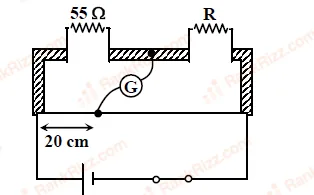
Shown in the figure below is a meter-bridge set up with null deflection in the galvanometer.
The value of the unknown resistor is

  1. A

  2. B

  3. C

  4. D

JEE MAIN 2007Ohm's law, resistance, resistivity and colour codeTRANSCRIBED

The resistance of a wire is 5 ohm at and 6 ohm at . The resistance of the wire at will be

  1. A

    2 ohm

  2. B

    1 ohm

  3. C

    4 ohm

  4. D

    3 ohm

JEE MAIN 2006Ohm's law, resistance, resistivity and colour codeTRANSCRIBED

A material '' has twice the specific resistance of ''. A circular wire made of '' has twice the diameter of a wire made of ''. Then for the two wires to have the same resistance, the ratio of their respective lengths must be

  1. A

    2

  2. B

    1

  3. C

  4. D

JEE MAIN 2006Kirchhoff's laws and circuit analysisTRANSCRIBED

The Kirchhoff's first law and second law , where the symbols have their usual meanings, are respectively based on

  1. A

    conservation of charge, conservation of energy

  2. B

    conservation of charge, conservation of momentum

  3. C

    conservation of energy, conservation of charge

  4. D

    conservation of momentum, conservation of charge

JEE MAIN 2006Wheatstone bridgeTRANSCRIBED

In a Wheatstone's bridge, there resistances and connected in the three arms and the fourth arm is formed by two resistances and connected in parallel. The condition for bridge to be balanced will be

  1. A

  2. B

  3. C

  4. D

JEE MAIN 2006Combination of resistors and equivalent resistanceTRANSCRIBED

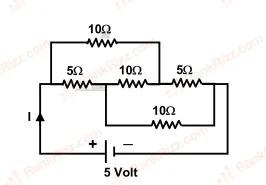
Consider the circuit shown below. The current drawn from the 5 volt source will be

  1. A

    0.17 A

  2. B

    0.33 A

  3. C

    0.5 A

  4. D

    0.67 A

JEE MAIN 2006Ohm's law, resistance, resistivity and colour codeTRANSCRIBED

The resistance of a bulb filament is at a temperature of . If its temperature coefficient of resistance be per , its resistance will become at a temperature of

  1. A

  2. B

  3. C

  4. D

JEE MAIN 2006Cells: emf, internal resistance and combinationsTRANSCRIBED

A thermocouple is made from two metals, Antimony and Bismuth. If one junction of the couple is kept hot and the other is kept cold then, an electric current will

  1. A

    flow from Antimony to Bismuth at the cold junction

  2. B

    flow from Antimony to Bismuth at the hot junction

  3. C

    flow from Bismuth to Antimony at the cold junction

  4. D

    not flow through the thermocouple

JEE MAIN 2006Electric power and heating effect of currentTRANSCRIBED

An electric bulb is rated volt watt. The power consumed by it when operated on volt will be

  1. A

    50 watt

  2. B

    75 watt

  3. C

    40 watt

  4. D

    25 watt

JEE MAIN 2005Galvanometer conversion to ammeter and voltmeterTRANSCRIBED

A moving coil galvanometer has equal divisions. Its current sensitivity is divisions per milliampere and voltage sensitivity is divisions per millivolt. In order that each division reads volt, the resistance in ohms needed to be connected in series with the coil will be

  1. A

  2. B

  3. C

  4. D

JEE MAIN 2005Kirchhoff's laws and circuit analysisTRANSCRIBED

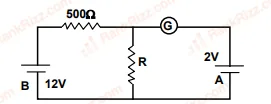
In the circuit, the galvanometer shows zero deflection. If the batteries and have negligible resistance, the value of the resistor will be

  1. A

  2. B

  3. C

  4. D

JEE MAIN 2005Cells: emf, internal resistance and combinationsTRANSCRIBED

Two sources of equal emf are connected to an external resistance . The internal resistance of the two sources are and (R_2 > R_1). If the potential difference across the source having internal resistance is zero, then

  1. A

  2. B

  3. C

  4. D

JEE MAIN 2005Electric power and heating effect of currentTRANSCRIBED

A heater coil is cut into two equal parts and only one part is now used in the heater. The heat generated will now be

  1. A

    doubled

  2. B

    four times

  3. C

    one fourth

  4. D

    halved

JEE MAIN 2005Cells: emf, internal resistance and combinationsTRANSCRIBED

An energy source will supply a constant current into the load if its internal resistance is

  1. A

    equal to the resistance of the load.

  2. B

    very large as compared to the load resistance.

  3. C

    zero.

  4. D

    non-zero but less than the resistance of the load.

JEE MAIN 2005PotentiometerTRANSCRIBED

In a potentiometer experiment the balancing with a cell is at length cm. On shunting the cell with a resistance of the balancing length becomes cm. The internal resistance of the cell is

  1. A

  2. B

  3. C

  4. D