RankRizzStart free

Current Electricity — JEE Main Previous Year Questions

Every Current Electricity question JEE Main has set, grouped by the idea it tests rather than the order of the syllabus. 386 questions across 10 distinct ideas. Free to read, answer key on every one.

Questions

386

Distinct ideas

10

Share of marks

5.6%

Difficulty

MEDIUM

The ideas inside Current Electricity

A chapter is not one subject — it is a handful of procedures the examiner reuses. These are the ones Current Electricity questions actually test.

01Electric current, current density and drift velocityset 24×
02Ohm's law, resistance, resistivity and colour codeset 51×
03Combination of resistors and equivalent resistanceset 49×
04Cells: emf, internal resistance and combinationsset 27×
05Kirchhoff's laws and circuit analysisset 49×
06Wheatstone bridgeset 14×
07Meter bridgeset 23×
08Potentiometerset 29×
09Electric power and heating effect of currentset 60×
10Galvanometer conversion to ammeter and voltmeterset 60×

Every Current Electricity question

261–280 OF 386 · NEWEST FIRST

JEE MAIN 2019 · 09 JAN S1Ohm's law, resistance, resistivity and colour codeTRANSCRIBED

A copper wire is stretched to make it 0.5% longer. The percentage change in its electrical resistance if its volume remains unchanged is:

  1. A

    2.5%

  2. B

    1.0%

  3. C

    2.0%

  4. D

    0.5%

JEE MAIN 2019 · 10 APR S1Electric current, current density and drift velocityTRANSCRIBED

A current of 5 A passes through a copper conductor (resistivity = Ω m) of radius of cross-section 5 mm. Find the mobility of the charges if their drift velocity is ms.

  1. A

    1.5 m V s

  2. B

    1.8 m V s

  3. C

    1.0 m V s

  4. D

    1.3 m V s

JEE MAIN 2019 · 10 APR S1Galvanometer conversion to ammeter and voltmeterTRANSCRIBED

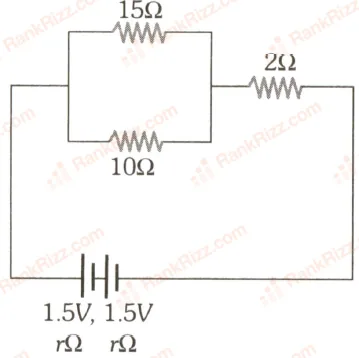
In the given circuit, an ideal voltmeter connected across the 10 Ω resistance reads 2 V. The internal resistance r, of each cell is:

  1. A

    0 Ω

  2. B

    1.5 Ω

  3. C

    0.5 Ω

  4. D

    1 Ω

JEE MAIN 2019 · 12 JAN S1Galvanometer conversion to ammeter and voltmeterTRANSCRIBED

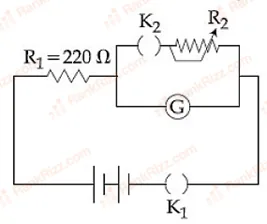
The galvanometer deflection, when key is closed but is open, equals (see figure). On closing also and adjusting to , the deflection in galvanometer becomes . The resistance of the galvanometer is, then, given by [Neglect the internal resistance of battery]:

  1. A

  2. B

  3. C

  4. D

JEE MAIN 2019 · 08 APR S1Cells: emf, internal resistance and combinationsTRANSCRIBED

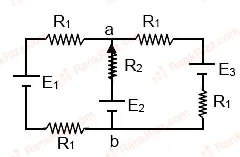
For the circuit shown, with , , V and V, the potential difference between the points 'a' and 'b' is approximately (in V):

  1. A

    3.3

  2. B

    2.3

  3. C

    2.7

  4. D

    3.7

JEE MAIN 2019 · 09 JAN S1Kirchhoff's laws and circuit analysisTRANSCRIBED

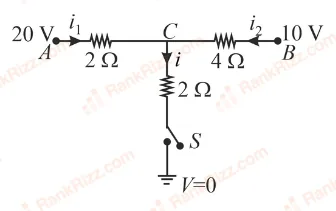
When the switch , in the circuit shown, is closed, then the value of current will be:

image
  1. A

    2 A

  2. B

    5 A

  3. C

    3 A

  4. D

    4 A

JEE MAIN 2019 · 11 JAN S1Electric power and heating effect of currentTRANSCRIBED

Two equal resistances when connected in series to a battery, consume electric power of 60 W. If these resistance are now connected in parallel combination to the same battery, the electric power consumed will be:

  1. A

    60 W

  2. B

    240 W

  3. C

    120 W

  4. D

    30 W

JEE MAIN 2019 · 10 APR S1Galvanometer conversion to ammeter and voltmeterTRANSCRIBED

A moving coil galvanometer allows a full scale current of A. A series resistance of Ω is required to convert the galvanometer into a voltmeter of range 0 - 5 V. Therefore, the value of shunt resistance required to convert the above galvanometer into an ammeter of range 0 - 10 mA is:

  1. A

    100 Ω

  2. B

    200 Ω

  3. C

    300 Ω

  4. D

    10 Ω

JEE MAIN 2019 · 09 JAN S2Ohm's law, resistance, resistivity and colour codeTRANSCRIBED

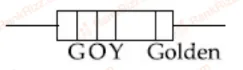
A carbon resistance has a following colour code. What is the value of the resistance?


GOY Golden

  1. A

    6.4 M 5%

  2. B

    64 k 10%

  3. C

    530 k 5%

  4. D

    5.3 M 5%

JEE MAIN 2019 · 11 JAN S2Cells: emf, internal resistance and combinationsTRANSCRIBED

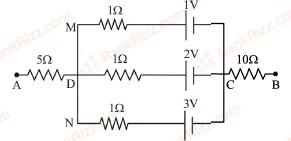
In the circuit shown, the potential difference between A and B is

  1. A

    1 V

  2. B

    2 V

  3. C

    3V

  4. D

    6 V

JEE MAIN 2019 · 10 JAN S1Kirchhoff's laws and circuit analysisTRANSCRIBED

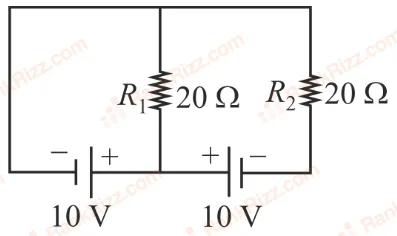
In the given circuit the cells have zero internal resistance. The currents (in amperes) passing through resistance and respectively, are:

image
  1. A

    0, 1

  2. B

    2, 2

  3. C

    0.5, 0

  4. D

    1, 2

JEE MAIN 2019 · 12 JAN S1PotentiometerTRANSCRIBED

An ideal battery of emf 4V and resistance R are connected in series in the primary circuit of a potentiometer of length 1 m and resistance . The value of R, to give a potential difference of 5 mV across 10 cm of potentiometer wire, is:

  1. A

  2. B

  3. C

  4. D

JEE MAIN 2019 · 12 APR S1Galvanometer conversion to ammeter and voltmeterTRANSCRIBED

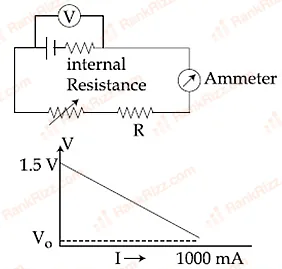
To verify Ohm's law, a student connects the voltmeter across the battery as shown in the figure. The measured voltage is plotted as a function of the current, and the following graph is obtained.

If V is almost zero, identify the correct statement:

  1. A

    The emf of the battery is 1.5 V and its internal resistance is 1.5 Ω

  2. B

    The value of the resistance R is 1.5 Ω

  3. C

    The potential difference across the battery is 1.5 V when it sends a current of 1000 mA

  4. D

    The emf of the battery is 1.5 V and the value of R is 1.5 Ω

JEE MAIN 2019 · 12 JAN S2Galvanometer conversion to ammeter and voltmeterTRANSCRIBED

A galvanometer, whose resistance is 50 ohm, has 25 divisions in it. When a current of A passes through it, its needle (pointer) deflects by one division. To use this galvanometer as a voltmeter of range 2.5 V it should be connected to a resistance of:

  1. A

    6250 ohm

  2. B

    250 ohm

  3. C

    6200 ohm

  4. D

    200 ohm

JEE MAIN 2019 · 09 APR S2Ohm's law, resistance, resistivity and colour codeTRANSCRIBED

A metal wire of resistance 3 is elongated to make a uniform wire of double its previous length. This new wire is now bent and the ends joined to make a circle. If two points on this circle make an angle 60° at the center, the equivalent resistance between these two points will be:

  1. A

  2. B

  3. C

  4. D

JEE MAIN 2019 · 08 APR S1Ohm's law, resistance, resistivity and colour codeTRANSCRIBED

A 200 resistor has certain colour code. If one replaced the red colour by green in the code, the new resistance will be:

  1. A

    300

  2. B

    100

  3. C

    400

  4. D

    500

JEE MAIN 2019 · 09 JAN S1Electric current, current density and drift velocityTRANSCRIBED

Drift speed of electrons, when 1.5 A current flows in a copper wire of cross section 5 mm is . If the electron density in copper is m, the value of in mm s is close to (Take charge of an electron to be C)

  1. A

    0.2

  2. B

    3

  3. C

    2

  4. D

    0.02

JEE MAIN 2019 · 11 JAN S1Wheatstone bridgeTRANSCRIBED

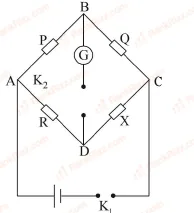
In a Wheatstone bridge (see fig.), Resistances P and Q are approximately equal. When , the bridge is balanced. On interchanging P and Q, the value of R, for balance, is . The value of Y is close to

  1. A

    401.5 ohm

  2. B

    404.5 ohm

  3. C

    403.5 ohm

  4. D

    402.5 ohm

JEE MAIN 2019 · 10 APR S1Ohm's law, resistance, resistivity and colour codeTRANSCRIBED

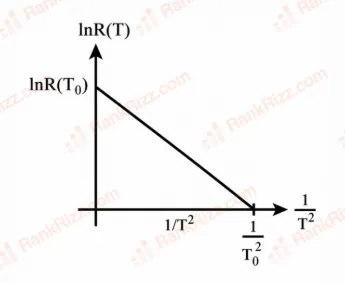
In an experiment, the resistance of a material is plotted as a function of temperature (in some range). As shown in the figure, it is a straight line.

image

One may conclude that

  1. A

  2. B

  3. C

  4. D

JEE MAIN 2019 · 09 JAN S2Kirchhoff's laws and circuit analysisTRANSCRIBED

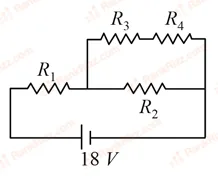
In the given circuit the internal resistance of the 18V cell is negligible. If , and and the reading of an ideal voltmeter across is 5 V, then the value of will be:

  1. A

    550

  2. B

    300

  3. C

    450

  4. D

    230