Every Oscillations question JEE Main has set, grouped by the idea it tests rather than the order of the syllabus. 182 questions across 7 distinct ideas. Free to read, answer key on every one.
A chapter is not one subject — it is a handful of procedures the examiner reuses. These are the ones Oscillations questions actually test.
01SHM: equation, phase, velocity and accelerationset 78×
02Energy in simple harmonic motionset 17×
03Superposition of SHMsset 3×
04Spring-block oscillationsset 51×
05Simple, compound and torsional pendulumsset 14×
06SHM of floating bodies, liquids, gases and charged systemsset 5×
07Damped and forced oscillations and resonanceset 14×
Every Oscillations question
1–20 OF 182 · NEWEST FIRST
JEE MAIN 2026 · 21 JAN S2Energy in simple harmonic motionTRANSCRIBED
The kinetic energy of a simple harmonic oscillator is oscillating with angular frequency of 176 rad/ s. The frequency of this simple harmonic oscillator is _____Hz. [take π=722]
JEE MAIN 2026 · 28 JAN S2Spring-block oscillationsTRANSCRIBED
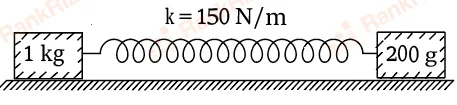
As shown in the figure, a spring is kept in a stretched position with some extension by holding the masses 1 kg and 0.2 kg with a separation more than spring natural length and are released. Assuming the horizontal serface to be frictionless, the angular frequency (in SI unit) of the system is:
JEE MAIN 2026 · 24 JAN S1SHM of floating bodies, liquids, gases and charged systemsTRANSCRIBED
A cylindrical block of mass M and area of cross section A is floating in a liquid of density ρ and with its axis vertical. When depressed a little and released the block starts oscillating. The period of oscillation is ___
JEE MAIN 2026 · 23 JAN S1Spring-block oscillationsTRANSCRIBED
A simple pendulum of string length 30 cm performs 20 oscillations in 10 s. The length of the string required for the pendulum to perfo rm 40 oscillations in the same time duration is _________cm. [Assume that the mass of the pendulum remains same.]
JEE MAIN 2026 · 22 JAN S2Spring-block oscillationsTRANSCRIBED
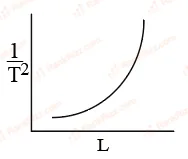
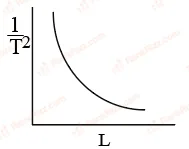
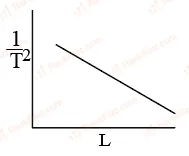
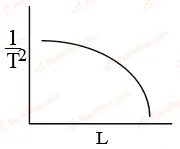
Using a simple pendulum experiment g is determind by measuring its time period T. Which of the following plots represent the correct relation between the pendulum length L and time period T?
JEE MAIN 2026 · 04 APR S2Spring-block oscillationsTRANSCRIBED
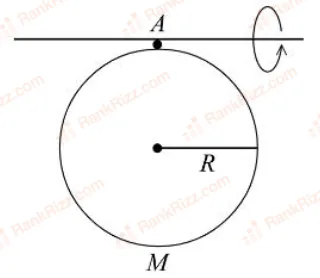
A uniform disc of radius R and mass M is free to oscillate about the axis A as shown in the figure. For small oscillations the time period is ______. ( g is acceleration due to gravity)
JEE MAIN 2026 · 06 APR S2Spring-block oscillationsTRANSCRIBED
A spring stretches by 2 mm when it is loaded with a mass of 200 g. From equilibrium position the mass is further pulled down by 2 mm and released. The frequency associated with the system and maximum energy in the spring are __________ Hz and __________ J, respectively. (Take g=10 m/s2)
JEE MAIN 2026 · 06 APR S1SHM: equation, phase, velocity and accelerationTRANSCRIBED
A particle is executing simple harmonic motion. Its amplitude is A and time period is 5 sec. The time required by it to move from x=A to x=2A is _______ sec.
JEE MAIN 2026 · 08 APR S2Spring-block oscillationsTRANSCRIBED
The frequency of oscillation of a mass m suspended by a spring is v1. If the length of the spring is cut to half, the same mass oscillates with frequency v2. The value of v1v2 is __________.
JEE MAIN 2026 · 28 JAN S1SHM: equation, phase, velocity and accelerationTRANSCRIBED
The displacement of a particle, executing simple harmonic motion with time period T, is expressed as x(t)=Asinωt, where A is the amplitude. The maximum value of potential energy of this oscillator is found at t=T/2β. The value of β is_____.
JEE MAIN 2026 · 04 APR S1SHM: equation, phase, velocity and accelerationTRANSCRIBED
The velocity of a particle executing simple harmonic motion along x-axis is described as v2=50−x2, where x represents displacement. If the time period of motion is 7x s, the value of x is _____.
JEE MAIN 2026 · 02 APR S2SHM: equation, phase, velocity and accelerationTRANSCRIBED
The equation of motion of a particle is given by x=asin(50t+3π) cm. The particle will come to rest at time t1 and it will have zero acceleration at time t2. The t1 and t2 respectively are _____.
JEE MAIN 2025 · 29 JAN S2SHM: equation, phase, velocity and accelerationTRANSCRIBED
Two bodies A and B of equal mass are suspended from two massless springs of spring constant k1 and k2, respectively. If the bodies oscillate vertically such that their amplitudes are equal, the ratio of the maximum velocity of A to the maximum velocity of B is
JEE MAIN 2025 · 03 APR S1Spring-block oscillationsTRANSCRIBED
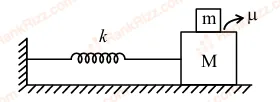
Two blocks of masses m and M, (M>m), are placed on a frictionless table as shown in figure. A massless spring with spring constant k is attached with the lower block. If the system is slightly displaced and released then (μ = coefficient of friction between the two blocks)
(A) The time period of small oscillation of the two blocks is T=2πkm+M (B) The acceleration of the blocks is a=M+mkx (C) The magnitude of the frictional force on upper block is M+mmμ∣x∣ (D) The maximum amplitude of the upper block, if it does not slip, is kμ(M+m)g (E) Maximum frictional force can be μ(M+m)g.
Choose the correct answer from the options given below :
JEE MAIN 2025 · 02 APR S1SHM: equation, phase, velocity and accelerationTRANSCRIBED
A particle is subjected to two simple harmonic motions as: x1=7sin5t cm and x2=27sin(5t+3π) cm where x is displacement and t is time in seconds. The maximum acceleration of the particle is x×10−2 ms−2. The value of x is:
JEE MAIN 2025 · 28 JAN S2Energy in simple harmonic motionTRANSCRIBED
Given below are two statements. One is labelled as Assertion (A) and the other is labelled as Reason (R). Assertion (A) : Knowing initial position x∘ and initial momentum p∘ is enough to determine the position and momentum at any time t for a simple harmonic motion with a given angular frequency ω. Reason (R): The amplitude and phase can be expressed in terms of x∘ and p∘. In the light of the above statements, choose the correct answer from the options given below :
A
(A) is false but (R) is true
B
(A) is true but (R) is false
C
Both (A) and (R) are true but (R) is NOT the correct explanation of (A)
D
Both (A) and (R) are true and (R) is the correct explanation of (A)
JEE MAIN 2025 · 24 JAN S1SHM: equation, phase, velocity and accelerationTRANSCRIBED
A particle is executing simple harmonic motion with time period 2s and amplitude 1cm. If D and d are the total distance and displacement covered by the particle in 12.5s, then dD is: