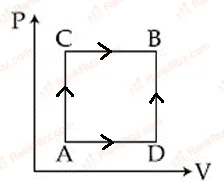
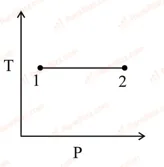
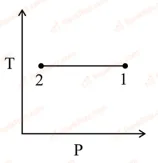
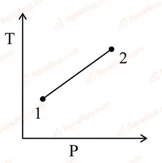
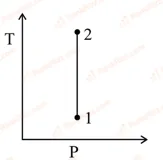
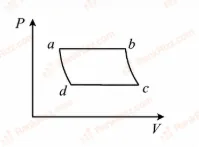
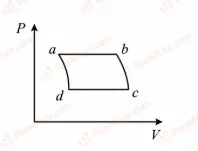
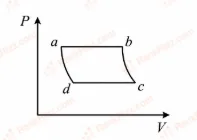
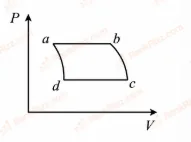
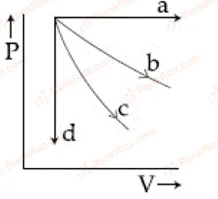
The given diagram shows four processes i.e., isochoric, isobaric, isothermal and adiabatic. The correct assignment of the processes, in the same order is given by:
- A
a d b c
- B
d a b c
- C
a d c b
- D
d a c b
Every Thermodynamics question JEE Main has set, grouped by the idea it tests rather than the order of the syllabus. 190 questions across 6 distinct ideas. Free to read, answer key on every one.
Questions
190
Distinct ideas
6
Share of marks
3%
Difficulty
MEDIUM
A chapter is not one subject — it is a handful of procedures the examiner reuses. These are the ones Thermodynamics questions actually test.
141–160 OF 190 · NEWEST FIRST
The given diagram shows four processes i.e., isochoric, isobaric, isothermal and adiabatic. The correct assignment of the processes, in the same order is given by:

a d b c
d a b c
a d c b
d a c b
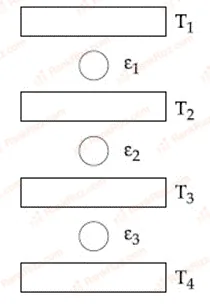
Three Carnot engines operate in series between a heat source at a temperature and a heat sink at temperature (see figure). There are two other reservoirs at temperature and , as shown, with T_1 > T_2 > T_3 > T_4. The three engines are equally efficient if:

A Carnot engine has an efficiency of . When the temperature of the sink is reduced by 62°C, its efficiency is doubled. The temperatures of the source and the sink are, respectively,
124 °C, 62 °C
37 °C, 99 °C
99 °C, 37 °C
62 °C, 124 °C
A gas can be taken from A to B via two different processes ACB and ADB.
When path ACB is used 60 J of heat flows into the system and 30 J of work is done by the system. If the path ADB is used then work done by the system is 10 J, the heat flows into the system in the path ADB is:
100 J
20 J
40 J
80 J
One mole of an ideal gas passes through a process where pressure and volume obey the relation P = P[1 - ]. Here P and V are constants. Calculate the change in the temperature of the gas if its volume changes from V to 2V.
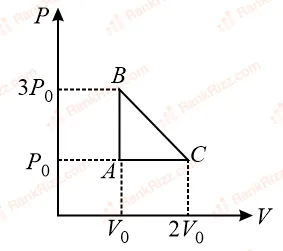
One mole of an ideal monatomic gas is taken along the path ABCA as shown in the PV diagram. The maximum temperature attained by the gas along the path BC is given by:

A Carnot's engine works as a refrigerator between 250 K and 300 K. It receives 500 cal heat from the reservoir at the lower temperature. The amount of work done in each cycle to operate the refrigerator is:
420 J
2100 J
772 J
2520 J
Two Carnot engines A and B are operated in series. Engine A receives heat from a reservoir at 600 K and rejects heat to a reservoir at temperature T. Engine B receives heat rejected by engine A and in turn rejects it to a reservoir at 100 K. If the efficiencies of the two engines A and B are represented by and respectively, then what is the value of ?
One mole of an ideal monoatomic gas is compressed isothermally in a rigid vessel to double its pressure at room temperature, 27C. The work done on the gas will be:
300R ln 6
300R
300R ln 7
300R ln 2
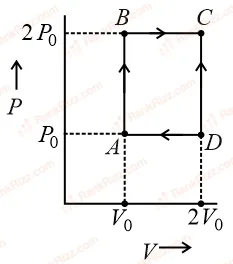
An engine operates by taking moles of an ideal gas through the cycle shown in figure. The thermal efficiency of the engine is: (Take , where is gas constant)

0.24
0.15
0.32
0.08
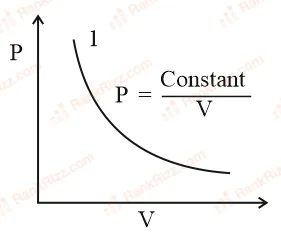
For the diagram given for an ideal gas
Out of the following which one correctly represents the diagram?


moles of an ideal gas undergoes a process as shown in the figure. The maximum temperature of the gas during the process will be:

An ideal gas undergoes a quasi-static, reversible process in which its molar heat capacity C remains constant. If during this process the relation of pressure P and volume V is given by = constant, then n is given by (Here and are molar specific heat at constant pressure and constant volume, respectively):
A Carnot freezer takes heat from water at inside it and rejects it to the room at a temperature of . The latent heat of ice is J kg. If 5 kg of water at is converted into ice at by the freezer, then the energy consumed by the freezer is close to:
J
J
J
J
Consider a spherical shell of radius R at temperature T. The black body radiation inside it can be considered as an ideal gas of photons with internal energy per unit volume and pressure . If the shell now undergoes an adiabatic expansion the relation between T and R is:
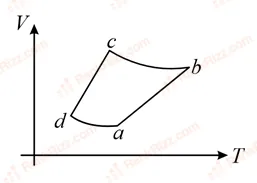
An ideal gas goes through a reversible cycle has the V - T diagram shown below. Process and are adiabatic.
The corresponding P - V diagram for the process is (all figures are schematic and not drawn to scale):


A solid body of constant heat capacity 1 J (C) is being heated by keeping it in contact with reservoirs in two ways: (i) Sequentially keeping in contact with 2 reservoirs such that each reservoir supplies the same amount of heat. (ii) Sequentially keeping in contact with 8 reservoirs such that each reservoir supplies the same amount of heat. In both cases the body is brought from initial temperature 100 K to final temperature 200 K. Entropy change of the body in the two cases respectively is: Note: This question was awarded as a bonus since temperatures were given in centigrade instead of in Kelvin. Proper corrections are made in the question to avoid it.
The equation of state for a gas is given by , where n is the number of moles and is a positive constant. The initial temperature and pressure of one mole of the gas contained in a cylinder are T and P respectively. The work done by the gas when its temperature doubles isobarically will be:
During an adiabatic compression, 830 J of work is done on 2 moles of a diatomic ideal gas to reduce its volume by 50%. The change in its temperature is nearly: (R = 8.3 JK mol)
40 K
33 K
20 K
14 K
A Carnot engine absorbs 1000 J of heat energy from a reservoir at 127°C and rejects 600 J of heat energy during each cycle. The efficiency of engine and temperature of sink will be:
20% and °C
40% and °C
50% and °C
70% and °C
OTHER PHYSICS CHAPTERS