RankRizzStart free

Thermodynamics — JEE Main Previous Year Questions

Every Thermodynamics question JEE Main has set, grouped by the idea it tests rather than the order of the syllabus. 190 questions across 6 distinct ideas. Free to read, answer key on every one.

Questions

190

Distinct ideas

6

Share of marks

3%

Difficulty

MEDIUM

The ideas inside Thermodynamics

A chapter is not one subject — it is a handful of procedures the examiner reuses. These are the ones Thermodynamics questions actually test.

01Zeroth and first law of thermodynamicsset 34×
02Work done in thermodynamic processes and P-V diagramsset 30×
03Isothermal and adiabatic processesset 54×
04Isobaric, isochoric and polytropic processesset 23×
05Multi-step processes and gas-piston-spring systemsAdvanced only · 34×
06Second law, heat engines, refrigerators and reversibilityset 12×
07Carnot engine and Carnot cycleset 37×

Every Thermodynamics question

61–80 OF 190 · NEWEST FIRST

JEE MAIN 2023 · 25 JAN S1Carnot engine and Carnot cycleTRANSCRIBED

A Carnot engine with efficiency 50% takes heat from a source at 600 K. In order to increase the efficiency to 70%, keeping the temperature of sink same, the new temperature of the source will be:

  1. A

    360 K

  2. B

    1000 K

  3. C

    900 K

  4. D

    300 K

JEE MAIN 2023 · 13 APR S2Isothermal and adiabatic processesTRANSCRIBED

The initial pressure and volume of an ideal gas are and . The final pressure of the gas when the gas is suddenly compressed to volume will be:
(Given = ratio of specific heats at constant pressure and at constant volume.)

  1. A

  2. B

  3. C

  4. D

JEE MAIN 2023 · 15 APR S1Work done in thermodynamic processes and P-V diagramsTRANSCRIBED

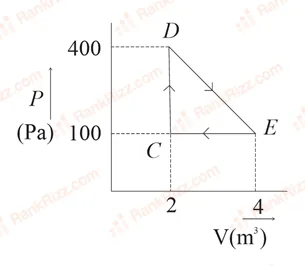
A thermodynamic system is taken through cyclic process. The total work done in the process is :

  1. A

    J

  2. B

    J

  3. C

    J

  4. D

    Zero

JEE MAIN 2023 · 08 APR S2Carnot engine and Carnot cycleTRANSCRIBED

Work done by a Carnot engine operating between temperatures 127C and 27C is 2 kJ. The amount of heat transferred to the engine by the reservoir is:

  1. A

    8 kJ

  2. B

    2.67 kJ

  3. C

    2 kJ

  4. D

    4 kJ

JEE MAIN 2023 · 01 FEB S1Isothermal and adiabatic processesTRANSCRIBED

A sample of gas at temperature is adiabatically expanded to double its volume. The work done by the gas in the process is, (given ):

  1. A

  2. B

  3. C

  4. D

JEE MAIN 2023 · 10 APR S1Isothermal and adiabatic processesTRANSCRIBED

Consider two containers A and B containing monoatomic gases at the same Pressure , Volume and Temperature . The gas in A is compressed isothermally to of its original volume while the gas in B is compressed adiabatically to of its original volume. The ratio of final pressure of gas in B to that of gas in A is

  1. A

    8

  2. B

    4

  3. C

  4. D

JEE MAIN 2023 · 24 JAN S2Isothermal and adiabatic processesTRANSCRIBED

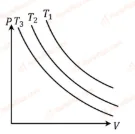
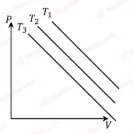
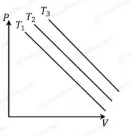
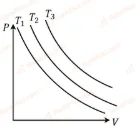
In an Isothermal change, the change in pressure and volume of a gas can be represented for three different temperature; T_3 > T_2 > T_1 as:

  1. A
    image
  2. B
    image
  3. C
    image
  4. D
    image
JEE MAIN 2023 · 06 APR S1Zeroth and first law of thermodynamicsTRANSCRIBED

A source supplies heat to a system at the rate of 1000 W. If the system performs work at a rate of 200 W. The rate at which internal energy of the system increases is

  1. A

    600 W

  2. B

    800 W

  3. C

    500 W

  4. D

    1200 W

JEE MAIN 2023 · 25 JAN S2Isobaric, isochoric and polytropic processesTRANSCRIBED

Match List I with List II:
A. Isothermal Process   I. Work done by the gas decreases internal energy
B. Adiabatic Process   II. No change in internal energy
C. Isochoric Process   III. The heat absorbed goes partly to increase internal energy and partly to do work
D. Isobaric Process   IV. No work is done on or by the gas
Choose the correct answer from the options below:

  1. A

    A-II, B-I, C-III, D-IV

  2. B

    A-II, B-I, C-IV, D-III

  3. C

    A-I, B-II, C-IV, D-III

  4. D

    A-I, B-II, C-III, D-IV

JEE MAIN 2023 · 30 JAN S1Isothermal and adiabatic processesTRANSCRIBED

Heat is given to an ideal gas in an isothermal process.
A. Internal energy of the gas will decrease.
B. Internal energy of the gas will increase.
C. Internal energy of the gas will not change.
D. The gas will do positive work.
E. The gas will do negative work.
Choose the correct answer from the options given below:

  1. A

    A and E only

  2. B

    B and D only

  3. C

    C and E only

  4. D

    C and D only

JEE MAIN 2023 · 08 APR S1Zeroth and first law of thermodynamicsTRANSCRIBED

Given below are two statements:
Statement I: If heat is added to a system, its temperature must increase.
Statement II: If positive work is done by a system in a thermodynamic process, its volume must increase.
In the light of the above statements, choose the correct answer from the options given below

  1. A

    Statement I is true but Statement II is false

  2. B

    Both Statement I and Statement II are false

  3. C

    Both Statement I and Statement II are true

  4. D

    Statement I is false but Statement II is true

JEE MAIN 2022 · 26 JUN S1Carnot engine and Carnot cycleTRANSCRIBED

The efficiency of a Carnot's engine, working between steam point and ice point, will be

  1. A

  2. B

  3. C

  4. D

JEE MAIN 2022 · 28 JUN S1Isothermal and adiabatic processesTRANSCRIBED

Statement - I : When amount of an ideal gas undergoes adiabatic change from state to state , then work done is , where and = universal gas constant.
Statement - II : In the above case, when work is done on the gas, the temperature of the gas would rise.

  1. A

    Both statement-I and statement-II are true.

  2. B

    Both statement-I and statement-II are false.

  3. C

    Statement-I is true but statement-II is false.

  4. D

    Statement-I is false but statement-II is true.

JEE MAIN 2022 · 25 JUL S1Isothermal and adiabatic processesTRANSCRIBED

A certain amount of gas of volume at temperature and pressure expands isothermally until its volume gets doubled. Later it expands adiabatically until its volume gets redoubled. The final pressure of the gas will be (Use )

  1. A

  2. B

  3. C

  4. D

JEE MAIN 2022 · 26 JUL S1Isobaric, isochoric and polytropic processesTRANSCRIBED

mole of certain monoatomic ideal gas undergoes a temperature increase of at constant pressure. The increase in the internal energy of the gas in this process is (Given )

  1. A

  2. B

  3. C

  4. D

JEE MAIN 2022 · 28 JUL S1Carnot engine and Carnot cycleTRANSCRIBED

A Carnot engine has efficiency of 50%. If the temperature of sink is reduced by 40°C, its efficiency increases by 30%. The temperature of the source will be:

  1. A

    166.7 K

  2. B

    255.1 K

  3. C

    266.7 K

  4. D

    367.7 K

JEE MAIN 2022 · 24 JUN S2Carnot engine and Carnot cycleTRANSCRIBED

A Carnot engine takes kcal of heat from a reservoir at C and gives heat to a sink at C. The work done by the engine is

  1. A

    J

  2. B

    Zero

  3. C

    J

  4. D

    J

JEE MAIN 2022 · 29 JUN S2Isothermal and adiabatic processesTRANSCRIBED

Starting with the same initial conditions, an ideal gas expands from volume to in three different ways. The work done by the gas is if the process is purely isothermal, , if the process is purely adiabatic and if the process is purely isobaric. Then, choose the correct option

  1. A

    W_2 < W_1 < W_3

  2. B

    W_1 < W_2 < W_3

  3. C

    W_2 < W_3 < W_1

  4. D

    W_3 < W_1 < W_2

JEE MAIN 2022 · 26 JUL S1Isothermal and adiabatic processesTRANSCRIBED

A monoatomic gas at pressure and volume is suddenly compressed to one eighth of its original volume. The final pressure at constant entropy will be

  1. A

  2. B

  3. C

  4. D

JEE MAIN 2022 · 27 JUL S2Carnot engine and Carnot cycleTRANSCRIBED

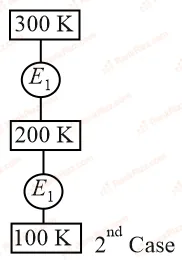
In 1st case, Carnot engine operates between temperatures 300 K and 100 K. In 2nd case, as shown in the figure, a combination of two engines is used. The efficiency of this combination (in 2nd case) will be :

  1. A

    same as the 1st case

  2. B

    always greater than the 1st case

  3. C

    always less than the 1st case

  4. D

    may increase or decrease with respect to the 1st case