JEE MAIN 2024 · 05 APR S2Isothermal and adiabatic processesTRANSCRIBED
During an adiabatic process, if the pressure of a gas is found to be proportional to the cube of its absolute temperature, then the ratio of for the gas is :
- A
- B
- C
- D
Every Thermodynamics question JEE Main has set, grouped by the idea it tests rather than the order of the syllabus. 190 questions across 6 distinct ideas. Free to read, answer key on every one.
Questions
190
Distinct ideas
6
Share of marks
3%
Difficulty
MEDIUM
A chapter is not one subject — it is a handful of procedures the examiner reuses. These are the ones Thermodynamics questions actually test.
41–60 OF 190 · NEWEST FIRST
During an adiabatic process, if the pressure of a gas is found to be proportional to the cube of its absolute temperature, then the ratio of for the gas is :
A total of heat is given to one mole of helium kept in a cylinder. The temperature of helium increases by . The work done by the gas is: Given, .
A sample of 1 mole gas at temperature T is adiabatically expanded to double its volume. If adiabatic constant for the gas is , then the work done by the gas in the process is:
The pressure and volume of an ideal gas are related as (Constant). The work done when the gas is taken from state to state is :
Two thermodynamical processes are shown in the figure. The molar heat capacity for process and are and . The molar heat capacity at constant pressure and constant volume are represented by and , respectively. Choose the correct statement.
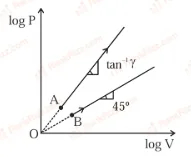
C_P > C_B > C_V
and
C_P > C_V > C_A = C_B
C_A > C_P > C_V
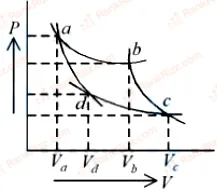
Two different adiabatic paths for the same gas intersect two isothermal curves as shown in P-V diagram. The relation between the ratio and the ratio is:
The volume of an ideal gas is changed adiabatically from 5 litres to 4 litres. The ratio of initial pressure to final pressure is:
The given figure represents two isobaric processes for the same mass of an ideal gas, then
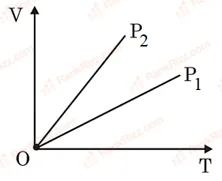
P_2 > P_1
P_1 > P_2
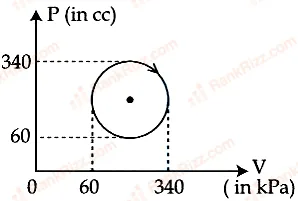
The heat absorbed by a system in going through the given cyclic process is :
1 kg of water at 100C is converted into steam at 100C by boiling at atmospheric pressure. The volume of water changes from m as a liquid to 1.671 m as steam. The change in internal energy of the system during the process will be (Given latent heat of vaporisation = 2257 kJ/kg, Atmospheric pressure Pa)
kJ
kJ
kJ
kJ
1 g of a liquid is converted to vapour at Pa pressure. If 10% of the heat supplied is used for increasing the volume by 1600 during this phase change, then the increase in internal energy in the process will be :
4320 J
432000 J
4800 J
J
1 g of a liquid is converted to vapour at Pa pressure. If 10% of the heat supplied is used for increasing the volume by 1600 cm during this phase change, then the increase in internal energy in the process will be:
4320 J
432000 J
4800 J
J
Given below are two statements. One is labelled as Assertion A and the other is labelled as Reason R.
Assertion A: If and represent the heat supplied to the system and the work done on the system respectively. Then according to the first law of thermodynamics .
Reason R: First law of thermodynamics is based on law of conservation of energy.
In the light of the above statements, choose the correct answer from the option given below:
A is correct but R is not correct
A is not correct but R is correct
Both A and R are correct and R is the correct explanation of A
Both A and R are correct but R is not the correct explanation of A
Given below are two statements: one is labelled as Assertion A and the other is labelled as Reason R.
Assertion A: Efficiency of a reversible heat engine will be highest at C temperature of cold reservoir.
Reason R: The efficiency of Carnot's engine depends not only on temperature of cold reservoir but it depends on the temperature of hot reservoir too and is given as
In the light of the above statements, choose the correct answer from the options given below:
A is true but R is false
Both A and R are true but R is NOT the correct explanation of A
A is false but R is true
Both A and R are true and R is the correct explanation of A
A gas is compressed adiabatically, which one of the following statement is NOT true?
There is no heat supplied to the system
There is no change in the internal energy
The temperature of the gas increases
The change in the internal energy is equal to the work done on the gas
The thermodynamic process, in which internal energy of the system remains constant is
Isochoric
Adiabatic
Isothermal
Isobaric
The pressure of a gas changes linearly with volume from to as shown in figure. If no heat is supplied to or extracted from the gas then change in the internal energy of the gas will be
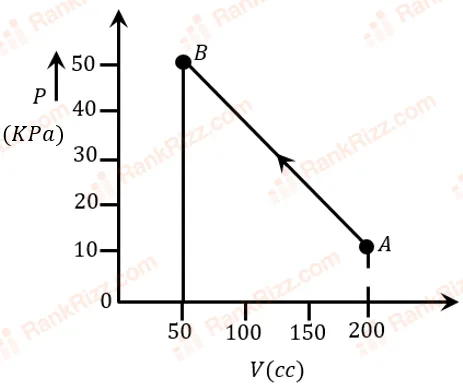
6 J
Zero
-4.5 J
4.5 J
A Carnot engine operating between two reservoirs has efficiency . When the temperature of cold reservoir raised by , its efficiency decreases to . The value of , if the temperature of hot reservoir is C, will be
K
K
K
K
An engine operating between the boiling and freezing points of water will have
A. Efficiency more than 27%.
B. Efficiency less than the efficiency of a Carnot engine operating between the same two temperatures.
C. Efficiency equal to 27%.
D. Efficiency less than 27%.
Choose the correct answer from the options given below
B, C and D only
A and B only
B and D only
B and C only
A hypothetical gas expands adiabatically such that its volume changes from 08 litres to 27 litres. If the ratio of final pressure of the gas to initial pressure of the gas is . Then the ratio of will be.
OTHER PHYSICS CHAPTERS