JEE MAIN 2020 · 07 JAN S1Isothermal and adiabatic processesTRANSCRIBED
A litre of dry air at STP expands adiabatically to a volume of 3 litres. If , the work done by air is: () [Take air to be an ideal gas]
- A
60.7 J
- B
90.5 J
- C
100.8 J
- D
48 J
Every Thermodynamics question JEE Main has set, grouped by the idea it tests rather than the order of the syllabus. 190 questions across 6 distinct ideas. Free to read, answer key on every one.
Questions
190
Distinct ideas
6
Share of marks
3%
Difficulty
MEDIUM
A chapter is not one subject — it is a handful of procedures the examiner reuses. These are the ones Thermodynamics questions actually test.
121–140 OF 190 · NEWEST FIRST
A litre of dry air at STP expands adiabatically to a volume of 3 litres. If , the work done by air is: () [Take air to be an ideal gas]
60.7 J
90.5 J
100.8 J
48 J
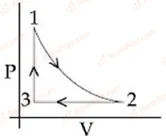
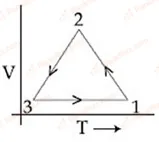
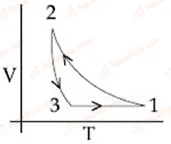
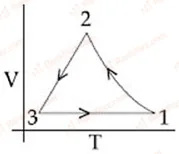
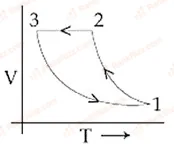
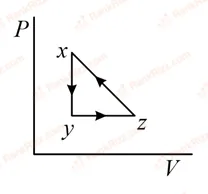
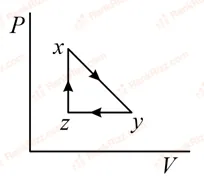
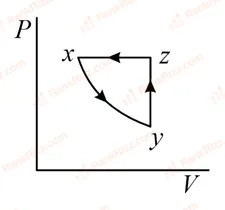
Which of the following is an equivalent cyclic process corresponding to the thermodynamic cyclic given in the figure? Where, is adiabatic. (Graphs are schematic and are not to scale)
Three different processes that can occur in an ideal monoatomic gas are shown in the vs diagram. The paths are labelled as , and . The change in internal energies during these processes are taken as , and and the work done as , and . The correct relation between these parameters are:
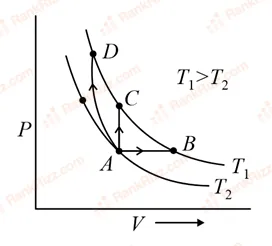
E_{AB} = E_{AC} < E_{AD}, W_{AB} > 0, , W_{AD} < 0
, W_{AB} > 0, , W_{AD} < 0
E_{AB} < E_{AC} < E_{AD}, W_{AB} > 0, W_{AC} > W_{AD}
E_{AB} > E_{AC} > E_{AD}, W_{AB} < W_{AC} < W_{AD}
In an adiabatic process, the density of a diatomic gas becomes times its initial value. The final pressure of the gas is found to be times the initial pressure. The value of is:
32
326
128
Two ideal Carnot engines operate in cascade (all heat given up by one engine is used by the other engine to produce work) between temperatures, T and T. The temperature of the hot reservoir of the first engine is T and the temperature of the cold reservoir of the second engine is T. T is temperature of the sink of first engine which is also the source for the second engine. How is T related to T and T, if both the engines perform equal amount of work?
A thermodynamic cycle xyzx is shown on a V-T diagram.
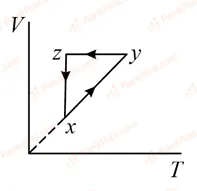
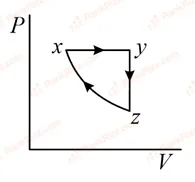
The P-V diagram that best describes this cycle is: (Diagrams are schematic and not to scale)
A Carnot engine having an efficiency of is being used as a refrigerator. If the work done on the refrigerator is 10 J, the amount of heat absorbed from the reservoir at a lower temperature is
99 J
100 J
1 J
90 J
Match the thermodynamics processes taking place in a system with the correct conditions. In the table: is the heat supplied, is the work done and is change in internal energy of the system.
Process Condition
(I) Adiabatic (A)
(II) Isothermal (B)
(III) Isochoric (C)
(IV) Isobaric (D)
(I)-(A), (II)-(B), (III)-(D), (IV)-(D)
(I)-(B), (II)-(A), (III)-(D), (IV)-(C)
(I)-(A), (II)-(A), (III)-(B), (IV)-(C)
(I)-(B), (II)-(D), (III)-(A), (IV)-(C)
Starting at temperature , one mole of an ideal diatomic gas is first compressed adiabatically from volume to . It is then allowed to expand isobarically to volume . If all the processes are the quasi-static then the final temperature of the gas (in ) is (to the nearest integer) ___________.
An engine takes in 5 moles of air at 20 C and 1 atm, and compresses it adiabatically to of the original volume. Assuming air to be a diatomic ideal gas made up of rigid molecules, the change in its internal energy during this process comes out to be X kJ. The value of X to the nearest integer is:
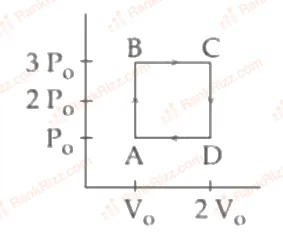
An engine operates by taking a monatomic ideal gas through the cycle shown in the figure. The percentage efficiency of the engine is close to___
A Carnot engine operates between two reservoirs of temperatures 900K and 300K. The engine performs 1200J of work per cycle. The heat energy (in J) delivered by the engine to the low temperature reservoir, in a cycle, is
If minimum possible work is done by a refrigerator in converting 100 grams of water at 0°C to ice, how much heat (in calories) is released to the surroundings at temperature 27°C (Latent heat of ice = 80 Cal/gram) to the nearest integer?
Two carnot engines and are operated in series. The first one, , receives heat at and rejects to a reservoir at temperature . The second engine receives heat rejected by the first engine and, in turn, rejects to a heat reservoir at . Calculate the temperature if the work outputs of the two engines are equal:
500 K
400 K
300 K
600 K
For the given cyclic process CAB as shown for a gas, the work done is:
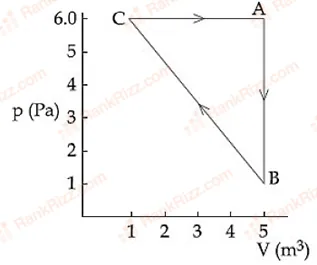
10 J
5 J
1 J
30 J
Half mole of an ideal monoatomic gas is heated at a constant pressure of 1 atm from 20C to 90C. Work done by the gas is
73 J
581 J
291 J
146 J
A rigid diatomic ideal gas undergoes an adiabatic process at room temperature. The relation between temperature and volume for this process is = constant, then x is:
In a process, temperature and volume of one mole of an ideal monoatomic gas are varied according to the relation VT = K, where K is a constant. In this process the temperature of the gas is increased by . The amount of heat absorbed by gas is (R is gas constant):
Following figure shows two processes A and B for a gas. If and are the amount of heat absorbed by the system in two cases, and and are changes in internal energies, respectively, then:
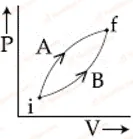
\Delta Q_A < \Delta Q_B; \; \Delta U_A < \Delta U_B
\Delta Q_A > \Delta Q_B; \; \Delta U_A = \Delta U_B
\Delta Q_A > \Delta Q_B; \; \Delta U_A > \Delta U_B
A sample of an ideal gas is taken through the cyclic process abca as shown in the figure. The change in the internal energy of the gas along the path ca is -180 J. The gas absorbs 250 J of heat along the path ab and 60 J along the path bc. The work done by the gas along the path abc is:
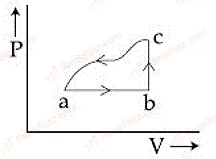
130 J
100 J
120 J
140 J
OTHER PHYSICS CHAPTERS