An object is placed beyond the centre of curvature of the given concave mirror. If the distance of the object is from and the distance of the image formed is from , the radius of curvature of this mirror is:
- A
- B
- C
- D
Every Ray Optics & Optical Instruments question JEE Main has set, grouped by the idea it tests rather than the order of the syllabus. 272 questions across 9 distinct ideas. Free to read, answer key on every one.
Questions
272
Distinct ideas
9
Share of marks
7%
Difficulty
MEDIUM
A chapter is not one subject — it is a handful of procedures the examiner reuses. These are the ones Ray Optics & Optical Instruments questions actually test.
161–180 OF 272 · NEWEST FIRST
An object is placed beyond the centre of curvature of the given concave mirror. If the distance of the object is from and the distance of the image formed is from , the radius of curvature of this mirror is:
Curved surfaces of a plano-convex lens of refractive index and a plano-concave lens of refractive index have equal radius of curvature as shown in figure. Find the ratio of radius of curvature to the focal length of the combined lenses.

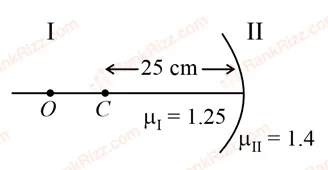
Region I and II are separated by a spherical surface of radius 25 cm. An object is kept in region I at a distance of 40 cm from the surface. The distance of the image from the surface is:

55.44 cm
9.52 cm
18.23 cm
37.58 cm
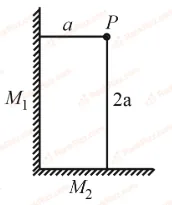
Two plane mirrors and are at right angle to each other as shown. A point source is placed at and meter away from and respectively. The shortest distance between any two images thus formed is: (Take )

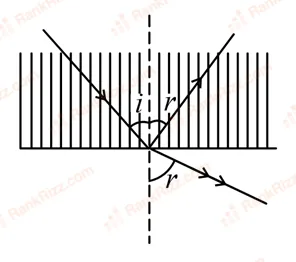
A ray of light passes from a denser medium to a rarer medium at an angle of incidence . The reflected and refracted rays make an angle of 90 with each other. The angle of reflection and refraction are respectively and . The critical angle is given by,

Given below are two statements: one is labeled as Assertion A and the other is labeled as Reason R.
Assertion A: For a simple microscope, the angular size of the object equals the angular size of the image.
Reason R: Magnification is achieved as the small object can be kept much closer to the eye than 25 cm and hence it subtends a large angle. In the light of the above statements, choose the most appropriate answer from the options given below:
A is false but R is true
Both A and R are true but R is NOT the correct explanation of A
A is true but R is false
Both A and R are true and R is the correct explanation of A
A prism of refractive index and angle of prism is placed in the position of minimum angle of deviation. If minimum angle of deviation is also , then in terms of refractive index,
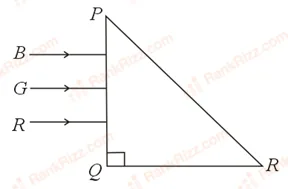
Three rays of light, namely red (R), green (G) and blue (B) are incident on the face PQ of a right angled prism PQR as shown in figure.
The refractive indices of the material of the prism for red, green and blue wavelength are 1.27, 1.42 and 1.49 respectively. The colour of the ray(s) emerging out of the face PR is :
green
red
blue and green
blue
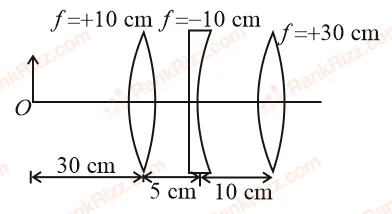
Find the distance of the image from object , formed by the combination of lenses in the figure:

75 cm
10 cm
infinity
20 cm
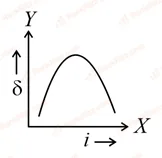
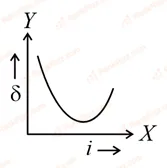
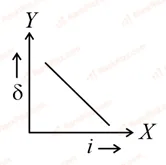
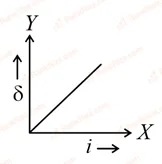
The expected graphical representation of the variation of angle of deviation '' with angle of incidence 'i' in a prism is:


The incident ray, reflected ray and the outward drawn normal are denoted by the unit vectors , and respectively. Then choose the correct relation for these vectors.
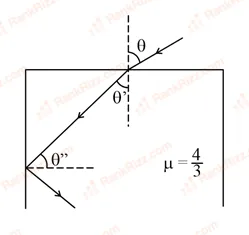
A ray of light entering from air into a denser medium of refractive index , as shown in figure. The light ray suffers total internal reflection at the adjacent surface as shown. The maximum value of angle should be equal to:

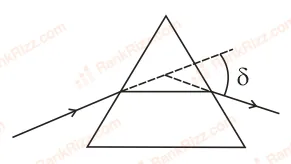
The angle of deviation through a prism is minimum when
(A) Incident ray and emergent ray are symmetric to the prism
(B) The refracted ray inside the prism becomes parallel to its base
(C) Angle of incidence is equal to that of the angle of emergence
(D) When angle of emergence is double the angle of incidence
Choose the correct answer from the options given below:
Statements (A), (B) and (C) are true
Only statement (D) is true
Only statements (A) and (B) are true
Statements (B) and (C) are true
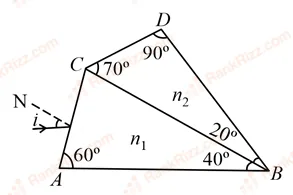
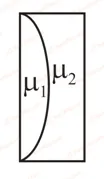
A prism of refractive index and another prism of refractive index are stuck together (as shown in the figure). and depend on , the wavelength of light, according to the relation and
The wavelength for which rays incident at any angle on the interface pass through without bending at that interface will be _________ nm.

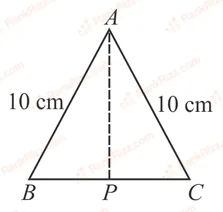
Cross-section view of a prism is the equilateral triangle shown in the figure. The minimum deviation is observed using this prism when the angle of incidence is equal to the prism angle. The time taken by light to travel from P (midpoint of BC) to A is _________ s. (Given, speed of light in vacuum = m s and )

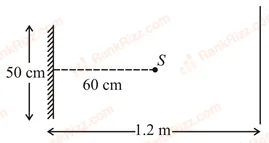
A point source of light S, placed at a distance 60 cm infront of the centre of a plane mirror of width 50 cm, hangs vertically on a wall. A man walks infront of the mirror along a line parallel to the mirror at a distance 1.2 m from it (see in the figure). The distance between the extreme points where he can see the image of the light source in the mirror is ______ cm

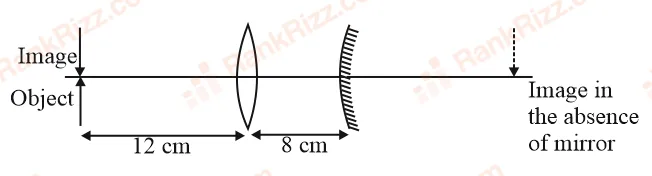
An object is placed at a distance of 12 cm from a convex lens. A convex mirror of focal length 15 cm is placed on another side of the lens at 8 cm as shown in the figure. The image of the object coincides with the object.
When the convex mirror is removed, a real and inverted image is formed at a position. The distance of the image from the object will be _________ cm
An object viewed from a near point distance of 25 cm, using a microscopic lens with magnification 6, gives an unresolved image. A resolved image is observed at infinite distance with a total magnification double the earlier using an eyepiece along with the given lens and a tube of length 0.6 m, if the focal length of the eyepiece is equal to ___ cm.
The image of an object placed in air formed by a convex refracting surface is at a distance of 10 m behind the surface. The image is real and is at of the distance of the object from the surface. The wavelength of light inside the surface is times the wavelength in air. The radius of the curved surface is m, the value of is ________.
A ray of light passing through a prism suffers minimum deviation. It is found that the angle of incidence is double the angle of refraction within the prism. Then, the angle of prism is ___ (in degrees).
OTHER PHYSICS CHAPTERS