Ray Optics & Optical Instruments — JEE Main Previous Year Questions
Every Ray Optics & Optical Instruments question JEE Main has set, grouped by the idea it tests rather than the order of the syllabus. 272 questions across 9 distinct ideas. Free to read, answer key on every one.
A chapter is not one subject — it is a handful of procedures the examiner reuses. These are the ones Ray Optics & Optical Instruments questions actually test.
01Reflection and plane mirrorsset 2×
02Spherical mirrors: mirror formula and magnificationset 38×
03Refraction at plane surfaces, Snell's law and apparent depthset 96×
04Total internal reflection and critical angleset 12×
05Refraction at spherical surfacesset 1×
06Thin lenses: lens formula, lens maker's formula and powerset 98×
07Combinations of lenses and mirrorsset 2×
08Prism: deviation and dispersionset 2×
09Optical instruments: microscopes and telescopesset 21×
Every Ray Optics & Optical Instruments question
41–60 OF 272 · NEWEST FIRST
JEE MAIN 2025 · 23 JAN S1Thin lenses: lens formula, lens maker's formula and powerTRANSCRIBED
Given a thin convex lens (refractive index μ2), kept in a liquid (refractive index \mu_{1},\mu_{1}<\mu_{2}) having radii of curvatures ∣R1∣ and ∣R2∣ . Its second surface is silver polished. Where should an object be placed on the optic axis so that a real and inverted image is formed at the same place?
JEE MAIN 2025 · 02 APR S1Thin lenses: lens formula, lens maker's formula and powerTRANSCRIBED
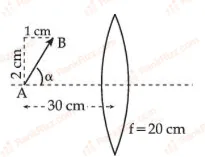
A slanted object AB is placed on one side of convex lens as shown in the diagram. The image is formed on the opposite side. Angle made by the image with principal axis is:
JEE MAIN 2025 · 08 APR S2Thin lenses: lens formula, lens maker's formula and powerTRANSCRIBED
A concave-convex lens of refractive index 1.5 and the radii of curvature of its surfaces are 30cm and 20cm, respectively. The concave surface is upwards and is filled with a liquid of refractive index 1.3. The focal length of the liquid-glass combination will be
JEE MAIN 2025 · 22 JAN S1Thin lenses: lens formula, lens maker's formula and powerTRANSCRIBED
Given is a thin convex lens of glass (refractive index μ) and each side having radius of curvature R. One side is polished for complete reflection. At what distance from the lens, an object be placed on the optic axis so that the image gets formed on the object itself ?
JEE MAIN 2025 · 28 JAN S1Refraction at plane surfaces, Snell's law and apparent depthTRANSCRIBED
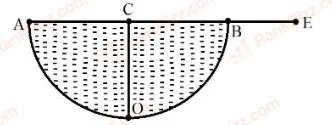
A hemispherical vessel is completely filled with a liquid of refractive index μ. A small coin is kept at the lowest point (O) of the vessel as shown in figure. The minimum value of the refractive index of the liquid so that a person can see the coin from point E (at the level of the vessel) is
JEE MAIN 2025 · 28 JAN S2Refraction at plane surfaces, Snell's law and apparent depthTRANSCRIBED
In a long glass tube, mixture of two liquids A and B with refractive indices 1.3 and 1.4 respectively, forms a convex refractive meniscus towards . If an object placed at 13 cm from the vertex of the meniscus in A forms an image with a magnification of '-2' then the radius of curvature of meniscus is :
JEE MAIN 2025 · 07 APR S2Spherical mirrors: mirror formula and magnificationTRANSCRIBED
A mirror is used to produce an image with magnification of 41. If the distance between object and its image is 40 cm, then the focal length of the mirror is :
JEE MAIN 2025 · 07 APR S1Thin lenses: lens formula, lens maker's formula and powerTRANSCRIBED
A lens having refractive index 1.6 has focal length of 12 cm, when it is in air. Find the focal length of the lens when it is placed in water. (Take refractive index of water as 1.28)
JEE MAIN 2025 · 04 APR S1Spherical mirrors: mirror formula and magnificationTRANSCRIBED
When an object is placed 40 cm away from a spherical mirror an image of magnification 21 is produced. To obtain an image with magnification of 31, the object is to be moved:
JEE MAIN 2025 · 23 JAN S2Refraction at plane surfaces, Snell's law and apparent depthTRANSCRIBED
The refractive index of the material of a glass prism is 3. The angle of minimum deviation is equal to the angle of the prism. What is the angle of the prism?
JEE MAIN 2025 · 24 JAN S1Thin lenses: lens formula, lens maker's formula and powerTRANSCRIBED
A thin plano convex lens made of glass of refractive index 1.5 is immersed in a liquid of refractive index 1.2. When the plane side of the lens is silver coated for complete reflection, the lens immersed in the liquid behaves like a concave mirror of focal length 0.2 m. The radius of curvature of the curved surface of the lens is
JEE MAIN 2025 · 29 JAN S1Total internal reflection and critical angleTRANSCRIBED
At the interface between two materials having refractive indices n1 and n2, the critical angle for reflection of an em wave is θ1C. The n2 material is replaced by another material having refractive index n3 such that the critical angle at the interface between n1 and n3 materials is θ2C. If n_{3} > n_{2} > n_{1};\frac{n_{2}}{n_{3}}=\frac{2}{5} and sinθ2C−sinθ1C=21, then θ1C is
JEE MAIN 2025 · 29 JAN S1Thin lenses: lens formula, lens maker's formula and powerTRANSCRIBED
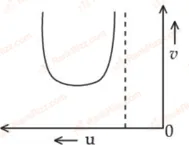
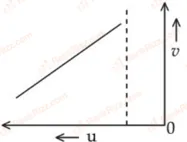
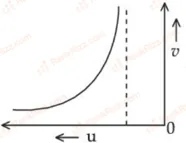
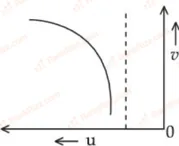
Let u and υ be the distances of the object and the image from a lens of focal length f. The correct graphical representation of u and υ for a convex lens when |u| > f, is
JEE MAIN 2025 · 29 JAN S2Thin lenses: lens formula, lens maker's formula and powerTRANSCRIBED
A convex lens made of glass (refractive index = 1.5) has focal length 24 cm in air. When it is totally immersed in water (refractive index 1.33), its focal length changes to
JEE MAIN 2025 · 24 JAN S2Optical instruments: microscopes and telescopesTRANSCRIBED
A photograph of a landscape is captured by a drone camera at a height of 18 km . The size of the camera film is 2cm×2cm and the area of the landscape photographed is 400km2. The focal length of the lens in the drone camera is :
JEE MAIN 2025 · 08 APR S2Thin lenses: lens formula, lens maker's formula and powerTRANSCRIBED
A convex lens of focal length 30 cm is placed in contact with a concave lens of focal length 20 cm. An object is placed at 20 cm to the left of this lens system. The distance of the image from the lens in cm is _____.
JEE MAIN 2025 · 24 JAN S1Thin lenses: lens formula, lens maker's formula and powerTRANSCRIBED
A plano-convex lens having radius of curvature of first surface 2cm exhibits focal length f1 in air. Another plano-convex lens with first surface radius of curvature 3cm has focal length f2 when it is immersed in a liquid of refractive index 1.2. If both the lenses are made of same glass of refractive index 1.5, then the ratio f1:f2 will be: