RankRizzStart free

Ray Optics & Optical Instruments — JEE Main Previous Year Questions

Every Ray Optics & Optical Instruments question JEE Main has set, grouped by the idea it tests rather than the order of the syllabus. 272 questions across 9 distinct ideas. Free to read, answer key on every one.

Questions

272

Distinct ideas

9

Share of marks

7%

Difficulty

MEDIUM

The ideas inside Ray Optics & Optical Instruments

A chapter is not one subject — it is a handful of procedures the examiner reuses. These are the ones Ray Optics & Optical Instruments questions actually test.

01Reflection and plane mirrorsset 2×
02Spherical mirrors: mirror formula and magnificationset 38×
03Refraction at plane surfaces, Snell's law and apparent depthset 96×
04Total internal reflection and critical angleset 12×
05Refraction at spherical surfacesset 1×
06Thin lenses: lens formula, lens maker's formula and powerset 98×
07Combinations of lenses and mirrorsset 2×
08Prism: deviation and dispersionset 2×
09Optical instruments: microscopes and telescopesset 21×

Every Ray Optics & Optical Instruments question

201–220 OF 272 · NEWEST FIRST

JEE MAIN 2020 · 02 SEP S2Total internal reflection and critical angleTRANSCRIBED

A light ray enters a solid glass sphere of refractive index at an angle of incidence 60. The ray is both reflected and refracted at the farther surface of the sphere. The angle (in degrees) between the reflected and refracted rays at this surface is ___________.
JEE MAIN 2019 · 12 JAN S1Spherical mirrors: mirror formula and magnificationTRANSCRIBED

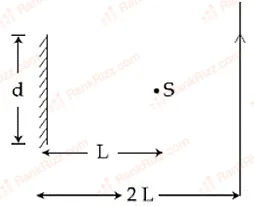
A point source of light, S is placed at a distance L in front of the center of plane mirror of width d which is hanging vertically on a wall. A man walks in front of the mirror along a line parallel to the mirror, at a distance 2L as shown below. The distance over which the man can see the image of the light source in the mirror is:

  1. A

    3d

  2. B

    2d

  3. C

    d

  4. D

JEE MAIN 2019 · 11 JAN S1Thin lenses: lens formula, lens maker's formula and powerTRANSCRIBED

An object is at a distance of 20 m from a convex lens of focal length 0.3 m. The lens forms an image of the object. If the object moves away from the lens at a speed of 5 m/s the speed and direction of the image will be

  1. A

    m/s away from the lens

  2. B

    m/s away from the lens

  3. C

    m/s towards the lens

  4. D

    m/s towards the lens

JEE MAIN 2019 · 12 JAN S2Thin lenses: lens formula, lens maker's formula and powerTRANSCRIBED

A plano-convex lens (focal length , refractive index , radius of curvature R) fits exactly into a plano-concave lens (focal length , refractive index , radius of curvature R). Their plane surfaces are parallel to each other. Then, the focal length of the combination will be:

  1. A

  2. B

  3. C

  4. D

JEE MAIN 2019 · 12 APR S2Refraction at plane surfaces, Snell's law and apparent depthTRANSCRIBED

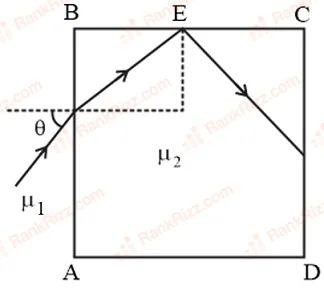
A transparent cube of side d, made of a material of refractive index , is immersed in a liquid of refractive index (\mu_1 < \mu_2). A ray is incident on the face AB at an angle (shown in the figure). Total internal reflection takes place at point E on the face BC.

Then must satisfy

  1. A

    \theta < \sin^{-1}\sqrt{\frac{\mu_2^2}{\mu_1^2} - 1}

  2. B

    \theta > \sin^{-1}\frac{\mu_1}{\mu_2}

  3. C

    \theta < \sin^{-1}\frac{\mu_1}{\mu_2}

  4. D

    \theta > \sin^{-1}\sqrt{\frac{\mu_2^2}{\mu_1^2} - 1}

JEE MAIN 2019 · 08 APR S1Refraction at plane surfaces, Snell's law and apparent depthTRANSCRIBED

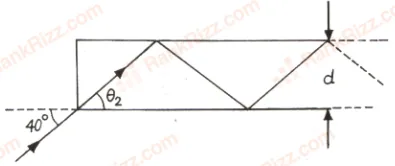
In figure, the optical fiber is m long and has a diameter of m. If a ray of light is incident on one end of the fiber at angle , the number of reflections it makes before emerging from the other end is close to: (refractive index of fiber is 1.31, sin 40° = 0.64 and sin(0.49) = 30°.)

  1. A

    55000

  2. B

    57000

  3. C

    45000

  4. D

    66000

JEE MAIN 2019 · 11 JAN S1Refraction at plane surfaces, Snell's law and apparent depthTRANSCRIBED

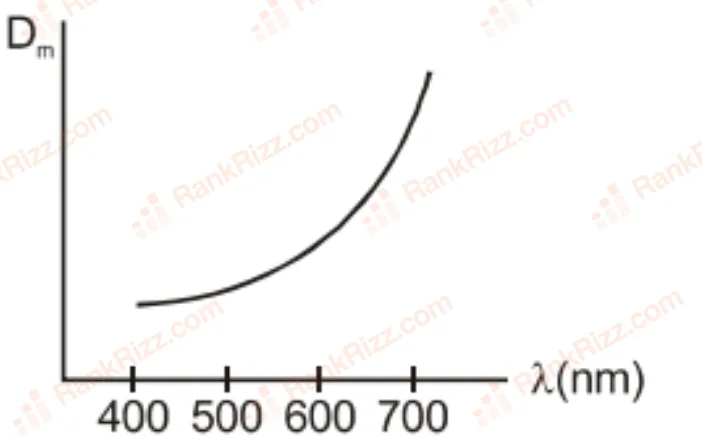
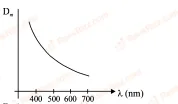
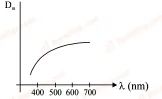
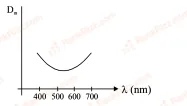
The variation of refractive index of a crown glass thin prism with wavelength of the incident light is shown. Which of the following graphs is the correct one, if is the angle of minimum deviation?

  1. A
    image
  2. B
  3. C
  4. D
JEE MAIN 2019 · 10 APR S1Total internal reflection and critical angleTRANSCRIBED

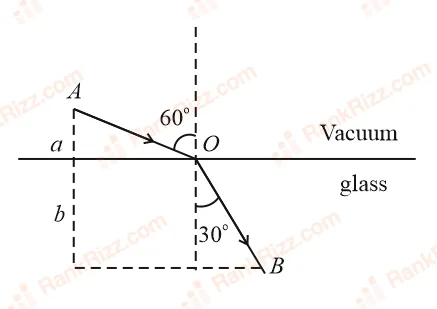
A ray of light AO in vacuum is incident on a glass slab at angle 60° and refracted at angle 30° along OB as shown in the figure. The optical path length of light ray from A to B is:

  1. A

  2. B

  3. C

  4. D

JEE MAIN 2019 · 09 JAN S2Reflection and plane mirrorsTRANSCRIBED

Two plane mirrors are inclined to each other such that a ray of light incident on the first mirror and parallel to the second mirror is finally reflected from the second mirror and parallel to the first mirror . The angle between the two mirrors will be:

  1. A

    60

  2. B

    45

  3. C

    90

  4. D

    75

JEE MAIN 2019 · 11 JAN S2Refraction at plane surfaces, Snell's law and apparent depthTRANSCRIBED

A monochromatic light is incident at a certain angle on an equilateral triangular prism and suffers minimum deviation. If the refractive index of the material of the prism is , then the angle of incidence is:

  1. A

  2. B

  3. C

  4. D

JEE MAIN 2019 · 10 APR S2Thin lenses: lens formula, lens maker's formula and powerTRANSCRIBED

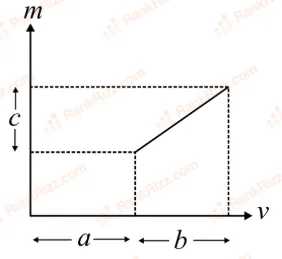
The graph shows how the magnification m produced by a thin lens varies with image distance v. The focal length of the lens used is

image
  1. A

  2. B

  3. C

  4. D

JEE MAIN 2019 · 10 JAN S1Thin lenses: lens formula, lens maker's formula and powerTRANSCRIBED

A plano-convex lens of refractive index and focal length is kept in contact with another plano-concave lens of refractive index and focal length . If the radius of curvature of their spherical faces is each and , the and are related as:

  1. A

  2. B

  3. C

  4. D

JEE MAIN 2019 · 12 JAN S1Thin lenses: lens formula, lens maker's formula and powerTRANSCRIBED

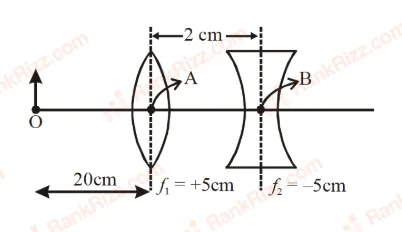
What is the position and nature of image formed by lens combination shown in figure? (, are focal lengths)

image
  1. A

    40 cm from point B at right; real

  2. B

    cm from point B at right, real

  3. C

    70 cm from point B at right; real

  4. D

    70 cm from point B at left; virtual

JEE MAIN 2019 · 12 APR S1Refraction at plane surfaces, Snell's law and apparent depthTRANSCRIBED

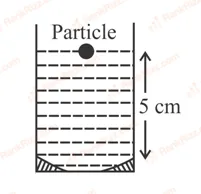
A concave mirror has radius of curvature of 40 cm. It is at the bottom of a glass that has water filled up to 5 cm (see figure). If a small particle is floating on the surface of water, its image as seen, from directly above the glass, is at a distance d from the surface of water. The value of d is close to: (Refractive index of water = 1.33)

  1. A

    13.4 cm

  2. B

    8.8 cm

  3. C

    6.7 cm

  4. D

    11.7 cm

JEE MAIN 2019 · 12 JAN S2Thin lenses: lens formula, lens maker's formula and powerTRANSCRIBED

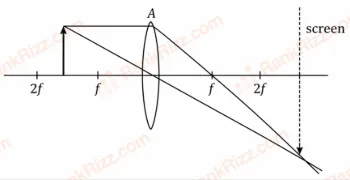
Formation of real image using a biconvex lens is shown below.

image

If the whole set up is immersed in water without disturbing the object and the screen positions, what will one observe on the screen?

  1. A

    Image disappears

  2. B

    Magnified image

  3. C

    Erect real image

  4. D

    No change

JEE MAIN 2019 · 09 APR S2Thin lenses: lens formula, lens maker's formula and powerTRANSCRIBED

A convex lens of focal length 20 cm produces images of the same magnification 2 when an object is kept at two distances and (x_1 > x_2) from the lens. The ratio of and is:

  1. A

    2 : 1

  2. B

    5 : 3

  3. C

    4 : 3

  4. D

    3 : 1

JEE MAIN 2019 · 08 APR S1Thin lenses: lens formula, lens maker's formula and powerTRANSCRIBED

An upright object is placed at a distance of 40 cm in front of a convergent lens of focal length 20 cm. A convergent mirror of focal length 10 cm is placed at a distance of 60 cm on the other side of the lens. The position and size of the final image will be:

  1. A

    40 cm from the convergent lens, twice the size of the object

  2. B

    20 cm from the convergent mirror, twice the size of the object

  3. C

    40 cm from the convergent lens, same size of the object

  4. D

    20 cm from the convergent mirror, same size of the object

JEE MAIN 2019 · 10 APR S1Thin lenses: lens formula, lens maker's formula and powerTRANSCRIBED

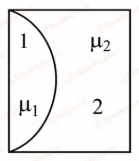
One plano-convex and one plano-concave lens of the same radius of curvature R but of different materials are joined side by side as shown in the figure. If the refractive index of the material of 1 is and that of 2 is , then the focal length of the combination is:

image
  1. A

  2. B

  3. C

  4. D

JEE MAIN 2019 · 09 APR S1Spherical mirrors: mirror formula and magnificationTRANSCRIBED

A concave mirror for face viewing has a focal length of 0.4 m. The distance at which you hold the mirror from your face in order to see your image upright with a magnification of 5 is:

  1. A

    1.60 m

  2. B

    0.16 m

  3. C

    0.32 m

  4. D

    0.24 m

JEE MAIN 2019 · 10 JAN S2Thin lenses: lens formula, lens maker's formula and powerTRANSCRIBED

The eye can be regarded as a single refracting surface. The radius of curvature of this surface is equal to that of the cornea (7.8 mm). This surface separates two media of refractive indices 1 and 1.34. Calculate the distance from the refracting surface at which a parallel beam of light will come to focus.

  1. A

    4.0 cm

  2. B

    1 cm

  3. C

    2 cm

  4. D

    3.07 cm