Ray Optics & Optical Instruments — JEE Main Previous Year Questions
Every Ray Optics & Optical Instruments question JEE Main has set, grouped by the idea it tests rather than the order of the syllabus. 272 questions across 9 distinct ideas. Free to read, answer key on every one.
A chapter is not one subject — it is a handful of procedures the examiner reuses. These are the ones Ray Optics & Optical Instruments questions actually test.
01Reflection and plane mirrorsset 2×
02Spherical mirrors: mirror formula and magnificationset 38×
03Refraction at plane surfaces, Snell's law and apparent depthset 96×
04Total internal reflection and critical angleset 12×
05Refraction at spherical surfacesset 1×
06Thin lenses: lens formula, lens maker's formula and powerset 98×
07Combinations of lenses and mirrorsset 2×
08Prism: deviation and dispersionset 2×
09Optical instruments: microscopes and telescopesset 21×
Every Ray Optics & Optical Instruments question
141–160 OF 272 · NEWEST FIRST
JEE MAIN 2022 · 24 JUN S1Thin lenses: lens formula, lens maker's formula and powerTRANSCRIBED
Two identical thin biconvex lenses of focal length 15 cm and refractive index 1.5 are in contact with each other. The space between the lenses is filled with a liquid of refractive index 1.25. The focal length of the combination is ______ cm.
JEE MAIN 2022 · 24 JUN S2Refraction at plane surfaces, Snell's law and apparent depthTRANSCRIBED
A ray of light is incident at an angle of incidence 60° on the glass slab of refractive index 3. After refraction, the light ray emerges out from other parallel faces and lateral shift between incident ray and emergent ray is 43 cm. The thickness of the glass slab is ______ cm.
JEE MAIN 2022 · 26 JUN S1Spherical mirrors: mirror formula and magnificationTRANSCRIBED
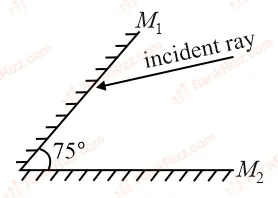
A light ray is incident, at an incident angle θ1, on the system of two plane mirrors M1 and M2 having an inclination angle 75° between them (as shown in figure). After reflecting from mirror M1 it gets reflected back by the mirror M2 with an angle of reflection 30°. The total deviation of the ray will be ______ degree.
JEE MAIN 2022 · 26 JUN S2Refraction at plane surfaces, Snell's law and apparent depthTRANSCRIBED
A small bulb is placed at the bottom of a tank containing water to a depth of 7 m. The refractive index of water is 34. The area of the surface of water through which light from the bulb can emerge out is xπ m2. The value of x is ______
JEE MAIN 2022 · 29 JUN S1Thin lenses: lens formula, lens maker's formula and powerTRANSCRIBED
A parallel beam of light is allowed to fall on a transparent spherical globe of diameter 30 cm and refractive index 1.5. The distance from the centre of the globe at which beam of light can converge is ______ mm.
JEE MAIN 2022 · 25 JUL S2Thin lenses: lens formula, lens maker's formula and powerTRANSCRIBED
A convex lens of focal length 20 cm is placed in front of convex mirror with principal axis coinciding each other. The distance between the lens and mirror is 10 cm. A point object is placed on principal axis at a distance of 60 cm from the convex lens. The image formed by combination coincides the object itself. The focal length of the convex mirror is ______ cm.
JEE MAIN 2022 · 26 JUL S1Thin lenses: lens formula, lens maker's formula and powerTRANSCRIBED
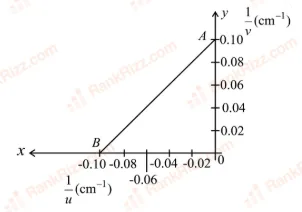
The graph between u1 and v1 for a thin convex lens in order to determine its focal length is plotted as shown in the figure. The refractive index of lens is 1.5 and its both the surfaces have same radius of curvatures R. The value of R will be ______ cm. (Where u = object distance, v = image distance)
JEE MAIN 2022 · 26 JUL S2Refraction at plane surfaces, Snell's law and apparent depthTRANSCRIBED
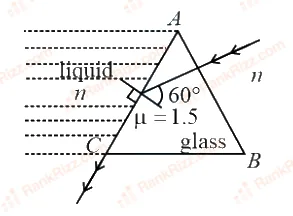
In the given figure, the face AC of the equilateral prism is immersed in a liquid of refractive index n. For incident angle 60° at the side AC, the refracted light beam just grazes along face AC. The refractive index of the liquid n=4x. The value of x is ______. (Given refractive index of glass =1.5)
JEE MAIN 2022 · 28 JUL S2Spherical mirrors: mirror formula and magnificationTRANSCRIBED
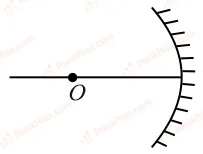
An object 'O' is placed at a distance of 100 cm in front of a concave mirror of radius of curvature 200 cm as shown in the figure. The object starts moving towards the mirror at a speed 2 cm s−1. The position of the image from the mirror after 10 s will be at _____ cm.
JEE MAIN 2022 · 29 JUL S1Refraction at plane surfaces, Snell's law and apparent depthTRANSCRIBED
The X-Y plane be taken as the boundary between two transparent media M1 and M2. M1 in Z≥0 has a refractive index of 2 and M2 with Z < 0 has a refractive index of 3. A ray of light travelling in M1 along the direction given by the vector A=43i^−33j^−5k^, is incident on the plane of separation. The value of difference between the angle of incident in M1 and the angle of refraction in M2 will be _____ degree.
JEE MAIN 2022 · 27 JUL S2Refraction at plane surfaces, Snell's law and apparent depthTRANSCRIBED
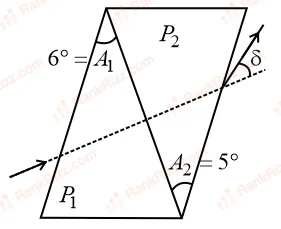
A thin prism of angle 6∘ and refractive index for yellow light (nY)=1.5 is combined with another prism of angle 5∘ and nY=1.55. The combination produces no dispersion. The net average deviation δ produced by the combination is (x1)∘. The value of x is _____
JEE MAIN 2022 · 28 JUL S2Thin lenses: lens formula, lens maker's formula and powerTRANSCRIBED
In an experiment with a convex lens, the plot of the image distance (v′) against the object distance (μ′) measured from the focus gives a curve v′μ′=225. If all the distances are measured in cm. The magnitude of the focal length of the lens is _____ cm.
JEE MAIN 2021 · 01 SEP S2Refraction at plane surfaces, Snell's law and apparent depthTRANSCRIBED
A glass tumbler having inner depth of 17.5 cm is kept on a table. A student starts pouring water (μ=34) into it while looking at the surface of water from the above. When he feels that the tumbler is half filled, he stops pouring water. Up to what height, the tumbler is actually filled?
JEE MAIN 2021 · 25 JUL S1Refraction at plane surfaces, Snell's law and apparent depthTRANSCRIBED
A ray of laser of a wavelength 630 nm is incident at an angle of 30∘ at the diamond-air interface. It is going from diamond to air. The refractive index of diamond is 2.42 and that of air is 1. Choose the correct option.
JEE MAIN 2021 · 16 MAR S2Thin lenses: lens formula, lens maker's formula and powerTRANSCRIBED
The refractive index of a converging lens is 1.4. What will be the focal length of this lens if it is placed in a medium of same refractive index? (Assume the radii of curvature of the faces of lens are R1 and R2 respectively)
JEE MAIN 2021 · 31 AUG S1Thin lenses: lens formula, lens maker's formula and powerTRANSCRIBED
An object is placed at the focus of concave lens having focal length f. What is the magnification and distance of the image from the optical centre of the lens?
JEE MAIN 2021 · 17 MAR S1Thin lenses: lens formula, lens maker's formula and powerTRANSCRIBED
The thickness at the centre of a plano convex lens is 3 mm and the diameter is 6 cm. If the speed of light in the material of the lens is 2×10⁸ m s−1. The focal length of the lens is:
JEE MAIN 2021 · 26 AUG S1Spherical mirrors: mirror formula and magnificationTRANSCRIBED
Car B overtakes another car A at a relative speed of 40 m s−1. How fast will the image of car B appear to move in the mirror of focal length 10 cm fitted in car A, when the car B is 1.9 m away from the car A?