RankRizzStart free

Kinetic Theory of Gases — JEE Main Previous Year Questions

Every Kinetic Theory of Gases question JEE Main has set, grouped by the idea it tests rather than the order of the syllabus. 191 questions across 6 distinct ideas. Free to read, answer key on every one.

Questions

191

Distinct ideas

6

Share of marks

3%

Difficulty

EASY

The ideas inside Kinetic Theory of Gases

A chapter is not one subject — it is a handful of procedures the examiner reuses. These are the ones Kinetic Theory of Gases questions actually test.

01Ideal gas equation and gas lawsset 38×
02Kinetic interpretation of pressure and temperatureset 23×
03RMS, average and most probable speeds of gas moleculesset 29×
04Degrees of freedom, equipartition of energy and internal energyset 22×
05Molar specific heats of gases, Mayer's relation and gas mixturesset 60×
06Mean free pathset 19×

Every Kinetic Theory of Gases question

161–180 OF 191 · NEWEST FIRST

JEE MAIN 2019 · 09 JAN S1RMS, average and most probable speeds of gas moleculesTRANSCRIBED

A mixture of 2 moles of helium gas (atomic mass = 4u), and 1 mole of argon gas (atomic mass = 40 u) is kept at 300 K in a container. The ratio of their rms speeds , is close to:

  1. A

    0.45

  2. B

    2.24

  3. C

    0.32

  4. D

    3.16

JEE MAIN 2019 · 12 APR S2Ideal gas equation and gas lawsTRANSCRIBED

The number density of molecules of a gas depends on their distance r from the origin as, . Then the numer of molecules is proportional to:

  1. A

  2. B

  3. C

  4. D

JEE MAIN 2019 · 10 APR S2Molar specific heats of gases, Mayer's relation and gas mixturesTRANSCRIBED

When heat Q is supplied to a diatomic gas of rigid molecules, at constant volume its temperature increases by . The heat required to produce the same change in temperature, at a constant pressure is:

  1. A

  2. B

  3. C

  4. D

JEE MAIN 2018 · 16 APR ONLINEMolar specific heats of gases, Mayer's relation and gas mixturesTRANSCRIBED

Two moles of helium are mixed with n moles of hydrogen. If for the mixture then the value of n is:

  1. A

    1

  2. B

    3

  3. C

    2

  4. D

JEE MAIN 2018 · 15 APR S2RMS, average and most probable speeds of gas moleculesTRANSCRIBED

The value closest to the thermal velocity of a Helium atom at room temperature (300 K) in ms is: [k = 1.4 10 J/K; m = 7 10 kg]

  1. A

  2. B

  3. C

  4. D

JEE MAIN 2017 · 02 APR OFFLINEMolar specific heats of gases, Mayer's relation and gas mixturesTRANSCRIBED

and are specific heats at constant pressure and constant volume respectively. It is observed that, for hydrogen gas and for nitrogen gas. The correct relation between and is:

  1. A

  2. B

  3. C

  4. D

JEE MAIN 2017 · 08 APR ONLINEMolar specific heats of gases, Mayer's relation and gas mixturesTRANSCRIBED

An ideal gas has molecules with 5 degrees of freedom. The ratio of specific heats at constant pressure () and at constant volume () is:

  1. A

  2. B

    6

  3. C

  4. D

JEE MAIN 2017 · 09 APR ONLINEDegrees of freedom, equipartition of energy and internal energyTRANSCRIBED

moles of diatomic gas in a cylinder is at a temperature . Heat is supplied to the cylinder such that the temperature remains constant but moles of the diatomic gas get converted into monoatomic gas. The change in the total kinetic energy of the gas is

  1. A

    0

  2. B

  3. C

  4. D

JEE MAIN 2017 · 02 APR OFFLINEIdeal gas equation and gas lawsTRANSCRIBED

The temperature of an open room of volume 30 m increases from 17°C to 27°C due to the sunshine. The atmospheric pressure in the room remains Pa. If and are the number of molecules in the room before and after heating, then will be:

  1. A

  2. B

  3. C

  4. D

JEE MAIN 2016 · 09 APR ONLINEMolar specific heats of gases, Mayer's relation and gas mixturesTRANSCRIBED

The ratio of work done by an ideal monoatomic gas to the heat supplied to it in an isobaric process is

  1. A

  2. B

  3. C

  4. D

JEE MAIN 2016 · 10 APR ONLINEIdeal gas equation and gas lawsTRANSCRIBED

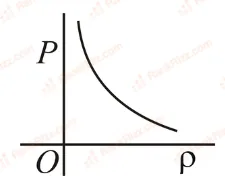
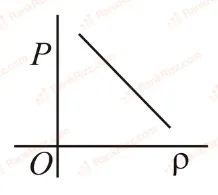
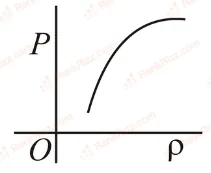
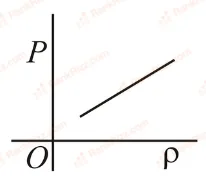
Which of the following shows the correct relationship between the pressure and density of an ideal gas at constant temperature?

  1. A
    image
  2. B
    image
  3. C
    image
  4. D
    image
JEE MAIN 2015 · 04 APR OFFLINEMean free pathTRANSCRIBED

Consider an ideal gas confined in an isolated closed chamber. As the gas undergoes an adiabatic expansion, the average time of collision between molecules increases as , where is the volume of the gas. The value of is

  1. A

  2. B

  3. C

  4. D

JEE MAIN 2015 · 10 APR ONLINEKinetic interpretation of pressure and temperatureTRANSCRIBED

In an ideal gas at temperature T, the average force that a molecule applies on the walls of a closed container depends on as . A good estimate for is:

  1. A

    2

  2. B

  3. C

    1

  4. D

JEE MAIN 2015 · 11 APR ONLINEMolar specific heats of gases, Mayer's relation and gas mixturesTRANSCRIBED

Using equipartition of energy, the specific heat (in J kg K) of Aluminium at high temperature can be estimated to be (atomic weight of Aluminium = 27)

  1. A

    25

  2. B

    1850

  3. C

    410

  4. D

    925

JEE MAIN 2014 · 09 APR ONLINEIdeal gas equation and gas lawsTRANSCRIBED

Modern vacuum pumps can evacuate a vessel down to a pressure of atm. at room temperature (300 K). Taking R = 8.3 JK mole, 1 atm = Pa and mole, the mean distance between molecules of gas in an evacuated vessel will be of the order of:

  1. A

    0.2 m

  2. B

    0.2 mm

  3. C

    0.2 cm

  4. D

    0.2 nm

JEE MAIN 2014 · 11 APR ONLINEIdeal gas equation and gas lawsTRANSCRIBED

An ideal monoatomic gas is confined in a cylinder by a spring loaded piston of cross section m. Initially the gas is at 300 K and occupies a volume of m and the spring is in its relaxed state as shown in figure. The gas is heated by a small heater until the piston moves out slowly by 0.1 m. The force constant of the spring is 8000 N/m and the atmospheric pressure is N/m. The cylinder and the piston are thermally insulated. The piston and the spring are massless and there is no friction between the piston and the cylinder. The final temperature of the gas will be: (Neglect the heat loss through the lead wires of the heater. The heat capacity of the heater coil is also negligible).

  1. A

    300 K

  2. B

    800 K

  3. C

    500 K

  4. D

    1000 K

JEE MAIN 2014 · 12 APR ONLINERMS, average and most probable speeds of gas moleculesTRANSCRIBED

At room temperature a diatomic gas is found to have an r.m.s. speed of 1930 ms. The gas is:

  1. A

    H

  2. B

    Cl

  3. C

    O

  4. D

    F

JEE MAIN 2014 · 19 APR ONLINEKinetic interpretation of pressure and temperatureTRANSCRIBED

A gas molecule of mass M at the surface of the earth has kinetic energy equivalent to 0 °C. If it were to go up straight without colliding with any other molecules, how high it would rise? Assume that the height attained is much less than the radius of the earth. (k is Boltzmann constant)

  1. A

  2. B

  3. C

    0

  4. D

JEE MAIN 2013 · 09 APR ONLINEMolar specific heats of gases, Mayer's relation and gas mixturesTRANSCRIBED

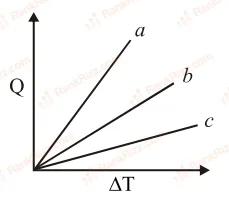
Figure shows the variation in temperature () with the amount of heat supplied (Q) in an isobaric process corresponding to a monoatomic (M), diatomic (D) and a polyatomic (P) gas. The initial state of all the gases are the same and the scales for the two axes coincide. Ignoring vibrational degrees of freedom, the lines a, b and c respectively correspond to :

  1. A

    P, M and D

  2. B

    M, D and P

  3. C

    P, D and M

  4. D

    D, M and P

JEE MAIN 2013 · 23 APR ONLINEIdeal gas equation and gas lawsTRANSCRIBED

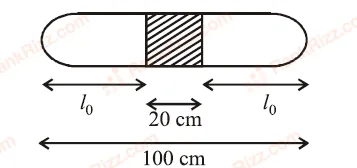
A thin tube sealed at both ends is 100 cm long. It lies horizontally, the middle 20 cm containing mercury and two equal ends containing air at standard atmospheric pressure. If the tube is now turned to a vertical position, by what amount will the mercury be displaced?
(Given : cross-section of the tube can be assumed to be uniform)

  1. A

    2.95 cm

  2. B

    5.18 cm

  3. C

    8.65 cm

  4. D

    0.0 cm