JEE MAIN 2025 · 28 JAN S2RMS, average and most probable speeds of gas moleculesTRANSCRIBED
The ratio of vapour densities of two gases at the same temperature is , then the ratio of r.m.s. velocities will be :
- A
- B
- C
- D
Every Kinetic Theory of Gases question JEE Main has set, grouped by the idea it tests rather than the order of the syllabus. 191 questions across 6 distinct ideas. Free to read, answer key on every one.
Questions
191
Distinct ideas
6
Share of marks
3%
Difficulty
EASY
A chapter is not one subject — it is a handful of procedures the examiner reuses. These are the ones Kinetic Theory of Gases questions actually test.
21–40 OF 191 · NEWEST FIRST
The ratio of vapour densities of two gases at the same temperature is , then the ratio of r.m.s. velocities will be :
Pressure of an ideal gas, contained in a closed vessel, is increased by 0.4% when heated by 1°C. Its initial temperature must be:
25°C
2500 K
250 K
250°C
For a diatomic gas, if for rigid molecules and for another diatomic molecules, but also having vibrational modes. Then, which one of the following options is correct ? (Cp and Cv are specific heats of the gas at constant pressure and volume)
\gamma_{2} < \gamma_{1}
\gamma_{2} > \gamma_{1}
For a particular ideal gas which of the following graphs represents the variation of mean squared velocity of the gas molecules with temperature?
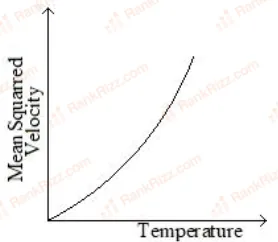
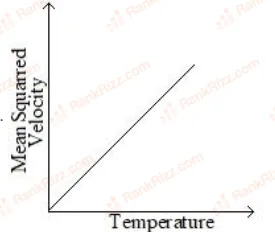
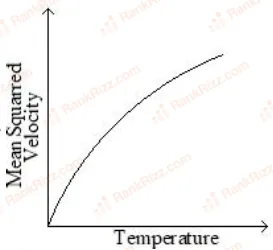
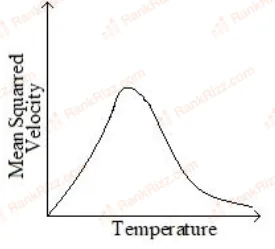
The internal energy of air in a sized room at 1 atmospheric pressure will be _________ J.
(Consider air as diatomic molecule)
The temperature of 1 mole of an ideal monoatomic gas is increased by at constant pressure. The total heat added and change in internal energy are and respectively. If then the value of x is
A container of fixed volume contains a gas at . To double the pressure of the gas, the temperature of gas should be raised to ______ .
is the specific heat ratio of monoatomic gas A having 3 translational degrees of freedom. is the specific heat ratio of polyatomic gas B having 3 translational, 3 rotational degrees of freedom and 1 vibrational mode. If , then the value of n is ______.
A diatomic gas does 200 J of work when it is expanded isobarically. The heat given to the gas in the process is:
850 J
800 J
600 J
700 J
kg air is heated at constant volume through . The specific heat of air at constant volume is and . The change in its internal energy is approximately.
J
J
J
J
At which temperature the r.m.s. velocity of a hydrogen molecule equal to that of an oxygen molecule at ?
A gas mixture consists of 8 moles of argon and 6 moles of oxygen at temperature . Neglecting all vibrational modes, the total internal energy of the system is
A diatomic gas () does 100 J of work in an isobaric expansion. The heat given to the gas is :
250 J
150 J
350 J
490 J
The temperature of a gas is and the average translational kinetic energy of its molecules is . The temperature at which the average translational kinetic energy of the molecules of the same gas becomes is :
If the root mean square velocity of hydrogen molecule at a given temperature and pressure is , the root mean square velocity of oxygen at the same condition in is:
2.0
0.5
1.5
1.0
The average kinetic energy of a monatomic molecule is eV at temperature: (Use )
K
K
K
K
The total kinetic energy of 1 mole of oxygen at 27°C is :
[Use universal gas constant (R) = 8.31 J mol K]
6845.5 J
5942.0 J
6232.5 J
5670.5 J
Two vessels and are of the same size and are at same temperature. contains g of hydrogen and contains g of oxygen. and are the pressures of the gases in and respectively, then is :
The temperature of a gas having molecules per cubic meter at atm (Given, ) is:
K
K
K
K
If three moles of monoatomic gas is mixed with two moles of a diatomic gas , the value of adiabatic exponent for the mixture is:
1.75
1.40
1.52
1.35
OTHER PHYSICS CHAPTERS