JEE MAIN 2024 · 04 APR S2Degrees of freedom, equipartition of energy and internal energyTRANSCRIBED
The translational degrees of freedom and rotational degrees of freedom of molecule are:
- A
and
- B
and
- C
and
- D
and
Every Kinetic Theory of Gases question JEE Main has set, grouped by the idea it tests rather than the order of the syllabus. 191 questions across 6 distinct ideas. Free to read, answer key on every one.
Questions
191
Distinct ideas
6
Share of marks
3%
Difficulty
EASY
A chapter is not one subject — it is a handful of procedures the examiner reuses. These are the ones Kinetic Theory of Gases questions actually test.
41–60 OF 191 · NEWEST FIRST
The translational degrees of freedom and rotational degrees of freedom of molecule are:
and
and
and
and
If is the number density and is the diameter of the molecule, then the average distance covered by a molecule between two successive collisions (i.e. mean free path) is represented by :
A sample contains mixture of helium and oxygen gas. The ratio of root mean square speed of helium and oxygen in the sample, is:
Energy of 10 non rigid diatomic molecules at temperature is :
Given below are two statements : Statement (I) : The mean free path of gas molecules is inversely proportional to square of molecular diameter. Statement (II) : Average kinetic energy of gas molecules is directly proportional to absolute temperature of gas. In the light of the above statements, choose the correct answer from the options given below :
Statement I is true but Statement II is false
Both Statement I and Statement II are false
Both Statement I and Statement II are true
Statement I is false but Statement II is true
Two moles of a monoatomic gas is mixed with six moles of a diatomic gas. The molar specific heat of the mixture at constant volume is :
moles of a polyatomic gas must be mixed with two moles of a monoatomic gas so that the mixture behaves as a diatomic gas. The value of is:
The specific heat at constant pressure of a real gas obeying equation is:
A mixture of one mole of monoatomic gas and one mole of a diatomic gas (rigid) are kept at room temperature . The ratio of specific heat of gases at constant volume respectively is:
P-T diagram of an ideal gas having three different densities (in three different cases) is shown in the figure. Which of the following is correct:
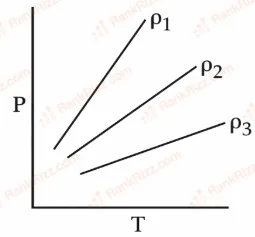
\rho_1 > \rho_2
\rho_2 < \rho_3
\rho_1 < \rho_2
The parameter that remains the same for molecules of all gases at a given temperature is :
kinetic energy
momentum
mass
speed
If the collision frequency of hydrogen molecules in a closed chamber at is , then the collision frequency of the same system at is :
For three low density gases , , pressure versus temperature graphs are plotted while keeping them at constant volume, as shown in the figure.
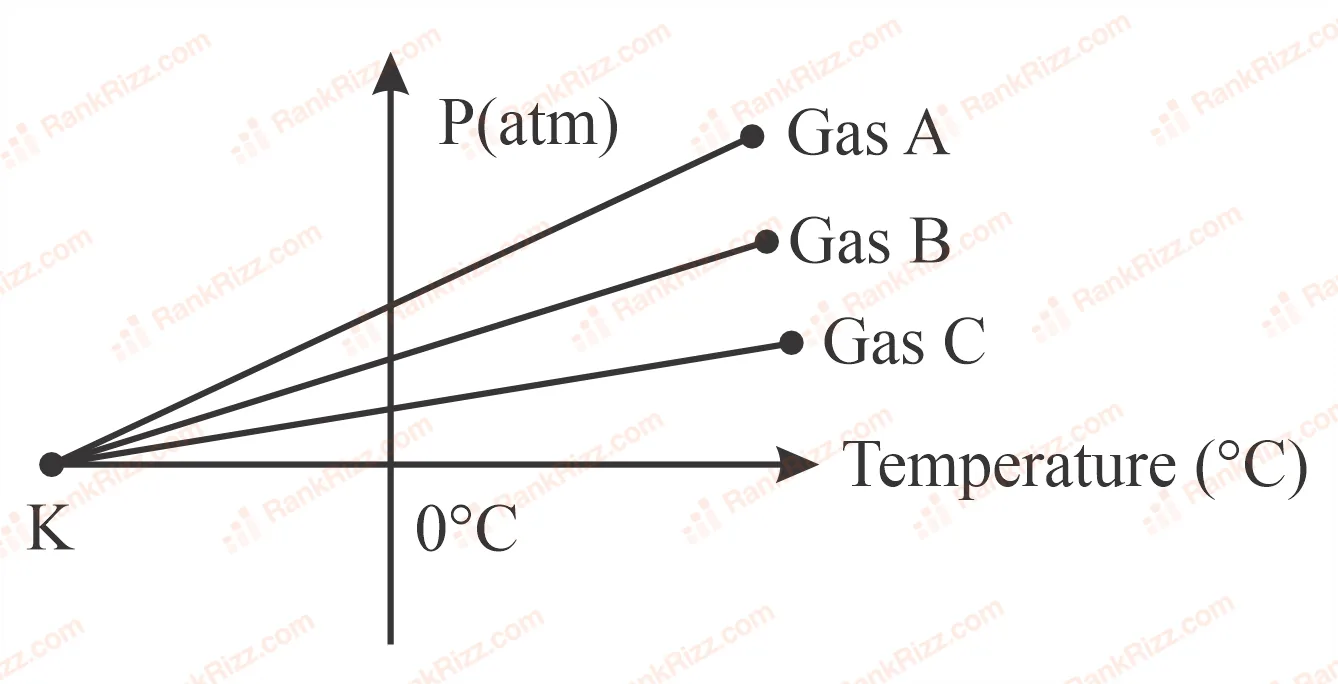
The temperature corresponding to the point 'K' is:
C
C
C
C
Heat energy of 735 J is given to a diatomic gas allowing the gas to expand at constant pressure. Each gas molecule rotates around an internal axis but do not oscillate. The increase in the internal energy of the gas will be:
525 J
441 J
572 J
735 J
According to law of equipartition of energy the molar specific heat of a diatomic gas at constant volume where the molecule has one additional vibrational mode is:-
Given below are two statements:
Statement I: The temperature of a gas is -73 °C. When the gas is heated to 527 °C, the root mean square speed of the molecules is doubled.
Statement II: The product of pressure and volume of an ideal gas will be equal to translational kinetic energy of the molecules.
In the light of the above statements, choose the correct answer from the options given below:
Both Statement I and Statement II are true
Statement I is true but Statement II is false
Both Statement I and Statement II are false
Statement I is false but Statement II is true
A bicycle tyre is filled with air having pressure of kPa at C. The approximate pressure of the air in the tyre when the temperature increases to C is
kPa
kPa
kPa
kPa
A flask contains hydrogen and oxygen in the ratio of by mass at temperature C. The ratio of average kinetic energy per molecule of hydrogen and oxygen respectively is:
A gas mixture consists of 2 moles of oxygen and 4 moles of neon at temperature . Neglecting all vibrational modes, the total internal energy of the system will be:
11RT
8RT
4RT
16RT
OTHER PHYSICS CHAPTERS