RankRizzStart free

Kinetic Theory of Gases — JEE Main Previous Year Questions

Every Kinetic Theory of Gases question JEE Main has set, grouped by the idea it tests rather than the order of the syllabus. 191 questions across 6 distinct ideas. Free to read, answer key on every one.

Questions

191

Distinct ideas

6

Share of marks

3%

Difficulty

EASY

The ideas inside Kinetic Theory of Gases

A chapter is not one subject — it is a handful of procedures the examiner reuses. These are the ones Kinetic Theory of Gases questions actually test.

01Ideal gas equation and gas lawsset 38×
02Kinetic interpretation of pressure and temperatureset 23×
03RMS, average and most probable speeds of gas moleculesset 29×
04Degrees of freedom, equipartition of energy and internal energyset 22×
05Molar specific heats of gases, Mayer's relation and gas mixturesset 60×
06Mean free pathset 19×

Every Kinetic Theory of Gases question

121–140 OF 191 · NEWEST FIRST

JEE MAIN 2021 · 26 AUG S2Ideal gas equation and gas lawsTRANSCRIBED

A cylindrical container of volume m contains one mole of hydrogen and two moles of carbon dioxide. Assume the temperature of the mixture is 400 K. The pressure of the mixture of gases is:
[Take gas constant as 8.3 J mol K]

  1. A

    Pa

  2. B

    Pa

  3. C

    Pa

  4. D

    24.9 Pa

JEE MAIN 2021 · 20 JUL S2Ideal gas equation and gas lawsTRANSCRIBED

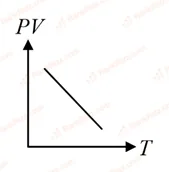
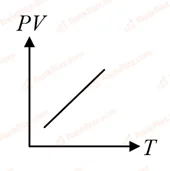
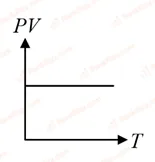
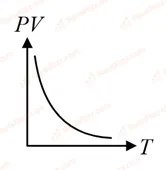
Which of the following graphs represent the behaviour of an ideal gas? Symbols have their usual meaning.

  1. A
  2. B
  3. C
  4. D
JEE MAIN 2021 · 20 JUL S2Molar specific heats of gases, Mayer's relation and gas mixturesTRANSCRIBED

The correct relation between the degrees of freedom and the ratio of specific heat is:

  1. A

  2. B

  3. C

  4. D

JEE MAIN 2021 · 01 SEP S2Kinetic interpretation of pressure and temperatureTRANSCRIBED

The average translational kinetic energy of gas molecules at _________ °C becomes equal to the K.E. of an electron accelerated from rest through a potential difference of 0.1 volt.
(Given J K) (Fill the nearest integer).

JEE MAIN 2021 · 25 JUL S2Mean free pathTRANSCRIBED

A system consists of two types of gas molecules and having the same number density m. The diameter of and are 10A and 5A respectively. They suffer collisions at room temperature. The ratio of average distance covered by the molecule to that of between two successive collisions is _________

JEE MAIN 2021 · 24 FEB S2RMS, average and most probable speeds of gas moleculesTRANSCRIBED

The root-mean-square speed of molecules of a given mass of a gas at 27°C and 1 atmosphere pressure is 200 m s. The root-mean-square speed of molecules of the gas at 127°C and 2 atmosphere pressure is m s. The value of will be ______.

JEE MAIN 2020 · 03 SEP S1Degrees of freedom, equipartition of energy and internal energyTRANSCRIBED

Consider a gas of triatomic molecules. The molecules are assumed to be triangular and made of massless rigid rods whose vertices are occupied by atoms. The internal energy of a mole of the gas at temperature T is:

  1. A

  2. B

  3. C

  4. D

JEE MAIN 2020 · 07 JAN S2Mean free pathTRANSCRIBED

Under an adiabatic process, the volume of an ideal gas gets doubled. Consequently, the mean collision time between the gas molecules changes from to . If for this gas then a good estimate for is given by

  1. A

    2

  2. B

  3. C

  4. D

JEE MAIN 2020 · 06 SEP S1Molar specific heats of gases, Mayer's relation and gas mixturesTRANSCRIBED

Molecules of an ideal gas are known to have three translational degrees of freedom. The gas is maintained at a temperature of T. The total internal energy, U of a mole of this gas, and the value of are given, respectively, by:

  1. A

    and

  2. B

    and

  3. C

    and

  4. D

    and

JEE MAIN 2020 · 02 SEP S2Mean free pathTRANSCRIBED

An ideal gas in a closed container is slowly heated. As its temperature increases, which of the following statements are true?
(A) the mean free path of the molecules decreases
(B) the mean collision time between the molecules decreases.
(C) the mean free path remains unchanged.
(D) the mean collision time relations unchanged.

  1. A

    (B) and (C)

  2. B

    (A) and (B)

  3. C

    (C) and (D)

  4. D

    (A) and (D)

JEE MAIN 2020 · 07 JAN S1Molar specific heats of gases, Mayer's relation and gas mixturesTRANSCRIBED

Two moles of an ideal gas, with , are mixed with three moles of another ideal gas . The value of for the mixture is

  1. A

    1.45

  2. B

    1.50

  3. C

    1.47

  4. D

    1.42

JEE MAIN 2020 · 09 JAN S1Molar specific heats of gases, Mayer's relation and gas mixturesTRANSCRIBED

Consider two ideal diatomic gases and at some temperature . Molecules of the gas are rigid, and have a mass . Molecules of the gas have an additional vibrational mode and have a mass . The ratio of the specific heats and of gas and , respectively is:

  1. A

    7 : 9

  2. B

    5 : 9

  3. C

    3 : 5

  4. D

    5 : 7

JEE MAIN 2020 · 05 SEP S1Kinetic interpretation of pressure and temperatureTRANSCRIBED

Number of molecules in a volume of of a perfect monoatomic gas at some temperature T and at a pressure of of mercury is close to? (Given, mean kinetic energy of a molecule (at T) is , , density of mercury )

  1. A

  2. B

  3. C

  4. D

JEE MAIN 2020 · 04 SEP S1Molar specific heats of gases, Mayer's relation and gas mixturesTRANSCRIBED

Match the ratio for ideal gases with different type of molecules:
Molecule Type                                   
(A) Monoatomic                                 (I) 7/5
(B) Diatomic rigid molecules             (II) 9/7
(C) Diatomic non-rigid molecules      (III) 4/3
(D) Triatomic rigid molecules            (IV) 5/3

  1. A

    (A) - (IV), (B) - (II), (C) - (I), (D) - (III)

  2. B

    (A) - (III), (B) - (IV), (C) - (II), (D) - (I)

  3. C

    (A) - (IV), (B) - (I), (C) - (II), (D) - (III)

  4. D

    (A) - (II), (B) - (III), (C) - (I), (D) - (IV)

JEE MAIN 2020 · 06 SEP S2Mean free pathTRANSCRIBED

In a dilute gas at pressure P and temperature T, the time between successive collision of a molecule varies with T as:

  1. A

    T

  2. B

  3. C

  4. D

JEE MAIN 2020 · 03 SEP S2Molar specific heats of gases, Mayer's relation and gas mixturesTRANSCRIBED

To raise the temperature of a certain mass of gas by 50°C at a constant pressure, 160 calories of heat is required. When the same mass of gas is cooled by 100°C at constant volume, 240 calories of heat is released. How many degrees of freedom does each molecule of this gas have (assume gas to be ideal)?

  1. A

    5

  2. B

    6

  3. C

    3

  4. D

    7

JEE MAIN 2020 · 08 JAN S1Mean free pathTRANSCRIBED

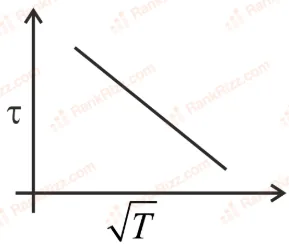
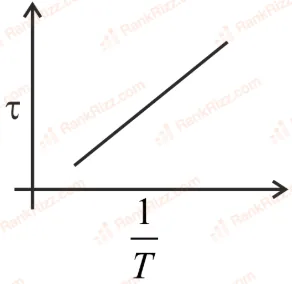
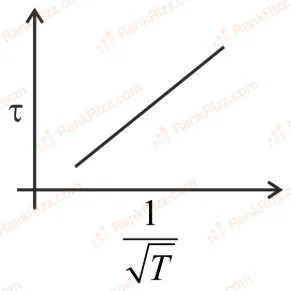
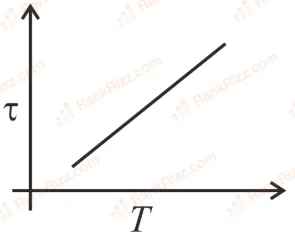
The plot that depicts the behavior of the mean free time (time between two successive collisions) for the molecules of an ideal gas, as a function of temperature (T), qualitatively, is: (Graphs are schematic and not drawn to scale)

  1. A
    image
  2. B
    image
  3. C
    image
  4. D
    image
JEE MAIN 2020 · 08 JAN S2Molar specific heats of gases, Mayer's relation and gas mixturesTRANSCRIBED

Consider a mixture of moles of helium gas and moles of oxygen gas (molecules taken to be rigid) as an ideal gas. Its value will be:

  1. A

  2. B

  3. C

  4. D

JEE MAIN 2020 · 09 JAN S2Mean free pathTRANSCRIBED

Two gases - argon (atomic radius 0.07 nm, atomic weight 40) and xenon (atomic radius 0.1 nm, atomic weight 140) have the same number density and are at the same temperature. The ratio of their respective mean free times is closest to:

  1. A

    3.67

  2. B

    1.83

  3. C

    2.3

  4. D

    1.09

JEE MAIN 2020 · 02 SEP S1Degrees of freedom, equipartition of energy and internal energyTRANSCRIBED

A gas mixture consists of 3 moles of oxygen and 5 moles of argon at temperature T. Assuming the gases to be ideal and the oxygen bond to be rigid, the total internal energy (in units of RT) of the mixture is:

  1. A

    15

  2. B

    13

  3. C

    20

  4. D

    11