An electric dipole of dipole moment is C m placed in a uniform electric field of N C in such a way that dipole moment is along electric field. The work done in rotating dipole by 180° in this field will be ______ mJ.
Every Electrostatics question JEE Main has set, grouped by the idea it tests rather than the order of the syllabus. 294 questions across 9 distinct ideas. Free to read, answer key on every one.
Questions
294
Distinct ideas
9
Share of marks
6%
Difficulty
MEDIUM
A chapter is not one subject — it is a handful of procedures the examiner reuses. These are the ones Electrostatics questions actually test.
121–140 OF 294 · NEWEST FIRST
An electric dipole of dipole moment is C m placed in a uniform electric field of N C in such a way that dipole moment is along electric field. The work done in rotating dipole by 180° in this field will be ______ mJ.
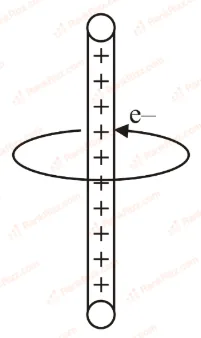
An electron revolves around an infinite cylindrical wire having uniform linear charge density C m in circular path under the influence of attractive electrostatic field as shown in the figure. The velocity of electron with which it is revolving is _______ m s. Given mass of electron kg

A stream of a positively charged particles having and velocity is deflected by an electric field . The electric field exists in a region of 10 cm along direction. Due to the electric field, the deflection of the charge particles in the direction is _____ mm.
A stream of positively charged particles having C kg and velocity m s is deflected by an electric field kV m. The electric field exists in a region of 10 cm along direction. Due to the electric field, the deflection of the charge particles in the direction is _____ mm.
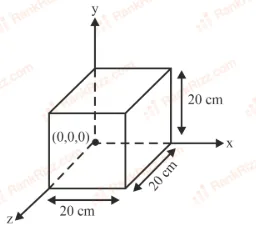
Expression for an electric field is given by V m. The electric flux through the cube of side 20 cm when placed in electric field (as shown in the figure) is ______ V cm.

A cubical volume is bounded by the surfaces , , , , , . The electric field in the region is given by . Where NC m. If cm, the charge contained in the cubical volume is C. The value of is ______. (Take C Nm)
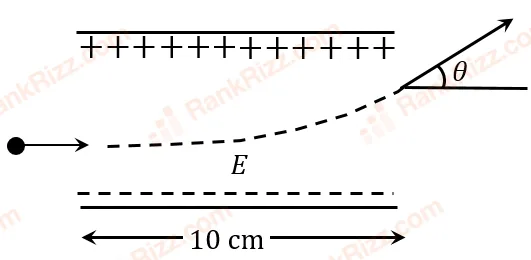
A uniform electric field of 10 N C is created between two parallel charged plates (as shown in figure). An electron enters the field symmetrically between the plates with a kinetic energy 0.5 eV. The length of each plate is 10 cm. The angle () of deviation of the path of electron as it comes out of the field is _____ (in degree).

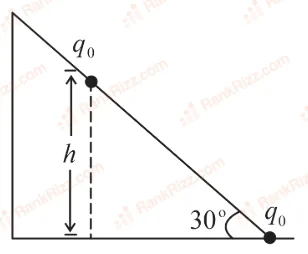
As shown in the figure, a configuration of two equal point charges is placed on an inclined plane. Mass of each point charge is 20 g. Assume that there is no friction between charge and plane. For the system of two point charges to be in equilibrium (at rest) the height m. The value of x is _______
Take N m C, m s

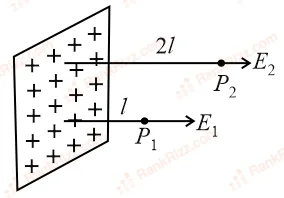
In the figure, a very large plane sheet of positive charge is shown. and are two points at distance and from the charge distribution. If is the surface charge density, then the magnitude of electric fields and at and respectively are

Sixty four conducting drops each of radius m and each carrying a charge of C are combined to form a bigger drop. The ratio of surface charge density of bigger drop to the smaller drop will be
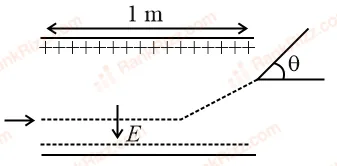
A uniform electric field V m is created between two parallel plates of length 1 m as shown in figure, (where = mass of electron and = charge of electron). An electron enters the field symmetrically between the plates with a speed of 2 m s. The angle of the deviation of the path of the electron as it comes out of the field will be

Statement-I : A point charge is brought in an electric field. The value of electric field at a point near to the charge may increase if the charge is positive.
Statement-II : An electric dipole is placed in a uniform electric field. The net electric force on the dipole will not be zero.
Both statement-I and statement-II are true.
Both statement-I and statement-II are false.
Statement-I is true but statement-II is false.
Statement-I is false but statement-II is true.
Two uniformly charged spherical conductors and of radii and are separated by a distance of . If the spheres are connected by a conducting wire, then in equilibrium condition, the ratio of the magnitudes of the electric fields at the surface of the sphere and will be
Two identical positive charges each are fixed at a distance of apart from each other. Another point charge with mass is placed at midpoint between two fixed charges. For a small displacement along the line joining the fixed charges, the charge executes SHM. The time period of oscillation of charge will be
A charge of is to be divided into two. The distance between the two divided charges is constant. The magnitude of the divided charges so that the force between them is maximum, will be:
and
and
and
and
Two identical metallic spheres A and B when placed at certain distance in air repel each other with a force of F. Another identical uncharged sphere C is first placed in contact with A and then in contact with B and finally placed at midpoint between spheres A and B. The force experienced by sphere C will be:
F
2F
A vertical electric field of magnitude N C just prevents a water droplet of a mass g from falling. The value of charge on the droplet will be : (Given m s)
C
C
C
C
Two identical charged particles each having a mass g and charge C are placed on a horizontal table with a separation of between them such that they stay in limited equilibrium. If the coefficient of friction between each particle and the table is , find the value of . [Use ms]
12 cm
10 cm
8 cm
5 cm
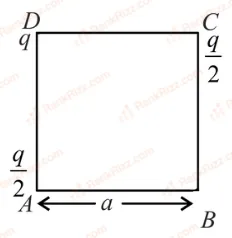
The three charges and are placed at the corners and of a square of side as shown in figure. The magnitude of electric field () at the corner of the square, is

Two point charges and of magnitude C and C respectively are placed at a distance apart. The electric field at the middle point between the charges is N C. The distance '' between the point charges and is
2 m
3 m
1 m
4 m
OTHER PHYSICS CHAPTERS