RankRizzStart free

Electrostatics — JEE Main Previous Year Questions

Every Electrostatics question JEE Main has set, grouped by the idea it tests rather than the order of the syllabus. 294 questions across 9 distinct ideas. Free to read, answer key on every one.

Questions

294

Distinct ideas

9

Share of marks

6%

Difficulty

MEDIUM

The ideas inside Electrostatics

A chapter is not one subject — it is a handful of procedures the examiner reuses. These are the ones Electrostatics questions actually test.

01Electric charge and Coulomb's lawset 42×
02Electric field due to point charges and superpositionset 25×
03Electric field of continuous charge distributionsset 42×
04Motion and equilibrium of charged bodies in electric fieldsset 7×
05Electric flux and Gauss's lawset 53×
06Electric potential and potential energyset 62×
07Relation between field and potential, equipotential surfacesset 13×
08Electric dipole and dipole in external fieldset 39×
09Conductors, concentric shells and earthingset 11×

Every Electrostatics question

281–294 OF 294 · NEWEST FIRST

JEE MAIN 2007Electric potential and potential energyTRANSCRIBED

An electric charge is placed at the origin of co-ordinate system. Two points and are situated at and respectively. The potential difference between the points and will be

  1. A

    9 volt

  2. B

    zero

  3. C

    2 volt

  4. D

    4.5 volt

JEE MAIN 2007Electric field due to point charges and superpositionTRANSCRIBED

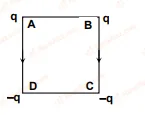
Charges are placed on the vertices of a square as shown. Let be the electric field and the potential at the centre. If the charges on and are interchanged with those on and respectively, then

  1. A

    remains unchanged, changes

  2. B

    Both and change

  3. C

    and remains unchanged

  4. D

    changes, remains unchanged

JEE MAIN 2007Relation between field and potential, equipotential surfacesTRANSCRIBED

The potential at a point (measured in ) due to some charges situated on the x-axis is given by Volts. The electric field at is given by

  1. A

    Volt/ and in the direction

  2. B

    Volt/ and in the direction.

  3. C

    Volt/ and in the direction

  4. D

    Volt/ and in the direction.

JEE MAIN 2007Electric charge and Coulomb's lawTRANSCRIBED

If and are the accelerations due to gravity on the surfaces of the earth and the moon respectively and if Millikan's oil drop experiment could be performed on the two surfaces, one will find the ratio to be

  1. A

    1

  2. B

    0

  3. C

  4. D

JEE MAIN 2006Electric dipole and dipole in external fieldTRANSCRIBED

A electric dipole is placed at an angle of to a non-uniform electric field. The dipole will experience

  1. A

    a torque only

  2. B

    a translational force only in the direction of the field

  3. C

    a translational force only in a direction normal to the direction of the field

  4. D

    a torque as well as a translational force

JEE MAIN 2006Motion and equilibrium of charged bodies in electric fieldsTRANSCRIBED

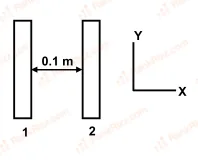
Two insulating plates are both uniformly charged in such a way that the potential difference between them is . (i.e. plate 2 is at a higher potential). The plates are separated by and can be treated as infinitely large. An electron is released from rest on the inner surface of plate 1. What is its speed when it hits plate 2?

  1. A

  2. B

  3. C

  4. D

JEE MAIN 2006Conductors, concentric shells and earthingTRANSCRIBED

Two spherical conductors and of radii and are separated by a distance of and are uniformly charged. If the spheres are connected by a conducting wire then in equilibrium condition, the ratio of the magnitude of the electric fields at the surface of spheres and is

  1. A

    1 : 4

  2. B

    4 : 1

  3. C

    1 : 2

  4. D

    2 : 1

JEE MAIN 2005Motion and equilibrium of charged bodies in electric fieldsTRANSCRIBED

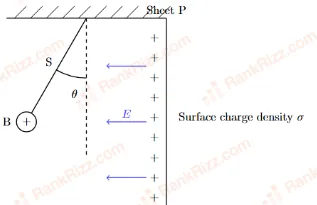
A charged ball hangs from a silk thread which makes an angle with a large charged conducting sheet , as show in the figure. The surface charge density of the sheet is proportional to

image
  1. A

  2. B

  3. C

  4. D

JEE MAIN 2005Electric field due to point charges and superpositionTRANSCRIBED

Two point charges and are located at and respectively. The location of a point on the axis at which the net electric field due to these two point charges is zero is

  1. A

  2. B

  3. C

  4. D

JEE MAIN 2005Electric potential and potential energyTRANSCRIBED

Two thin wires rings each having a radius are placed at a distance apart with their axes coinciding. The charges on the two rings are and . The potential difference between the centres of the two rings is

  1. A

  2. B

  3. C

    zero

  4. D

JEE MAIN 2004Electric charge and Coulomb's lawTRANSCRIBED

Two spherical conductor and having equal radii and carrying equal charges in them repel each other with a force when kept apart at some distance. A third spherical conductor having same radius as that of but uncharged brought in contact with , then brought in contact with and finally removed away from both. The new force of repulsion, between and is

  1. A

  2. B

  3. C

  4. D

JEE MAIN 2004Electric potential and potential energyTRANSCRIBED

A charged particle is shot towards another charged particle which is fixed, with a speed it approaches upto a closest distance and then returns. If were given a speed , the closest distances of approach would be

  1. A

  2. B

  3. C

  4. D

JEE MAIN 2004Electric charge and Coulomb's lawTRANSCRIBED

Four charges equal to are placed at the four corners of a square and a charge is at its centre. If the system is in equilibrium the value of is

  1. A

  2. B

  3. C

  4. D

JEE MAIN 2004Motion and equilibrium of charged bodies in electric fieldsTRANSCRIBED

A charged oil drop is suspended in a uniform field of V/m so that it neither falls nor rises. The charge on the drop will be (take the mass of the charge kg and )

  1. A

    C

  2. B

    C

  3. C

    C

  4. D

    C