RankRizzStart free

Electrostatics — JEE Main Previous Year Questions

Every Electrostatics question JEE Main has set, grouped by the idea it tests rather than the order of the syllabus. 294 questions across 9 distinct ideas. Free to read, answer key on every one.

Questions

294

Distinct ideas

9

Share of marks

6%

Difficulty

MEDIUM

The ideas inside Electrostatics

A chapter is not one subject — it is a handful of procedures the examiner reuses. These are the ones Electrostatics questions actually test.

01Electric charge and Coulomb's lawset 42×
02Electric field due to point charges and superpositionset 25×
03Electric field of continuous charge distributionsset 42×
04Motion and equilibrium of charged bodies in electric fieldsset 7×
05Electric flux and Gauss's lawset 53×
06Electric potential and potential energyset 62×
07Relation between field and potential, equipotential surfacesset 13×
08Electric dipole and dipole in external fieldset 39×
09Conductors, concentric shells and earthingset 11×

Every Electrostatics question

221–240 OF 294 · NEWEST FIRST

JEE MAIN 2019 · 11 JAN S2Electric dipole and dipole in external fieldTRANSCRIBED

An electric field of 1000 V/m is applied to an electric dipole at angle of . The value of electric dipole moment is C.m. What is the potential energy of the electric dipole?

  1. A

    J

  2. B

    J

  3. C

    J

  4. D

    J

JEE MAIN 2019 · 08 APR S2Electric dipole and dipole in external fieldTRANSCRIBED

An electric dipole is formed by two equal and opposite charges q with separation d. The charges have same mass m. It is kept in a uniform electric field E. If it is slightly rotated from its equilibrium orientation, then its angular frequency is:

  1. A

  2. B

  3. C

  4. D

JEE MAIN 2019 · 10 JAN S1Electric potential and potential energyTRANSCRIBED

A charge is distributed over three concentric spherical shells of radii , , (a < b < c) such that their surface charge densities are equal to one another. The total potential at a point at distance from their common centre, where r < a, would be:

  1. A

  2. B

  3. C

  4. D

JEE MAIN 2019 · 12 APR S1Electric dipole and dipole in external fieldTRANSCRIBED

A Point dipole is kept at the origin. The potential and electric field due to this dipole on the y-axis at a distance d are, respectively: (Taken V = 0 at infinity)

  1. A

    ,

  2. B

    ,

  3. C

    ,

  4. D

    ,

JEE MAIN 2019 · 09 APR S2Electric field of continuous charge distributionsTRANSCRIBED

Four point charges -q, +q, +q and -q are placed on y-axis at y = -2d, y = -d, and y = +2d, respectively. The magnitude of the electric field E at a point on the x-axis at x = D, with D >> d, will behave as:

  1. A

  2. B

  3. C

  4. D

JEE MAIN 2019 · 08 APR S2Electric potential and potential energyTRANSCRIBED

The electric field in a region is given by , where E is in NC and is in metres. The values of constants are A = 20 SI unit and B = 10 SI unit. If the potential at is and that at is , then is:

  1. A

    320 V

  2. B

    -520 V

  3. C

    180 V

  4. D

    -48 V

JEE MAIN 2019 · 09 APR S1Electric potential and potential energyTRANSCRIBED

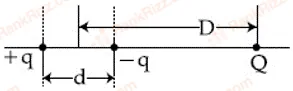
A system of three charges are placed as shown in the figure:


If D >> d, the potential energy of the system is best given by:

  1. A

  2. B

  3. C

  4. D

JEE MAIN 2019 · 10 JAN S2Electric dipole and dipole in external fieldTRANSCRIBED

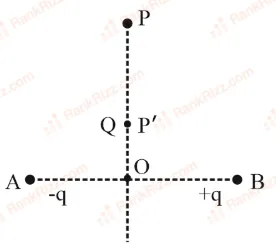
Charges and , located at A and B, respectively, constitute an electric dipole. Distance , is the mid point of the dipole and is perpendicular to . A charge is placed at P where and . The charge experiences an electrostatic force . If is now moved along the equatorial line to P' such that , the force on will be close to ():

image
  1. A

    27F

  2. B

  3. C

    3F

  4. D

    9F

JEE MAIN 2019 · 12 APR S2Electric flux and Gauss's lawTRANSCRIBED

Let a total charge 2Q be distributed in a sphere of radius R, with the charge density given by , where r is the distance from the centre. Two charges A and B, of -Q each, are placed on diametrically opposite points, at equal distance, a, from the centre. If A and B do not experience any force, then:

  1. A

    a =

  2. B

    a =

  3. C

    a =

  4. D

    a =

JEE MAIN 2019 · 10 JAN S2Electric potential and potential energyTRANSCRIBED

Four equal point charges each are placed in the plane at , , and . The work required to put a fifth charge at the origin of the coordinate system will be:

  1. A

  2. B

  3. C

  4. D

JEE MAIN 2019 · 10 APR S2Electric potential and potential energyTRANSCRIBED

In free space, a particle A of charge 1 μC is held fixed at point P. Another particle B of the same charge and mass 4 μg is kept at a distance of 1 mm from P. If B is released, then its velocity at a distance of 9 mm from P is:
[Take N m C]

  1. A

    1.0 m s

  2. B

    m s

  3. C

    m s

  4. D

    m s

JEE MAIN 2018 · 15 APR S1Motion and equilibrium of charged bodies in electric fieldsTRANSCRIBED

A body of mass M and charge q is connected to a spring of spring constant k. It is oscillating along x-direction about its equilibrium position, taken to be at x = 0, with an amplitude A. An electric field E is applied along the x-direction. Which of the following statements is correct?

  1. A

    The total energy of the system is

  2. B

    The new equilibrium position is at a distance from x = 0

  3. C

    The new equilibrium position is at a distance from x = 0

  4. D

    The total energy of the system is

JEE MAIN 2018 · 15 APR S1Electric flux and Gauss's lawTRANSCRIBED

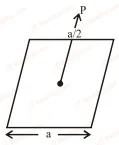
A charge Q is placed at a distance a/2 above the centre of the square surface of edge a as shown in the figure. The electric flux through the square surface is:

  1. A

  2. B

  3. C

  4. D

JEE MAIN 2018 · 08 APR OFFLINEConductors, concentric shells and earthingTRANSCRIBED

Three concentric metal shells A, B and C of respective radii a, b and c (a < b < c) have surface charge densities , and respectively. The potential of shell B is:

  1. A

  2. B

  3. C

  4. D

JEE MAIN 2018 · 15 APR S2Electric field of continuous charge distributionsTRANSCRIBED

A solid ball of radius R has a charge density given by for . The electric field outside the ball is:

  1. A

  2. B

  3. C

  4. D

JEE MAIN 2018 · 16 APR ONLINEElectric charge and Coulomb's lawTRANSCRIBED

Two identical conducting spheres A and B carry an equal charge. They are separated by a distance much larger than their diameters, and the force between them is F. A third identical conducting sphere, C, is uncharged. Sphere C is first touched to A, then to B, and then removed. As a result, force between A and B would be equal to:

  1. A

  2. B

  3. C

  4. D

    F

JEE MAIN 2017 · 02 APR OFFLINEElectric dipole and dipole in external fieldTRANSCRIBED

An electric dipole has fixed dipole moment , which makes angle with respect to -axis. When subjected to an electric field , it experiences a torque . When subjected to another electric field , it experiences a torque . The angle is:

  1. A

    90°

  2. B

    30°

  3. C

    45°

  4. D

    60°

JEE MAIN 2017 · 08 APR ONLINEElectric potential and potential energyTRANSCRIBED

There is a uniform electrostatic field in a region. The potential at various points on a small sphere centred at , in the region, is found to vary between the limits 589.0 V to 589.8 V. What is the potential at a point on the sphere whose radius vector makes an angle of 60° with the direction of the field?

  1. A

    589.4 V

  2. B

    589.5 V

  3. C

    589.2 V

  4. D

    589.6 V

JEE MAIN 2017 · 09 APR ONLINEElectric flux and Gauss's lawTRANSCRIBED

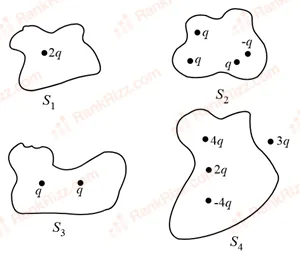
Four closed surfaces and corresponding charge distributions are shown below.

Let the respective electric fluxes through the surfaces be , , and . Then:

  1. A

    \phi_1 &gt; \phi_2 &gt; \phi_3 &gt; \phi_4

  2. B

    \phi_1 &lt; \phi_2 = \phi_3 &gt; \phi_4

  3. C

    \phi_1 &gt; \phi_3; \phi_2 &lt; \phi_4

  4. D

JEE MAIN 2016 · 03 APR OFFLINEElectric flux and Gauss's lawTRANSCRIBED

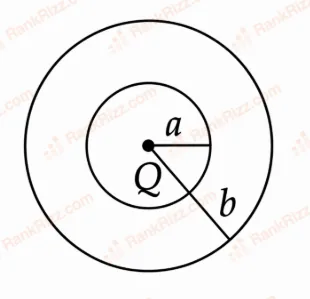
The region between two concentric spheres of radii 'a' and 'b', respectively (see figure), has volume charge density , where A is a constant and r is the distance from the centre. At the centre of the spheres is a point charge Q. The value of A such that the electric field in the region between the spheres will be constant, is:

image
  1. A

  2. B

  3. C

  4. D