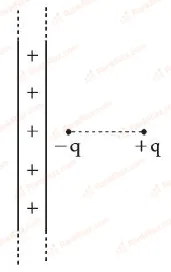
A point charge is placed at the origin. A second point charge is placed at in Cartesian coordinate system. The point in between them where the electric field vanishes is:
- A
- B
- C
- D
Every Electrostatics question JEE Main has set, grouped by the idea it tests rather than the order of the syllabus. 294 questions across 9 distinct ideas. Free to read, answer key on every one.
Questions
294
Distinct ideas
9
Share of marks
6%
Difficulty
MEDIUM
A chapter is not one subject — it is a handful of procedures the examiner reuses. These are the ones Electrostatics questions actually test.
41–60 OF 294 · NEWEST FIRST
A point charge is placed at the origin. A second point charge is placed at in Cartesian coordinate system. The point in between them where the electric field vanishes is:
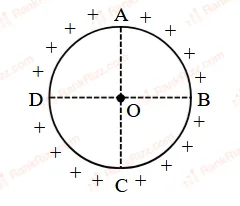
A metallic ring is uniformly charged as shown in figure. AC and BD are two mutually perpendicular diameters. Electric field due to arc AB to 'O' is 'E' is magnitude. What would be the magnitude of electric field at 'O' due to arc ABC?

Zero
An infinitely long wire has uniform linear charge density nC/m. The net flux through a Gaussian cube of side length cm, if the wire passes through two corners of the cube that are maximally displaced from each other, would be NmC, where x is :
[Neglect any edge effects and use SI units]
A small uncharged conducting sphere is placed in contact with an identical sphere but having charge and then removed to a distance such that the force of repulsion between them is . The distance between them is
3 cm
2 cm
4 cm
1 cm
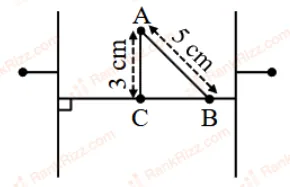
Two large plane parallel conducting plates are kept 10 cm apart as shown in figure. The potential difference between them is V. The potential difference between the points A and B (shown in the figure) is :

A dipole with two electric charges of 2 C magnitude each, with separation distance 0.5 m, is placed between the plates of a capacitor such that its axis is parallel to an electric field established between the plates when a potential difference of 5 V is applied. Separation between the plates is 0.5 mm. If the dipole is rotated by 30° from the axis, the value of the torque is :
Nm
Nm
Nm
Nm
Two metal spheres of radius R and 3R have same surface charge density . If they are brought in contact and then separated, the surface charge density on smaller and bigger sphere becomes and , respectively. The ratio is :
9
3
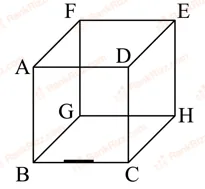
A line charge of length is kept at the center of an edge BC of a cube ABCDEFGH having edge length 'a' as shown in the figure. If the density of line charge is per unit length, then the total electric flux through
all the faces of the cube will be . (Take, as the free space permittivity)
The electrostatic potential on the surface of uniformly charged spherical shell of radius R = 10 cm is 120 V. The potential at the centre of shell, at a distance r = 5 cm from centre, and at a distance r = 15 cm from the centre of the shell, respectively, are :
120V, 120V, 80V
40V, 40V, 80V
0V, 0V, 80V
0V, 120V, 40V
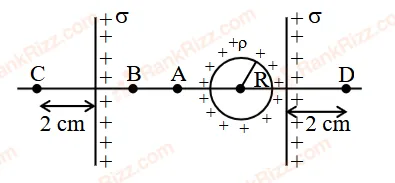
Two infinite identical charged sheets and a charged spherical body of charge density '' are arranged as shown in figure. Then the correct relation between the electrical fields at A, B, C and D points is:

A point charge causes an electric flux of to pass through a spherical Gaussian surface of 8.0 cm radius, centred on the charge. The value of the point charge is : (Given )
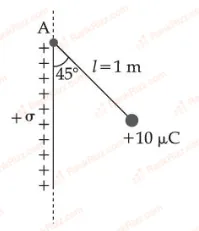
A small bob of mass 100 and charge C is connected to an insulating string of length 1 m. It is brought near to an infinitely long non-conducting sheet of charge density '' as shown in figure. If string subtends an angle of 45° with sheet at equilibrium the charge density of sheet will be:
(Given, F/m and acceleration due to gravity, m/s)

0.885 nC/m
17.7 nC/m
885 nC/m
1.77 nC/m
Two small spherical balls of mass 10g each with charges and , are attached to two ends of very light rigid rod of length 20 cm. The arrangement is now placed near an infinite non-conducting charge sheet with uniform charge density such that length of rod makes an angle of 30° with electric field generated by charge sheet. Net torque acting on the rod is: (Take )
112 Nm
1.12 Nm
2.24 Nm
11.2 Nm
An electric dipole is placed at a distance of 2 cm from an infinite plane sheet having positive charge density .
Choose the correct option from the following.
Potential energy and torque both are maximum.
Torque on dipole is zero and net force is directed away from the sheet.
Torque on dipole is zero and net force acts towards the sheet.
Potential energy of dipole is minimum and torque is zero.
Consider a circular loop that is uniformly charged and has a radius . Find the position along the positive z-axis of the cartesian coordinate system where the electric field is maximum if the ring was assumed to be placed in xy-plane at the origin :
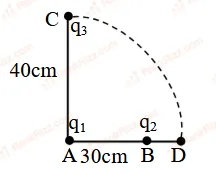
Two charges and are separated by a distance of 30 cm. A third charge initially at 'C' as shown in the figure, is moved along the circular path of radius 40 cm from C to D. If the difference in potential energy due to movement of from C to D is given by , the value of K is :

A positive ion A and a negative ion B has charges and , and masses and respectively. At an instant, the ions are separated by a certain distance r. At that instant the ratio of the magnitudes of electrostatic force to gravitational force is , where the value of 10P is (Take and universal gravitational constant as )
Assume that charge may not be an integral multiple of electrons.
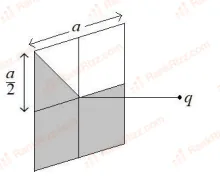
A square loop of sides is held normally in front of a point charge The flux of the electric field through the shaded region is , where the value of is

An electric dipole of dipole moment is placed in uniform electric field of magnitude . Initially, the dipole moment is parallel to electric field. The work that needs to be done on the dipole to make its dipole moment opposite to the field, will be ____ J.
The electric field in a region is given by N/C. The flux of the field through a rectangular surface parallel to x-z plane is 6.0 NmC. The area of the surface is _____ cm.
OTHER PHYSICS CHAPTERS