Every Oscillations question JEE Main has set, grouped by the idea it tests rather than the order of the syllabus. 182 questions across 7 distinct ideas. Free to read, answer key on every one.
A chapter is not one subject — it is a handful of procedures the examiner reuses. These are the ones Oscillations questions actually test.
01SHM: equation, phase, velocity and accelerationset 78×
02Energy in simple harmonic motionset 17×
03Superposition of SHMsset 3×
04Spring-block oscillationsset 51×
05Simple, compound and torsional pendulumsset 14×
06SHM of floating bodies, liquids, gases and charged systemsset 5×
07Damped and forced oscillations and resonanceset 14×
Every Oscillations question
141–160 OF 182 · NEWEST FIRST
JEE MAIN 2016 · 10 APR ONLINESHM: equation, phase, velocity and accelerationTRANSCRIBED
In an engine the piston undergoes vertical simple harmonic motion with amplitude 7 cm. A washer rests on top of the piston and moves with it. The motor speed is slowly increased. The frequency of the piston at which the washer no longer stays in contact with the piston, is close to:
JEE MAIN 2015 · 04 APR OFFLINESimple, compound and torsional pendulumsTRANSCRIBED
A pendulum made of a uniform wire of cross sectional area A has time period T. When an additional mass M is added to its bob, the time period changes to TM. If the Young's modulus of the material of the wire is Y, then Y1 is equal to: (g = gravitational acceleration)
JEE MAIN 2015 · 04 APR OFFLINESpring-block oscillationsTRANSCRIBED
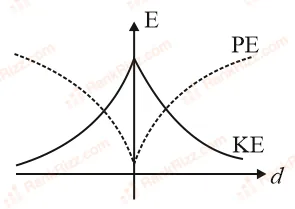
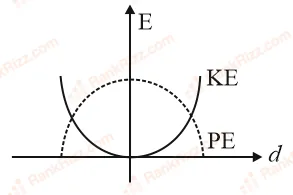
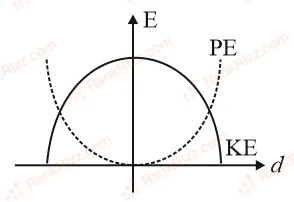
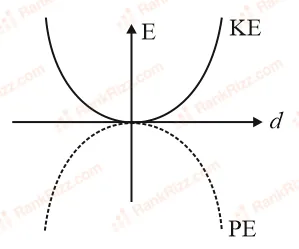
For a simple pendulum, a graph is plotted between its kinetic energy (K.E.) and potential energy (P.E.) against its displacement d. Which one of the following represents these correctly? (graphs are schematic and not drawn to scale)
JEE MAIN 2015 · 11 APR ONLINEDamped and forced oscillations and resonanceTRANSCRIBED
A pendulum with the time period of 1 s is losing energy due to damping. At a certain time, its energy is 45 J. If after completing 15 oscillations its energy has become 15 J, then its damping constant (in s−1) will be
JEE MAIN 2015 · 10 APR ONLINEDamped and forced oscillations and resonanceTRANSCRIBED
A simple harmonic oscillator of angular frequency 2 rad s−1 is acted upon by an external force F=sint N. If the oscillator is at rest in its equilibrium position at t=0, its position at later times is proportional to:
JEE MAIN 2015 · 11 APR ONLINESHM of floating bodies, liquids, gases and charged systemsTRANSCRIBED
A cylindrical block of wood (density = 650 kg m−3), of base area 30 cm2 and height 54 cm, floats in a liquid of density 900 kg m−3. The block is depressed slightly and then released. The time period of the resulting oscillations of the block would be equal to that of a simple pendulum of length (nearly):
JEE MAIN 2014 · 09 APR ONLINESpring-block oscillationsTRANSCRIBED
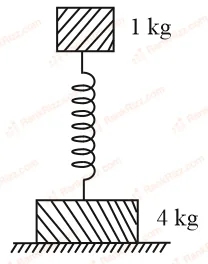
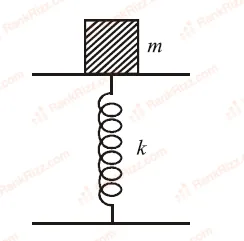
Two bodies of masses 1 kg and 4 kg are connected to a vertical spring, as shown in the figure. The smaller mass executes simple harmonic motion of angular frequency 25 rad s−1, and amplitude 1.6 cm while the bigger mass remains stationary on the ground. The maximum force exerted by the system on the floor is (take g=10 m s−2).
JEE MAIN 2014 · 09 APR ONLINEDamped and forced oscillations and resonanceTRANSCRIBED
The amplitude of a simple pendulum, oscillating in air with a small spherical bob, decreases from 10 cm to 8 cm in 40 seconds. Assuming that Stokes law is valid, and ratio of the coefficient of viscosity of air to that of carbon dioxide is 1.3, the time in which amplitude of this pendulum will reduce from 10 cm to 5 cm in carbondioxide will be close to (ln 5 = 1.601, ln 2 = 0.693).
JEE MAIN 2014 · 06 APR OFFLINESHM: equation, phase, velocity and accelerationTRANSCRIBED
A particle moves with simple harmonic motion in a straight line. In first τ s, after starting from rest it travels a distance a, and in next τ s it travels 2a, in same direction, then:
JEE MAIN 2014 · 09 APR ONLINESHM: equation, phase, velocity and accelerationTRANSCRIBED
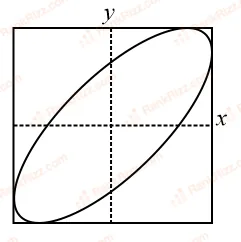
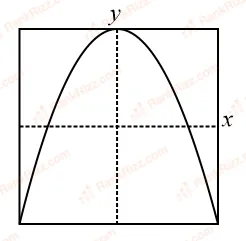
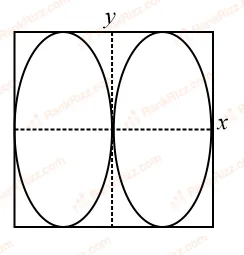
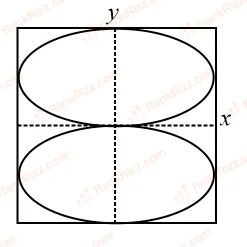
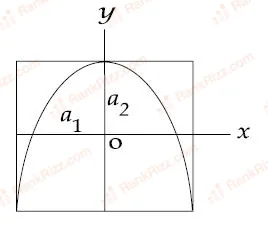
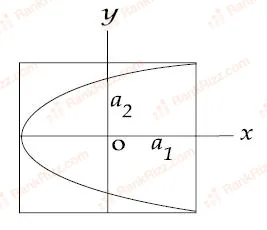
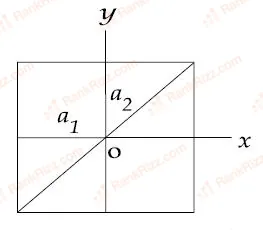
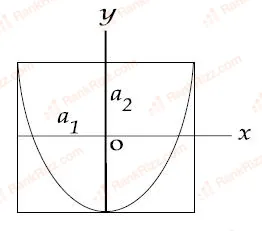
A particle which is simultaneously subjected to two perpendicular simple harmonic motions represented by; x=a1cosωt and y=a2cos2ωt traces a curve given by:
JEE MAIN 2014 · 11 APR ONLINEDamped and forced oscillations and resonanceTRANSCRIBED
The angular frequency of the damped oscillator is given by, ω=(mk−4m2r2) where k is the spring constant, m is the mass of the oscillator and r is the damping constant. If the ratio mkr2 is 8%, the change in time period compared to the undamped oscillator is approximately as follows:
JEE MAIN 2014 · 12 APR ONLINESHM: equation, phase, velocity and accelerationTRANSCRIBED
Which of the following expressions corresponds to simple harmonic motion along a straight line, where x is the displacement and a, b, c are positive constants?
JEE MAIN 2014 · 19 APR ONLINESHM: equation, phase, velocity and accelerationTRANSCRIBED
A body is in simple harmonic motion with time period T=0.5 s and amplitude A=1 cm. Find the average velocity in the interval in which it moves from equilibrium position to half of its amplitude.
JEE MAIN 2013 · 25 APR ONLINESpring-block oscillationsTRANSCRIBED
A uniform cylinder of length L and mass M having cross-sectional area A is suspended, with its length vertical, from a fixed point by a massless spring, such that it is half submerged in a liquid of density σ at equilibrium position. When the cylinder is given a downward push and released, it starts oscillating vertically with a small amplitude. The time period T of the oscillations of the cylinder will be :
JEE MAIN 2013 · 07 APR ONLINESHM of floating bodies, liquids, gases and charged systemsTRANSCRIBED
An ideal gas enclosed in a vertical cylindrical container supports a freely moving piston of mass M. The piston and the cylinder have equal cross-sectional area A. When the piston is in equilibrium, the volume of the gas is V0 and its pressure is P0. The piston is slightly displaced from the equilibrium position and released. Assuming that the system is completely isolated from its surrounding, the piston executes a simple harmonic motion with frequency [Assume the system is in space.]
JEE MAIN 2013 · 09 APR ONLINESpring-block oscillationsTRANSCRIBED
Two simple pendulums of length 1 m and 4 m respectively are both given small displacement in the same direction at the same instant. They will be again in phase after the shorter pendulum has completed number of oscillations equal to:
JEE MAIN 2013 · 22 APR ONLINESpring-block oscillationsTRANSCRIBED
A mass m=1.0 kg is put on a flat pan attached to a vertical spring fixed on the ground. The mass of the spring and the pan is negligible. When pressed slightly and released, the mass executes simple harmonic motion. The spring constant is 500 N/m. What is the amplitude A of the motion, so that the mass m tends to get detached from the pan? (Take g=10 m/s2). The spring is stiff enough so that it does not get distorted during the motion.
JEE MAIN 2013 · 23 APR ONLINESimple, compound and torsional pendulumsTRANSCRIBED
Bob of a simple pendulum of length l is made of iron. The pendulum is oscillating over a horizontal coil carrying direct current. If the time period of the pendulum is T then :
A
T < 2\pi\sqrt{\frac{l}{g}} and damping is smaller than in air alone.
B
T=2πgl and damping is larger than in air alone.
C
T > 2\pi\sqrt{\frac{l}{g}} and damping is smaller than in air alone.
D
T < 2\pi\sqrt{\frac{l}{g}} and damping is larger than in air alone.
JEE MAIN 2013 · 07 APR ONLINEDamped and forced oscillations and resonanceTRANSCRIBED
The amplitude of a damped oscillator decreases to 0.9 times its original magnitude in 5s. In another 10s it will decrease to α times its original magnitude, where α equals :