Every Oscillations question JEE Main has set, grouped by the idea it tests rather than the order of the syllabus. 182 questions across 7 distinct ideas. Free to read, answer key on every one.
A chapter is not one subject — it is a handful of procedures the examiner reuses. These are the ones Oscillations questions actually test.
01SHM: equation, phase, velocity and accelerationset 78×
02Energy in simple harmonic motionset 17×
03Superposition of SHMsset 3×
04Spring-block oscillationsset 51×
05Simple, compound and torsional pendulumsset 14×
06SHM of floating bodies, liquids, gases and charged systemsset 5×
07Damped and forced oscillations and resonanceset 14×
Every Oscillations question
101–120 OF 182 · NEWEST FIRST
JEE MAIN 2021 · 27 JUL S2SHM: equation, phase, velocity and accelerationTRANSCRIBED
An object of mass 0.5 kg is executing simple harmonic motion. It amplitude is 5 cm and time period (T) is 0.2 s. What will be the potential energy of the object at an instant t=4T s starting from mean position. Assume that the initial phase of the oscillation is zero.
JEE MAIN 2021 · 31 AUG S2Energy in simple harmonic motionTRANSCRIBED
For a body executing S.H.M.: (a) Potential energy is always equal to its K.E. (b) Average potential and kinetic energy over any given time interval are always equal. (c) Sum of the kinetic and potential energy at any point of time is constant. (d) Average K.E. in one time period is equal to average potential energy in one time period. Choose the most appropriate option from the options given below:
JEE MAIN 2021 · 20 JUL S2Energy in simple harmonic motionTRANSCRIBED
A particle is making simple harmonic motion along the X-axis. If at distances x1 and x2 from the mean position the velocities of the particle are v1 and v2, respectively. The time period of its oscillation is given as:
JEE MAIN 2021 · 26 AUG S2SHM: equation, phase, velocity and accelerationTRANSCRIBED
Two simple harmonic motions are represented by the equations x1=5sin(2πt+4π) and x2=52(sin2πt+cos2πt). The amplitude of the second motion is _________ times the amplitude in the first motion.
JEE MAIN 2021 · 25 JUL S1Spring-block oscillationsTRANSCRIBED
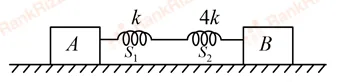
In the reported figure, two bodies A and B of masses 200 g and 800 g are attached with the system of springs. Springs are kept in a stretched position with some extension when the system is released. The horizontal surface is assumed to be frictionless. The angular frequency will be ___ rad s−1 when k=20 N m−1.
JEE MAIN 2021 · 27 AUG S2Superposition of SHMsTRANSCRIBED
Two simple harmonic motion, are represented by the equations y1=10sin(3πt+3π); y2=5(sin3πt+3cos3πt) Ratio of amplitude of y1 to y2 = x : 1. The value of x is _________.
JEE MAIN 2021 · 31 AUG S1SHM: equation, phase, velocity and accelerationTRANSCRIBED
A particle of mass 1 kg is hanging from a spring of force constant 100 N m−1. The mass is pulled slightly downward and released so that it executes free simple harmonic motion with time period T. The time when the kinetic energy and potential energy of the system will become equal, is nT. The value of n is _________.
JEE MAIN 2021 · 26 FEB S2SHM: equation, phase, velocity and accelerationTRANSCRIBED
A particle executes S.H.M. with amplitude A and time period T. The displacement of the particle when its speed is half of maximum speed is 2xA. The value of x is
JEE MAIN 2021 · 17 MAR S1Spring-block oscillationsTRANSCRIBED
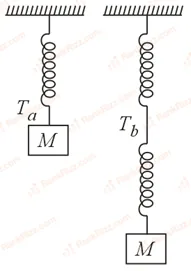
Consider two identical springs each of spring constant k and negligible mass compared to the mass M as shown. Fig. 1 shows one of them and Fig. 2 shows their series combination. The ratios of time period of oscillation of the two SHM is TaTb=x, where value of x is ________. (Round off to the Nearest Integer)
JEE MAIN 2021 · 27 JUL S2SHM: equation, phase, velocity and accelerationTRANSCRIBED
A particle executes simple harmonic motion represented by displacement function as x(t)=Asin(ωt+ϕ). If the position and velocity of the particle at t=0 s are 2 cm and 2ω cm s−1 respectively, then its amplitude is x2 cm where the value of x is _________
JEE MAIN 2020 · 05 SEP S2Simple, compound and torsional pendulumsTRANSCRIBED
A ring is hung on a nail. It can oscillate, without slipping or sliding (i) in its plane with a time period T1 and (ii) back and forth in a direction perpendicular to its plane, with a period T2. The ratio T2T1 will be:
JEE MAIN 2020 · 02 SEP S2Energy in simple harmonic motionTRANSCRIBED
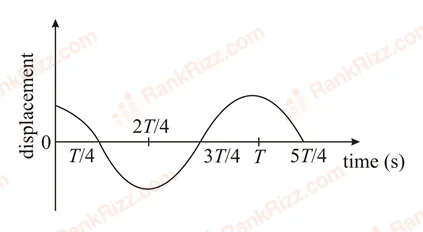
The displacement time graph of a particle executing SHM is given in figure: (sketch is schematic and not to scale)
Which of the following statements is/are true for this motion? (A) The force is zero at t=43T (B) The magnitude of acceleration is maximum at t=T (C) The speed is maximum at t=4T (D) The P.E. is equal to K.E. of the oscillation at t=2T
JEE MAIN 2020 · 03 SEP S2Spring-block oscillationsTRANSCRIBED
A block of mass m attached to a massless spring is performing oscillatory motion of amplitude 'A' on a frictionless horizontal plane. If half of the mass of the block breaks off when it is passing through its equilibrium point, the amplitude of oscillation for the remaining system become fA. The value of f is:
JEE MAIN 2020 · 06 SEP S2Spring-block oscillationsTRANSCRIBED
When a particle of mass m is attached to a vertical spring of spring constant k and released, its motion is described by y(t)=y0sin2ωt, where 'y' is measured from the lower end of unstretched spring. Then ω is:
JEE MAIN 2019 · 11 JAN S2Simple, compound and torsional pendulumsTRANSCRIBED
The mass and the diameter of a planet are three times the respective values for the Earth. The period of oscillation of a simple pendulum on the Earth is 2 s. The period of oscillation of the same pendulum on the planet would be:
JEE MAIN 2019 · 10 APR S1Damped and forced oscillations and resonanceTRANSCRIBED
The displacement of a damped harmonic oscillator is given by x(t)=e−0.1tcos(10πt+φ). Here t is in seconds. The time taken for its amplitude of vibration to drop to half of its initial value is close to:
JEE MAIN 2019 · 09 JAN S2Energy in simple harmonic motionTRANSCRIBED
A particle is executing simple harmonic motion (SHM) of amplitude A, along the x-axis, about x=0. When its potential Energy (PE) equal kinetic energy (KE), the position of the particle will be:
JEE MAIN 2019 · 12 JAN S1Simple, compound and torsional pendulumsTRANSCRIBED
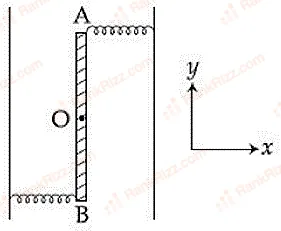
Two light identical springs of spring constant k are attached horizontally at the two ends of a uniform horizontal rod AB of length l and mass m. The rod is pivoted at its center 'O' and can rotate freely in horizontal plane. The other ends of the two springs are fixed to rigid supports as shown in figure. The rod is gently pushed through a small angle and released. The frequency of resulting oscillation is: