JEE MAIN 2019 · 11 JAN S1Energy in simple harmonic motionTRANSCRIBED
A particle undergoing simple harmonic motion has time dependent displacement given by . The ratio of kinetic to potential energy of this particle at s will be
- A
- B
1
- C
2
- D
Every Oscillations question JEE Main has set, grouped by the idea it tests rather than the order of the syllabus. 182 questions across 7 distinct ideas. Free to read, answer key on every one.
Questions
182
Distinct ideas
7
Share of marks
2.8%
Difficulty
MEDIUM
A chapter is not one subject — it is a handful of procedures the examiner reuses. These are the ones Oscillations questions actually test.
121–140 OF 182 · NEWEST FIRST
A particle undergoing simple harmonic motion has time dependent displacement given by . The ratio of kinetic to potential energy of this particle at s will be
1
2
A rod of mass and length is suspended at its middle by a wire. It exhibits torsional oscillations. If two masses, each of mass , are attached at a distance from its centre on both sides, it reduces the oscillation frequency by 20%. The value of ratio is close to:
0.17
0.77
0.57
0.37
A simple harmonic motion is represented by: cm. The amplitude and time period of the motion are:
5 cm, s
10 cm, s
5 cm, s
10 cm, s
A pendulum is executing simple harmonic motion and its maximum kinetic energy is . If the length of the pendulum is doubled and it performs simple harmonic motion with the same amplitude as in the first case, its maximum kinetic energy is
A damped harmonic oscillator has a frequency of 5 oscillations per second. The amplitude drops to half its value for every 10 oscillations. The time it will take to drop to of the original amplitude is close to:
50 s
100 s
20 s
10 s
A simple pendulum oscillating in air has period T. The bob of the pendulum is completely immersed in a non-viscous liquid. The density of the liquid is th of the material of the bob. If the bob is inside liquid all the time, its period of oscillation in this liquid is:
A particle executes simple harmonic motion with an amplitude of 5 cm. When the particle is at 4 cm from the mean position, the magnitude of its velocity in SI units is equal to that of its acceleration. Then, its periodic time in seconds is:
A simple pendulum of length 1 m is oscillating with an angular frequency 10 rad/s. The support of the pendulum starts oscillating up and down with a small angular frequency of 1 rad/s and an amplitude of m. The relative change in the angular frequency of the pendulum is best given by:
rad/s
1 rad/s
rad/s
rad/s
A cylindrical plastic bottle of negligible mass is filled with 310 ml of water and left floating in a pond with still water. If pressed downward slightly and released, it starts performing simple harmonic motion at angular frequency . If the radius of the bottle is 2.5 cm then is close to: (density of water kg/m)
5.00 rad sec
2.50 rad sec
7.9 rad sec
3.75 rad sec
An oscillator of mass M is at rest in its equilibrium position in a potential, . A particle of mass m comes from the right with speed u and collides completely inelastic with M and sticks to it. This process repeats every time the oscillator crosses its equilibrium position. The amplitude of oscillations after 13 collisions is: (M = 10, m = 5, u = 1, k = 1)
A particle executes simple harmonic motion and it is located at x = a, b and c at time t, 2t and 3t respectively. The frequency of the oscillation is:
A silver atom in a solid oscillates in simple harmonic motion in some direction with a frequency of s. What is the force constant of the bonds connecting one atom with the other? (Mole wt. of silver = 108 g mol and Avogadro number = )
5.5 N m
6.4 N m
7.1 N m
2.2 N m
Two simple harmonic motions, as shown, are at right angles. They are combined to form Lissajous figures. , . Identify the correct match below.
Parameters: A = B, a = 2b; ; Curve: Circle
Parameters: A = B, a = b; ; Curve: Line
Parameters: A B, a = b; ; Curve: Ellipse
Parameters: A B, a = b; ; Curve: Parabola
The ratio of maximum acceleration to maximum velocity in a simple harmonic motion is 10 s. At, the displacement is 5 m. What is the maximum acceleration? The initial phase is .
500 m s
m s
750 m s
m s
A block of mass 0.1 kg is connected to an elastic spring of spring constant 640 N m and oscillates in a damping medium of damping constant kg s. The system dissipates its energy gradually. The time taken for its mechanical energy of vibration to drop to half of its initial value, is closest to-
2 s
5 s
3 s
7 s
A particle is executing simple harmonic motion with a time period . At time , it is at its position of equilibrium. The kinetic energy - time graph of the particle will look like:
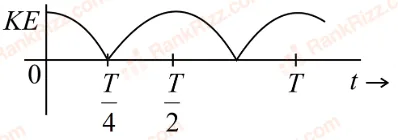
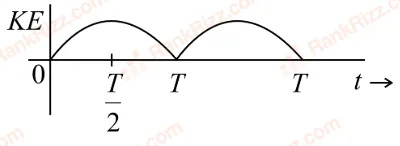
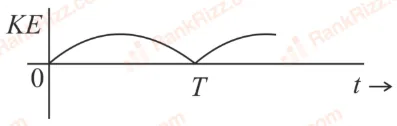
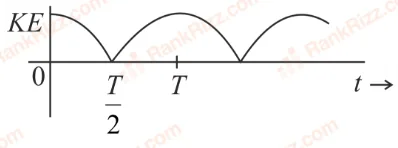
A 1 kg block attached to a spring vibrates with a frequency of 1 Hz on a frictionless horizontal table. Two springs identical to the original spring are attached in parallel to a 8 kg block placed on the same table. So, the frequency of vibration of the 8 kg block is:
2 Hz
Hz
Hz
Hz
In an experiment to determine the period of a simple pendulum of length 1 m, it is attached to different spherical bobs of radii and . The two spherical bobs have uniform mass distribution. If the relative difference in the periods, is found to be s, the difference in radii, is best-given by
0.01 cm
0.05 cm
0.5 cm
1 cm
A particle performs simple harmonic motion with amplitude A. Its speed is tripled at the instant that it is at a distance from equilibrium position. The new amplitude of the motion is:
3A
Two particles are performing simple harmonic motion in a straight line about the same equilibrium point. The amplitude and time period for both particles are same and equal to A and T, respectively. At time one particle has displacement A while the other one has displacement and they are moving towards each other. If they cross each other at time t, then t is:
OTHER PHYSICS CHAPTERS