RankRizzStart free

Rotational Motion — JEE Main Previous Year Questions

Every Rotational Motion question JEE Main has set, grouped by the idea it tests rather than the order of the syllabus. 276 questions across 10 distinct ideas. Free to read, answer key on every one.

Questions

276

Distinct ideas

10

Share of marks

5.6%

Difficulty

MEDIUM

The ideas inside Rotational Motion

A chapter is not one subject — it is a handful of procedures the examiner reuses. These are the ones Rotational Motion questions actually test.

01Moment of inertia of standard bodies and composite systemsset 73×
02Parallel and perpendicular axis theoremsset 10×
03Torque and the rotational form of Newton's second lawset 45×
04Fixed-axis rotation: kinematics, rotational energy and pulleysset 26×
05Equilibrium of rigid bodies and topplingset 4×
06Angular momentum of particles and rigid bodiesset 48×
07Conservation of angular momentumset 15×
08Rolling without slipping: kinematics and energyset 8×
09Rolling with friction, slipping and impulsive forcesset 45×
10Collisions involving rigid bodiesset 2×

Every Rotational Motion question

261–276 OF 276 · NEWEST FIRST

JEE MAIN 2011Conservation of angular momentumTRANSCRIBED

A thin horizontal circular disc is rotating about a vertical axis passing through its centre. An insect is at rest at a point near the rim of the disc. The insect now moves along a diameter of the disc to reach its other end. During the journey of the insect, the angular speed of the disc:

  1. A

    continuously decreases

  2. B

    continuously increases

  3. C

    first increases and then decreases

  4. D

    remains unchanged

JEE MAIN 2011Torque and the rotational form of Newton's second lawTRANSCRIBED

A pulley of radius is rotated about its axis by a force Newton (where is measured in seconds) applied tangentially. If the moment of inertia of the pulley about its axis of rotation is , the number of rotation made by the pulley before its direction of motion if reversed, is :

  1. A

    more than 3 but less than 6

  2. B

    more than 6 but less than 9

  3. C

    more than 9

  4. D

    less than 3

JEE MAIN 2010Angular momentum of particles and rigid bodiesTRANSCRIBED

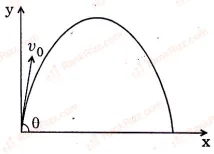
A small particle of mass is projected at an angle with the x-axis with an initial velocity in the plane as shown in the figure. At a time t < \frac{v_0 \sin\theta}{g}, the angular momentum of the particle is where and are unit vectors along x, y and z-axis respectively.

  1. A

  2. B

  3. C

  4. D

JEE MAIN 2009Fixed-axis rotation: kinematics, rotational energy and pulleysTRANSCRIBED

A thin uniform rod of length and mass is swinging freely about a horizontal axis passing through its end. Its maximum angular speed is . Its centre of mass rises to a maximum height of

  1. A

  2. B

  3. C

  4. D

JEE MAIN 2008Parallel and perpendicular axis theoremsTRANSCRIBED

Consider a uniform square plate of side '' and mass ''. The moment of inertia of this plate about an axis perpendicular to its plane and passing through one of its corners is

  1. A

  2. B

  3. C

  4. D

JEE MAIN 2007Parallel and perpendicular axis theoremsTRANSCRIBED

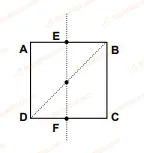
For the given uniform square lamina ABCD, whose centre is O,
  1. A

  2. B

  3. C

  4. D

JEE MAIN 2007Rolling without slipping: kinematics and energyTRANSCRIBED

A round uniform body of radius , mass and moment of inertia , rolls down (without slipping) an inclined plane making an angle with the horizontal. Then its acceleration is

  1. A

  2. B

  3. C

  4. D

JEE MAIN 2007Angular momentum of particles and rigid bodiesTRANSCRIBED

Angular momentum of the particle rotating with a central force is constant due to

  1. A

    Constant Force

  2. B

    Constant linear momentum.

  3. C

    Zero Torque

  4. D

    Constant Torque

JEE MAIN 2006Torque and the rotational form of Newton's second lawTRANSCRIBED

A force of acts on , the origin of the coordinate system. The torque about the point is

  1. A

  2. B

  3. C

  4. D

JEE MAIN 2006Conservation of angular momentumTRANSCRIBED

A thin circular ring of mass and radius is rotating about its axis with a constant angular velocity . Two objects each of mass are attached gently to the opposite ends of a diameter of the ring. The ring now rotates with an angular velocity

  1. A

  2. B

  3. C

  4. D

JEE MAIN 2006Moment of inertia of standard bodies and composite systemsTRANSCRIBED

Four point masses, each of value , are placed at the corners of a square of side . The moment of inertia of system about an axis passing through and parallel to is

  1. A

  2. B

  3. C

  4. D

JEE MAIN 2005Equilibrium of rigid bodies and topplingTRANSCRIBED

and are two like parallel forces. A couple of moment lies in the plane of and and is contained with them. The resultant of and after combining is displaced through a distance

  1. A

  2. B

  3. C

  4. D

JEE MAIN 2005Rolling without slipping: kinematics and energyTRANSCRIBED

An annular ring with inner and outer radii and is rolling without slipping with a uniform angular speed. The ratio of the forces experienced by the two particles situated on the inner and outer parts of the ring, is

  1. A

  2. B

  3. C

  4. D

JEE MAIN 2005Moment of inertia of standard bodies and composite systemsTRANSCRIBED

The moment of inertia of a uniform semicircular disc of mass and radius about a line perpendicular to the plane of the disc through the centre is

  1. A

  2. B

  3. C

  4. D

JEE MAIN 2004Conservation of angular momentumTRANSCRIBED

A solid sphere is rotating in free space. If the radius of the sphere is increased keeping mass same which one of the following will not be affected?

  1. A

    moment of inertia

  2. B

    angular momentum

  3. C

    angular velocity

  4. D

    rotational kinetic energy

JEE MAIN 2004Moment of inertia of standard bodies and composite systemsTRANSCRIBED

One solid sphere A and another hollow sphere B are of same mass and same outer radii. Their moment of inertia about their diameters are respectively and such that

  1. A

  2. B

    I_A > I_B

  3. C

    I_A < I_B

  4. D

    where and are their densities.