A uniform solid cylindrical roller of mass is being pulled on a horizontal surface with force parallel to the surface and applied at its centre. If the acceleration of the cylinder is and it is rolling without slipping then the value of is:
- A
- B
- C
- D
Every Rotational Motion question JEE Main has set, grouped by the idea it tests rather than the order of the syllabus. 276 questions across 10 distinct ideas. Free to read, answer key on every one.
Questions
276
Distinct ideas
10
Share of marks
5.6%
Difficulty
MEDIUM
A chapter is not one subject — it is a handful of procedures the examiner reuses. These are the ones Rotational Motion questions actually test.
241–260 OF 276 · NEWEST FIRST
A uniform solid cylindrical roller of mass is being pulled on a horizontal surface with force parallel to the surface and applied at its centre. If the acceleration of the cylinder is and it is rolling without slipping then the value of is:
A particle of mass 2 kg is on a smooth horizontal table and moves in a circular path of radius 0.6 m. The height of the table from the ground is 0.8 m. If the angular speed of the particle is 12 rad s, the magnitude of its angular momentum about a point on the ground right under the center of the circle is:
14.4 kg m s
11.52 kg m s
20.16 kg m s
8.64 kg m s
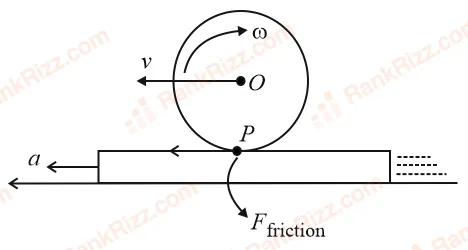
Consider a cylinder of mass M resting on a rough horizontal rug that is pulled out from under it with acceleration 'a' perpendicular to the axis of the cylinder. What is at point P? It is assumed that the cylinder does not slip.

Ma
Mg
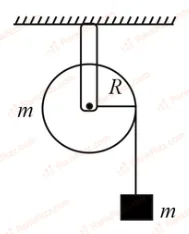
A mass is supported by a massless string wound around a uniform hollow cylinder of mass m and radius R. If the string does not slip on the cylinder, with what acceleration will the mass fall on release?

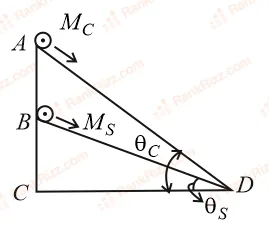
A cylinder of mass M and sphere of mass M are placed at points A and B of two inclines, respectively. (See figure). If they roll on the incline without slipping such that their accelerations are the same, then the ratio is:

A ball of mass 160 g is thrown up at an angle of 60° to the horizontal at a speed of 10 m s. The angular momentum of the ball at the highest point of the trajectory with respect to the point from which the ball is thrown is nearly (g = 10 m s)
1.73 kg m s
3.46 kg m s
3.0 kg m s
6.0 kg m s
A bob of mass m attached to an inextensible string of length is suspended from a vertical support. The bob rotates in a horizontal circle with an angular speed rad/s about the vertical. About the point of suspension:
Angular momentum is conserved
Angular momentum changes in magnitude but not in direction
Angular momentum changes in direction but not in magnitude
Angular momentum changes both in direction and magnitude
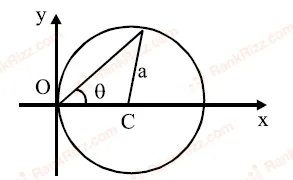
A particle of mass 1 unit is moving in a circular path of radius a, with a constant velocity v as shown in the figure. The centre of circle is marked by 'C'. The angular momentum from the origin O can be written as:

A bullet of mass 10 g and speed 500 m/s is fired into a door and gets embedded exactly at the centre of the door. The door is 1.0 m wide and weighs 12 kg. It is hinged at one end and rotates about a vertical axis practically without friction. The angular speed of the door just after the bullet embeds into it will be :
6.25 rad/sec
0.625 rad/sec
3.35 rad/sec
0.335 rad/sec
A ring of mass M and radius R is rotating about its axis with angular velocity . Two identical bodies each of mass m are now gently attached at the two ends of a diameter of the ring. Because of this, the kinetic energy loss will be :
A hoop of radius r and mass m rotating with an angular velocity is placed on a rough horizontal surface. The initial velocity of the centre of the hoop is zero. What will be the velocity of the centre of the hoop when it ceases to slip?
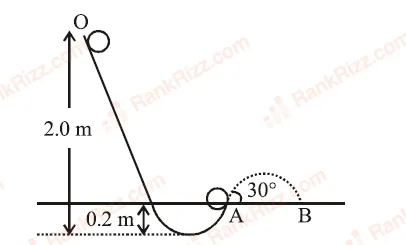
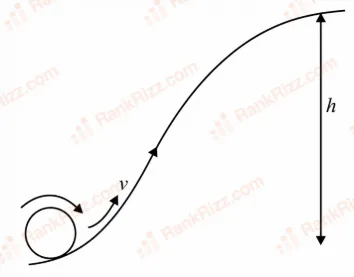
A tennis ball (treated as hollow spherical shell) starting from O rolls down a hill. At point A, the ball becomes air borne leaving at an angle of 30° with the horizontal. The ball strikes the ground at B. What is the value of the distance AB? (Moment of inertia of a spherical shell of mass m and radius R about its diameter = )

1.87 m
2.08 m
1.57 m
1.77 m
A particle of mass 2 kg is moving such that at time t, its position, in meter, is given by . The angular momentum of the particle at about the origin in kgm s is :
A circular hole of diameter is cut from a disc of mass and radius ; the circumference of the cut passes through the centre of the disc. The moment of inertia of the remaining portion of the disc about an axis perpendicular to the disc and passing through its centre is
A solid sphere having mass and radius rolls down an inclined plane. Then its kinetic energy is
rotational and translational
A stone of mass , tied to the end of a string, is whirled around in a circle on a horizontal frictionless table. The length of the string is reduced gradually keeping the angular momentum of the stone about the centre of the circle constant. Then, the tension in the string is given by , where is a constant, is the instantaneous radius of the circle. The value of is equal to
A thick-walled hollow sphere has outside radius . It rolls down an incline without slipping and its speed at the bottom is . Now the incline is waxed, so that it is practically frictionless and the sphere is observed to slide down (without any rolling). Its speed at the bottom is observed to be . The radius of gyration of the hollow sphere about an axis through its centre is
A solid sphere is rolling on a surface as shown in figure, with a translational velocity ms. If it is to climb the inclined surface continuing to roll without slipping, then minimum velocity for this to happen is

This question has Statement 1 and Statement 2. Out of the four choices given after the Statements, choose the one that best describes the two Statements.
Statement 1: When moment of inertia of a body rotating about an axis with angular speed increases, its angular momentum is unchanged but the kinetic energy increases if there is no torque applied on it.
Statement 2: , kinetic energy of rotation
Statement 1 is true, Statement 2 is true, 2 is not the correct explanation of Statement 1.
Statement 1 is false, Statement 2 is true.
Statement 1 is true, Statement 2 is true, 2 is correct explanation of the Statement 1.
Statement 1 is true, Statement 2 is false.
A mass hangs with the help of a string wrapped around a pulley on a frictionless bearing. The pulley has mass and radius . Assuming pulley to be a perfect uniform circular disc, the acceleration of the mass , if the string does not slip on the pulley, is:
OTHER PHYSICS CHAPTERS