RankRizzStart free

Gravitation — JEE Main Previous Year Questions

Every Gravitation question JEE Main has set, grouped by the idea it tests rather than the order of the syllabus. 205 questions across 7 distinct ideas. Free to read, answer key on every one.

Questions

205

Distinct ideas

7

Share of marks

2%

Difficulty

MEDIUM

The ideas inside Gravitation

A chapter is not one subject — it is a handful of procedures the examiner reuses. These are the ones Gravitation questions actually test.

01Newton's law of gravitation and superpositionset 2×
02Acceleration due to gravity and its variationset 56×
03Gravitational field and potential of rings, shells and spheresset 11×
04Gravitational potential energy of systemsset 25×
05Escape speedset 36×
06Satellites: orbital speed, period, energy and geostationary orbitsset 30×
07Kepler's laws and planetary motionset 45×

Every Gravitation question

161–180 OF 205 · NEWEST FIRST

JEE MAIN 2019 · 10 APR S2Kepler's laws and planetary motionTRANSCRIBED

A spaceship orbits around a planet at a height of 20 km from its surface. Assuming that only gravitational field of the planet acts on the spaceship, what will be the number of complete revolutions made by the spaceship in 24 hours around the planet?
[Given: Mass of planet = kg, Radius of planet = m, Gravitational constant G = Nm/kg]

  1. A

    17

  2. B

    9

  3. C

    13

  4. D

    11

JEE MAIN 2019 · 10 JAN S1Satellites: orbital speed, period, energy and geostationary orbitsTRANSCRIBED

A satellite is moving with a constant speed in circular orbit around the earth. An object of mass '' is ejected from the satellite such that it just escapes from the gravitational pull of the earth. At the time of ejection, the kinetic energy of the object is:

  1. A

  2. B

  3. C

  4. D

JEE MAIN 2019 · 09 APR S1Gravitational field and potential of rings, shells and spheresTRANSCRIBED

A solid sphere of mass M and radius a is surrounded by a uniform concentric spherical shell of thickness 2a and mass 2M. The gravitational field at distance 3a from the centre will be:

  1. A

  2. B

  3. C

  4. D

JEE MAIN 2019 · 10 JAN S2Escape speedTRANSCRIBED

Two stars of masses kg each, and at distance m rotate in a plane about their common centre of mass O. A meteorite passes through O moving perpendicular to the star's rotation plane. In order to escape from the gravitational field of this double star, the minimum speed that meteorite should have at O is: (Take Gravitational constant N m kg)

  1. A

    m s

  2. B

    m s

  3. C

    m s

  4. D

    m s

JEE MAIN 2019 · 09 APR S2Escape speedTRANSCRIBED

A test particle is moving in a circular orbit in the gravitational field produced by a mass density . Identify the current relation between the radius R of the particle's orbit and its period T:

  1. A

    TR is a constant

  2. B

    is a constant

  3. C

    T/R is a constant

  4. D

    is a constant

JEE MAIN 2019 · 08 APR S2Satellites: orbital speed, period, energy and geostationary orbitsTRANSCRIBED

A rocket has to be launched from earth in such a way that it never returns. If is the minimum energy delivered by the rocket launcher, what should be the minimum energy that the launcher should have, if the same rocket is to be launched from the surface of the moon? Assume that the density of the earth and the moon are equal and that the earth's volume is 64 times the volume of the moon.

  1. A

  2. B

  3. C

  4. D

JEE MAIN 2019 · 12 JAN S2Satellites: orbital speed, period, energy and geostationary orbitsTRANSCRIBED

Two satellites, A and B, have masses m and 2m respectively. A is in a circular orbit of radius R and B is in a circular orbit of radius 2R around the earth. The ratio of their kinetic energies, is:

  1. A

    2

  2. B

  3. C

    1

  4. D

JEE MAIN 2018 · 16 APR ONLINEAcceleration due to gravity and its variationTRANSCRIBED

Suppose that the angular velocity of rotation of the Earth is increased. Then, as a consequence:

  1. A

    weight of the object, everywhere on the earth, will decrease.

  2. B

    weight of the object, everywhere on the earth, will increase.

  3. C

    except at poles, weight of the object on the earth, will decrease.

  4. D

    there will be no change in weight anywhere on the earth.

JEE MAIN 2018 · 15 APR S1Kepler's laws and planetary motionTRANSCRIBED

A body of mass m is moving in a circular orbit of radius R about a planet of mass M. At some instant, it splits into two equal masses. The first mass moves in a circular orbit of radius , and the other mass, in a circular orbit of radius . The difference between the final and initial total energies is:

  1. A

  2. B

  3. C

  4. D

JEE MAIN 2018 · 15 APR S1Kepler's laws and planetary motionTRANSCRIBED

Take the mean distance of the moon and the sun from the earth to be km and km respectively. Their masses are kg and kg respectively. The radius of the earth is 6400 km. Let be the difference in the forces exerted by the moon at the nearest and farthest points on the earth and be the difference in the force exerted by the sun at the nearest and farthest points on the earth. Then, the number closest to is:

  1. A

    2

  2. B

    6

  3. C

  4. D

    0.6

JEE MAIN 2018 · 08 APR OFFLINEKepler's laws and planetary motionTRANSCRIBED

A particle is moving with a uniform speed in a circular orbit of radius R in a central force inversely proportional to the power of R. If the period of rotation of the particle is T, then:

  1. A

  2. B

    for any n

  3. C

  4. D

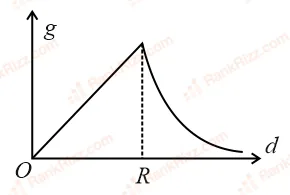
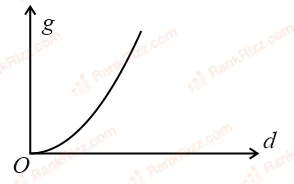
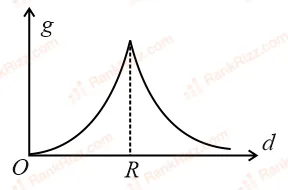
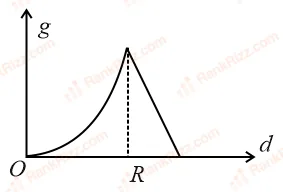
JEE MAIN 2017 · 02 APR OFFLINEAcceleration due to gravity and its variationTRANSCRIBED

The variation of acceleration due to gravity with distance from the centre of the earth is best represented by ( = Earth's radius):

  1. A
  2. B
  3. C
  4. D
JEE MAIN 2017 · 08 APR ONLINEAcceleration due to gravity and its variationTRANSCRIBED

If the Earth has no rotational motion, the weight of a person on the equator is . Determine the speed with which the earth would have to rotate about its axis so that the person at the equator will weigh . The radius of the Earth is 6400 km and m s.

  1. A

    rad s

  2. B

    rad s

  3. C

    rad s

  4. D

    rad s

JEE MAIN 2017 · 09 APR ONLINEGravitational field and potential of rings, shells and spheresTRANSCRIBED

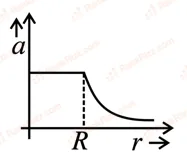
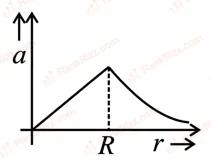
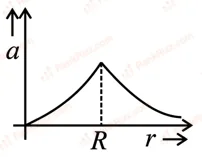
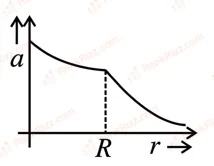
The mass density of a spherical body is given by for and for r > R, where is the distance from the center. The correct graph that describes qualitatively the acceleration, of a test particle as a function of is:

  1. A
    image
  2. B
    image
  3. C
    image
  4. D
    image
JEE MAIN 2016 · 03 APR OFFLINEEscape speedTRANSCRIBED

A satellite is revolving in a circular orbit at a height from the earth's surface (radius of earth ; h << R). The minimum increase in its orbital velocity required, so that the satellite could escape from the earth's gravitational field, is close to (Neglect the effect of atmosphere.)

  1. A

  2. B

  3. C

  4. D

JEE MAIN 2016 · 09 APR ONLINEKepler's laws and planetary motionTRANSCRIBED

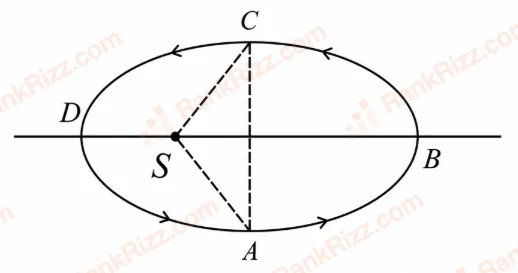
The figure shows an elliptical path of a planet around the sun such that the area of triangle is the area of the ellipse (see the figure below) with as the major axis, and as the minor axis. If is the time taken for the planet to go over the path and for the path taken over then:

image
  1. A

  2. B

  3. C

  4. D

JEE MAIN 2016 · 10 APR ONLINEKepler's laws and planetary motionTRANSCRIBED

An astronaut of mass is working on a satellite orbiting the earth at a distance from the earth's surface. The radius of the earth is , while its mass is . The gravitational pull on the astronaut is

  1. A

    Zero since astronaut feels weightless

  2. B

    \frac{GMm}{(R+h)^2} < F_G < \frac{GMm}{R^2}

  3. C

  4. D

    0 < F_G < \frac{GMm}{R^2}

JEE MAIN 2015 · 04 APR OFFLINEGravitational potential energy of systemsTRANSCRIBED

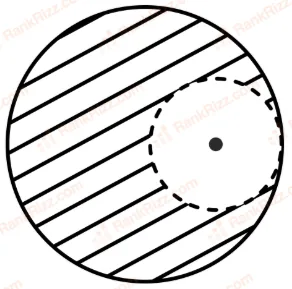
From a solid sphere of mass and radius , a spherical portion of radius is removed as shown in the figure. Taking gravitational potential at , the potential at the centre of the cavity thus formed is ( = gravitational constant)

image
  1. A

  2. B

  3. C

  4. D

JEE MAIN 2015 · 10 APR ONLINEGravitational field and potential of rings, shells and spheresTRANSCRIBED

A very long (length ) cylindrical galaxy is made of uniformly distributed mass and has radius (R << L). A star outside the galaxy is orbiting the galaxy in a plane perpendicular to the galaxy and passing through its centre. If the time period of the star is and its distance from the galaxy's axis is , then

  1. A

  2. B

  3. C

  4. D

JEE MAIN 2015 · 11 APR ONLINEGravitational potential energy of systemsTRANSCRIBED

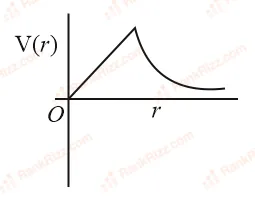
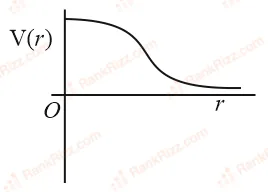
Which of the following most closely depicts the correct variation of the gravitation potential, with distance due to a large planet of radius and uniform mass density? (figures are not drawn to scale)

  1. A
  2. B
  3. C
  4. D