RankRizzStart free

Gravitation — JEE Main Previous Year Questions

Every Gravitation question JEE Main has set, grouped by the idea it tests rather than the order of the syllabus. 205 questions across 7 distinct ideas. Free to read, answer key on every one.

Questions

205

Distinct ideas

7

Share of marks

2%

Difficulty

MEDIUM

The ideas inside Gravitation

A chapter is not one subject — it is a handful of procedures the examiner reuses. These are the ones Gravitation questions actually test.

01Newton's law of gravitation and superpositionset 2×
02Acceleration due to gravity and its variationset 56×
03Gravitational field and potential of rings, shells and spheresset 11×
04Gravitational potential energy of systemsset 25×
05Escape speedset 36×
06Satellites: orbital speed, period, energy and geostationary orbitsset 30×
07Kepler's laws and planetary motionset 45×

Every Gravitation question

101–120 OF 205 · NEWEST FIRST

JEE MAIN 2022 · 25 JUL S2Acceleration due to gravity and its variationTRANSCRIBED

An object is taken to a height above the surface of earth at a distance from the centre of the earth. Where radius of earth, . The percentage decrease in the weight of the object will be

  1. A

  2. B

  3. C

  4. D

JEE MAIN 2022 · 29 JUL S2Gravitational potential energy of systemsTRANSCRIBED

An object of mass 1 kg is taken to a height from the surface of earth which is equal to three times the radius of earth. The gain in potential energy of the object will be [If, m s and radius of earth = 6400 km]

  1. A

    48 MJ

  2. B

    24 MJ

  3. C

    36 MJ

  4. D

    12 MJ

JEE MAIN 2022 · 29 JUN S1Satellites: orbital speed, period, energy and geostationary orbitsTRANSCRIBED

The escape velocity of a body on a planet is 12 km s. The escape velocity of the body on another planet , whose density is four times and radius is half of the planet , is

  1. A

    12 km s

  2. B

    24 km s

  3. C

    36 km s

  4. D

    6 km s

JEE MAIN 2022 · 29 JUL S1Acceleration due to gravity and its variationTRANSCRIBED

If the acceleration due to gravity experienced by a point mass at a height h above the surface of earth is same as that of the acceleration due to gravity at a depth () from the earth surface. The value of will be _____. (use km)

JEE MAIN 2022 · 25 JUN S2Satellites: orbital speed, period, energy and geostationary orbitsTRANSCRIBED

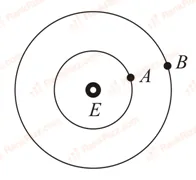
Two satellites and are revolving in circular orbits around a planet with radius km and km respectively. The ratio of speed of satellite to the speed of satellite in their respective orbits would be where ______.

JEE MAIN 2021 · 18 MAR S2Acceleration due to gravity and its variationTRANSCRIBED

If the angular velocity of earth's spin is increased such that the bodies at the equator start floating, the duration of the day would be approximately :
(Take : ms, the radius of earth, m, Take )

  1. A

    60 minutes

  2. B

    does not change

  3. C

    1200 minutes

  4. D

    84 minutes

JEE MAIN 2021 · 24 FEB S1Satellites: orbital speed, period, energy and geostationary orbitsTRANSCRIBED

Consider two satellites and with periods of revolution 1hr and 8hr respectively revolving around a planet in circular orbits. The ratio of angular velocity of satellite to the angular velocity of satellite is:

  1. A

    8 : 1

  2. B

    2 : 1

  3. C

    1 : 4

  4. D

    1 : 8

JEE MAIN 2021 · 16 MAR S1Kepler's laws and planetary motionTRANSCRIBED

The maximum and minimum distances of a comet from the Sun are m and m respectively. If the speed of the comet at the nearest point is m s, the speed at the farthest point is:

  1. A

    m s

  2. B

    m s

  3. C

    m s

  4. D

    m s

JEE MAIN 2021 · 24 FEB S2Acceleration due to gravity and its variationTRANSCRIBED

A body weighs 49 N on a spring balance at the north pole. What will be its weight recorded on the same weighing machine, if it is shifted to the equator?
[Use m s and radius of earth, km.]

  1. A

    49.17 N

  2. B

    48.83 N

  3. C

    49.83 N

  4. D

    49 N

JEE MAIN 2021 · 25 FEB S1Kepler's laws and planetary motionTRANSCRIBED

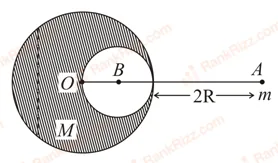
A solid sphere of radius gravitationally attracts a particle placed at from its centre with a force . Now a spherical cavity of radius is made in the sphere (as shown in figure) and the force becomes . The value of is:

  1. A

    41 : 50

  2. B

    50 : 41

  3. C

    25 : 36

  4. D

    36 : 25

JEE MAIN 2021 · 26 AUG S1Gravitational potential energy of systemsTRANSCRIBED

Inside a uniform spherical shell:
(a) The gravitational field is zero.
(b) The gravitational potential is zero.
(c) The gravitational field is the same everywhere.
(d) The gravitation potential is the same everywhere.
(e) All the above.
Choose the most appropriate answer from the options given below:

  1. A

    (a), (c) and (d) only

  2. B

    (a), (b) and (c) only

  3. C

    (b), (c) and (d) only

  4. D

    (e) only

JEE MAIN 2021 · 24 FEB S1Kepler's laws and planetary motionTRANSCRIBED

Four identical particles of equal mass of 1 kg are made to move along the circumference of a circle of radius 1 m under the action of their own mutual gravitational attraction. The speed of each particle will be:

  1. A

  2. B

  3. C

  4. D

JEE MAIN 2021 · 20 JUL S1Acceleration due to gravity and its variationTRANSCRIBED

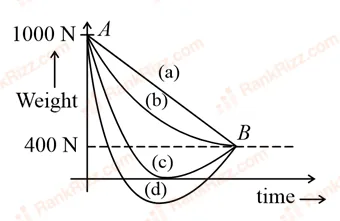
A person whose mass is 100 kg travels from Earth to Mars in a spaceship. Neglect all other objects in sky and take acceleration due to gravity on the surface of the Earth and Mars as 10 m s and 4 m s, respectively. Identify from the below figures, the curve that fits best for the weight of the passenger as a function of time.

  1. A

    (c)

  2. B

    (a)

  3. C

    (d)

  4. D

    (b)

JEE MAIN 2021 · 25 FEB S1Satellites: orbital speed, period, energy and geostationary orbitsTRANSCRIBED

Two satellites and of masses 200 kg and 400 kg are revolving round the earth at height of 600 km and 1600 km respectively. If and are the time periods of and respectively then the value of :


[Given: radius of earth = 6400 km, mass of earth = kg]

  1. A

    s

  2. B

    s

  3. C

    s

  4. D

    s

JEE MAIN 2021 · 17 MAR S2Satellites: orbital speed, period, energy and geostationary orbitsTRANSCRIBED

A geostationary satellite is orbiting around an arbitrary planet at a height of above the surface of , being the radius of . The time period of another satellite in hours at a height of from the surface of is ________. has the time period of 24 hours.

  1. A

  2. B

  3. C

    3

  4. D

    5

JEE MAIN 2021 · 25 JUL S1Kepler's laws and planetary motionTRANSCRIBED

The minimum and maximum distances of a planet revolving around the Sun are and . If the minimum speed of the planet on its trajectory is , then its maximum speed will be:

  1. A

  2. B

  3. C

  4. D

JEE MAIN 2021 · 24 FEB S1Kepler's laws and planetary motionTRANSCRIBED

Two stars of masses and at a distance rotate about their common centre of mass in free space. The period of revolution is:

  1. A

  2. B

  3. C

  4. D

JEE MAIN 2021 · 25 FEB S1Escape speedTRANSCRIBED

Given below are two statements: one is labelled as Assertion A and the other is labelled as Reason R.
Assertion A: The escape velocities of planet A and B are same. But A and B are of unequal mass.
Reason R: The product of their mass and radius must be same.
In the light of the above statements, choose the most appropriate answer from the options given below:

  1. A

    Both A and R are correct and R is the correct explanation of A

  2. B

    Both A and R are correct but R is NOT the correct explanation of A

  3. C

    A is not correct but R is correct

  4. D

    A is correct but R is not correct

JEE MAIN 2021 · 31 AUG S1Escape speedTRANSCRIBED

The masses and radii of the earth and moon are and respectively. Their centres are at a distance apart. Find the minimum escape velocity for a particle of mass to be projected from the middle of these two masses:

  1. A

  2. B

  3. C

  4. D

JEE MAIN 2021 · 27 JUL S2Kepler's laws and planetary motionTRANSCRIBED

Two identical particles of mass 1 kg each go round a circle of radius , under the action of their mutual gravitational attraction. The angular speed of each particle is:

  1. A

  2. B

  3. C

  4. D