JEE MAIN 2024 · 09 APR S2Photoelectric effect and Einstein's equationTRANSCRIBED
UV light of is incident on a photosensitive metal surface having work function . The maximum kinetic energy of ejected photoelectrons will be:
- A
- B
- C
- D
Every Dual Nature of Radiation & Matter question JEE Main has set, grouped by the idea it tests rather than the order of the syllabus. 216 questions across 4 distinct ideas. Free to read, answer key on every one.
Questions
216
Distinct ideas
4
Share of marks
3.4%
Difficulty
MEDIUM
A chapter is not one subject — it is a handful of procedures the examiner reuses. These are the ones Dual Nature of Radiation & Matter questions actually test.
41–60 OF 216 · NEWEST FIRST
UV light of is incident on a photosensitive metal surface having work function . The maximum kinetic energy of ejected photoelectrons will be:
For the photoelectric effect, the maximum kinetic energy of the photoelectrons is plotted against the frequency of the incident photons as shown in figure. The slope of the graph give
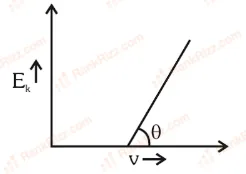
Ratio of Planck's constant to electric charge
Work function of the metal
Charge of electron
Planck's constant
In photoelectric experiment energy of irradiates a photo sensitive material. The stopping potential was measured to be . Work function of the photo sensitive material is :
A proton and an electron are associated with same de-Broglie wavelength. The ratio of their kinetic energies is: (Assume , and )
A proton and an electron have the same de Broglie wavelength. If and be the kinetic energies of proton and electron respectively, then choose the correct relation :
K_p > K_e
K_p < K_e
The de Broglie wavelengths of a proton and an particle are and respectively. The ratio of the velocities of proton and particle will be :
The threshold frequency of a metal with work function 6.63 eV is :
Hz
Hz
Hz
Hz
In a photoelectric effect experiment a light of frequency 1.5 times the threshold frequency is made to fall on the surface of photosensitive material. Now if the frequency is halved and intensity is doubled, the number of photo electrons emitted will be:
Doubled
Quadrupled
Zero
Halved
Given below are two statements: one is labelled as Assertion A and the other is labelled as Reason R. Assertion A: Number of photons increases with increase in frequency of light. Reason R: Maximum kinetic energy of emitted electrons increases with the frequency of incident radiation. In the light of the above statements, choose the most appropriate answer from the options given below:
Both A and R are correct and R is the correct explanation of A.
Both A and R are correct and R is NOT the correct explanation of A.
A is not correct but R is correct.
A is correct but R is not correct.
Which of the following statement is not true about stopping potential ?
It is times the maximum kinetic energy of electrons emitted.
It increases with increase in intensity of the incident light.
It depends on the nature of emitter material.
It depends upon frequency of the incident light.
Which of the following phenomena does not explain by wave nature of light. A. reflection B. diffraction C. photoelectric effect D. interference E. polarization. Choose the most appropriate answer from the options given below:
E only
B, D only
C only
A, C only
When UV light of wavelength is incident on the metal surface having work function , electron emission takes place. The stopping potential is: (Given )
A proton, an electron and an alpha particle have the same energies. Their de-Broglie wavelengths will be compared as :
\lambda_\alpha < \lambda_p < \lambda_e
\lambda_e > \lambda_\alpha > \lambda_p
\lambda_p > \lambda_e > \lambda_\alpha
\lambda_p < \lambda_e < \lambda_\alpha
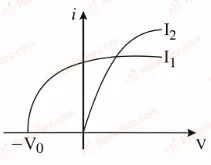
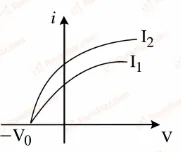
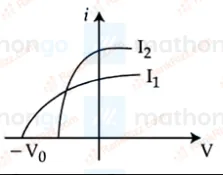
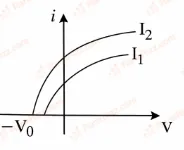
Which figure shows the correct variation of applied potential difference (V) with photoelectric current (I) at two different intensities of light (I_1 < I_2) of same wavelengths:
Monochromatic light of frequency Hz is produced by a laser. The power emitted is W. How many photons per second on an average, are emitted by the source? (Given J s)
The de-Broglie wavelength of an electron is the same as that of a photon. If velocity of electron is of the velocity of light, then the ratio of K.E. of electron and K.E. of photon will be:
Two sources of light emit with a power of W. The ratio of number of photons of visible light emitted by each source having wavelengths nm and nm respectively, will be:
The work function of a substance is . The longest wavelength of light that can cause the emission of photoelectrons from this substance is approximately:
When a metal surface is illuminated by light of wavelength , the stopping potential is V. When the same surface is illuminated by light of wavelength , stopping potential is V. The threshold wavelength for this surface is :
Given below are two statements :
Statement I :
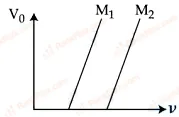
Figure shows the variation of stopping potential with frequency for the two photosensitive materials and . The slope gives value of , where is Planck's constant, is the charge of electron.
Statement II : will emit photoelectrons of greater kinetic energy for the incident radiation having same frequency.
In the light of the above statements, choose the most appropriate answer from the options given below.
Both Statement I and Statement II are correct
Statement I is incorrect but Statement II is correct
Both Statement I and Statement II are incorrect
Statement I is correct and Statement II is incorrect
OTHER PHYSICS CHAPTERS