RankRizzStart free

Dual Nature of Radiation & Matter — JEE Main Previous Year Questions

Every Dual Nature of Radiation & Matter question JEE Main has set, grouped by the idea it tests rather than the order of the syllabus. 216 questions across 4 distinct ideas. Free to read, answer key on every one.

Questions

216

Distinct ideas

4

Share of marks

3.4%

Difficulty

MEDIUM

The ideas inside Dual Nature of Radiation & Matter

A chapter is not one subject — it is a handful of procedures the examiner reuses. These are the ones Dual Nature of Radiation & Matter questions actually test.

01Photons: energy, momentum and radiation pressureset 29×
02Photoelectric effect and Einstein's equationset 98×
03de Broglie wavelength of matter wavesset 82×
04Davisson-Germer experimentset 7×

Every Dual Nature of Radiation & Matter question

181–200 OF 216 · NEWEST FIRST

JEE MAIN 2017 · 08 APR ONLINEPhotoelectric effect and Einstein's equationTRANSCRIBED

The maximum velocity of the photoelectrons emitted from the surface is when light of frequency falls on a metal surface. If the incident frequency is increased to , the maximum velocity of the ejected photoelectrons will be:

  1. A

    more than

  2. B

    equal to

  3. C

  4. D

    less than

JEE MAIN 2017 · 02 APR OFFLINEde Broglie wavelength of matter wavesTRANSCRIBED

A particle of mass and initial velocity collides with a particle of mass which is at rest. The collision is head on, and elastic. The ratio of the de-Broglie wavelengths to after the collision is:

  1. A

  2. B

  3. C

  4. D

JEE MAIN 2017 · 09 APR ONLINEPhotons: energy, momentum and radiation pressureTRANSCRIBED

A laser light of wavelength 660 nm is used to weld Retina detachment. If a laser pulse of width 60 ms and power 0.5 kW is used, the approximate number of photons in the pulse are (Take Planck's Constant, J s)

  1. A

  2. B

  3. C

  4. D

JEE MAIN 2016 · 03 APR OFFLINEPhotoelectric effect and Einstein's equationTRANSCRIBED

Radiation of wavelength is incident on a photocell. The fastest emitted photoelectron has a speed v. If the wavelength is changed to , the speed of the fastest emitted photoelectron will be:

  1. A

  2. B

  3. C

    > v\left(\frac{4}{3}\right)^{1/2}

  4. D

    < v\left(\frac{4}{3}\right)^{1/2}

JEE MAIN 2016 · 09 APR ONLINEPhotoelectric effect and Einstein's equationTRANSCRIBED

When photons of wavelength are incident on an isolated sphere, the corresponding stopping potential is found to be . When photons of wavelength are used, the corresponding stopping potential was thrice that of the above value. If light of wavelength is used then find the stopping potential for this case:

  1. A

  2. B

  3. C

  4. D

JEE MAIN 2016 · 10 APR ONLINEPhotoelectric effect and Einstein's equationTRANSCRIBED

A photoelectric surface is illuminated successively by monochromatic light of wavelengths and . If the maximum kinetic energy of the emitted photoelectrons in the second case is 3 times that in the first case, the work function of the surface is:

  1. A

  2. B

  3. C

  4. D

JEE MAIN 2015 · 10 APR ONLINEde Broglie wavelength of matter wavesTRANSCRIBED

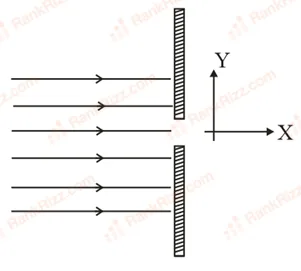
A parallel beam of electrons travelling in x - direction falls on a slit of width d (see the figure below). If after passing the slit, an electron acquires momentum in the y - direction, then for a majority of electrons passing through the slit (h is Planck's constant):

  1. A

    |p_y|d < h

  2. B

    |p_y|d > h

  3. C

  4. D

    |p_y|d >> h

JEE MAIN 2015 · 10 APR ONLINEde Broglie wavelength of matter wavesTRANSCRIBED

De-Broglie wavelength of an electron accelerated by a voltage of 50 V is close to C, kg, J s

  1. A

    0.5

  2. B

    1.2

  3. C

    1.7 

  4. D

    2.4

JEE MAIN 2015 · 04 APR OFFLINEDavisson-Germer experimentTRANSCRIBED

Match list-I (Fundamental Experiment) with List-II (its conclusion) and select the correct option from the choices given below the list:

List-I                                                 List-II
A. Franck-Hertz Experiment            (i) Particle nature of light
B. Photo-electric experiment          (ii) Discrete energy levels of the atom
C. Davison-Germer Experiment       (iii) Wave nature of electron
                                                             (iv) Structure of atom

  1. A

    A - (iv); B - (iii); C - (ii)

  2. B

    A - (i); B - (iv); C - (iii)

  3. C

    A - (ii); B - (iv); C - (iii)

  4. D

    A - (ii); B - (i); C - (iii)

JEE MAIN 2014 · 09 APR ONLINEde Broglie wavelength of matter wavesTRANSCRIBED

For which of the following particles will it be most difficult to experimentally verify the de-Broglie relationship?

  1. A

    An electron

  2. B

    An -particle

  3. C

    A dust particle

  4. D

    A proton

JEE MAIN 2014 · 19 APR ONLINEde Broglie wavelength of matter wavesTRANSCRIBED

Match List-I (Experiment performed) with List-II (Phenomena discovered/associated) and select the correct option from the options given below the lists.

List-I:                                                                  List-II:
(a) Davisson and Germer experiment                    (i) Wave nature of electrons
(b) Millikan's oil drop experiment                         (ii) Charge of an electron
(c) Rutherford experiment                                   (iii) Quantisation of energy levels
(d) Franck-Hertz experiment                               (iv) Existence of the nucleus

  1. A

    (a)-(iii), (b)-(iv), (c)-(i), (d)-(ii)

  2. B

    (a)-(i), (b)-(ii), (c)-(iv), (d)-(iii)

  3. C

    (a)-(iv), (b)-(iii), (c)-(ii), (d)-(i)

  4. D

    (a)-(i), (b)-(ii), (c)-(iii), (d)-(iv)

JEE MAIN 2014 · 11 APR ONLINEPhotons: energy, momentum and radiation pressureTRANSCRIBED

A photon of wavelength is scattered from an electron, which was at rest. The wavelength shift is three times of and the angle of scattering is 60°. The angle at which the electron recoiled is . The value of is: (electron speed is much smaller than the speed of light)

  1. A

    0.16

  2. B

    0.22

  3. C

    0.25

  4. D

    0.28

JEE MAIN 2014 · 12 APR ONLINEPhotoelectric effect and Einstein's equationTRANSCRIBED

A beam of light has two wavelengths of 4972 and 6216 with a total intensity of Wm equally distributed among the two wavelengths. The beam falls normally on an area of 1 cm of a clean metallic surface of work function 2.3 eV. Assume that there is no loss of light by reflection and that each capable photon ejects one electron. The number of photoelectrons liberated in 2 s is approximately:

  1. A

  2. B

  3. C

  4. D

JEE MAIN 2013 · 23 APR ONLINEde Broglie wavelength of matter wavesTRANSCRIBED

Electrons are accelerated through a potential difference V and protons are accelerated through a potential difference 4 V. The de-Broglie wavelengths are and for electrons and protons respectively. The ratio of is given by: (given is mass of electron and is mass of proton).

  1. A

  2. B

  3. C

  4. D

JEE MAIN 2013 · 25 APR ONLINEPhotoelectric effect and Einstein's equationTRANSCRIBED

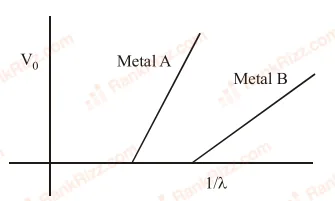
In an experiment on photoelectric effect, a student plots stopping potential against reciprocal of the wavelength of the incident light for two different metals A and B. These are shown in the figure.

Looking at the graphs, you can most appropriately say that:

  1. A

    Work function of metal B is greater than that of metal A

  2. B

    For light of certain wavelength falling on both metal, maximum kinetic energy of electrons emitted from A will be greater than those emitted from B.

  3. C

    Work function of metal A is greater than that of metal B

  4. D

    Students data is not correct

JEE MAIN 2013 · 07 APR ONLINEPhotoelectric effect and Einstein's equationTRANSCRIBED

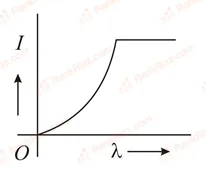
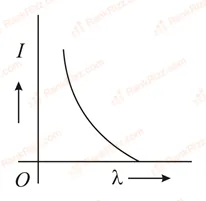
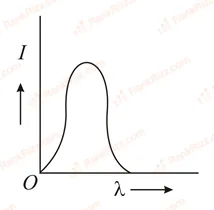
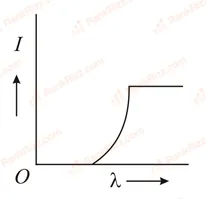
The anode voltage of a photocell is kept fixed. The wavelength of the light falling on the cathode is gradually changed. The plate current I of the photocell varies as follows :

  1. A
  2. B
  3. C
  4. D
JEE MAIN 2013 · 25 APR ONLINEPhotoelectric effect and Einstein's equationTRANSCRIBED

A copper ball of radius 1 cm and work function 4.47 eV is irradiated with ultraviolet radiation of wavelength 2500 . The effect of irradiation results in the emission of electrons from the ball. Further the ball will acquire charge and due to this there will be a finite value of the potential on the ball. The charge acquired by the ball is :

  1. A

    C

  2. B

    C

  3. C

    C

  4. D

    C

JEE MAIN 2013 · 22 APR ONLINEde Broglie wavelength of matter wavesTRANSCRIBED

Orbits of a particle moving in a circle are such that the perimeter of the orbit equals an integer number of de-Broglie wavelengths of the particle. For a charged particle moving in a plane perpendicular to a magnetic field, the radius of the orbital will therefore be proportional to :

  1. A

  2. B

  3. C

  4. D

JEE MAIN 2012Davisson-Germer experimentTRANSCRIBED

This question has statement 1 and statement 2. Of the four choices given after the statements, choose the one that best describes the two statements. Statement 1: Davisson-Germer experiment established the wave nature of electrons. Statement 2: If electrons have wave nature, they can interfere and show diffraction.

  1. A

    Statement 1 is false, Statement 2 is true

  2. B

    Statement 1 is true, Statement 2 is false

  3. C

    Statement 1 is true, Statement 2 is the correct explanation for statement 1

  4. D

    Statement 1 is true, Statement 2 is true, Statement 2 is not the correct explanation for statement 1.

JEE MAIN 2012Photoelectric effect and Einstein's equationTRANSCRIBED

Photoelectrons are ejected from a metal when light of frequency falls on it. Pick out the wrong statement from the following.

  1. A

    No electrons are emitted if is less than , where is the work function of the metal

  2. B

    The ejection of the photoelectrons is instantaneous.

  3. C

    The maximum energy of the photoelectrons is .

  4. D

    The maximum energy of the photoelectrons is independent of the intensity of the light.