JEE MAIN 2018 · 16 APR ONLINERC circuits: charging and dischargingTRANSCRIBED
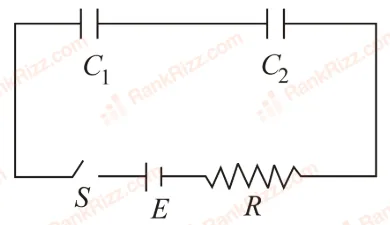
In the following circuit the switch S is closed at t = 0. The charge on the capacitor C as a function of time will be given by :
- A
- B
- C
- D
Every Capacitance question JEE Main has set, grouped by the idea it tests rather than the order of the syllabus. 174 questions across 7 distinct ideas. Free to read, answer key on every one.
Questions
174
Distinct ideas
7
Share of marks
2.8%
Difficulty
MEDIUM
A chapter is not one subject — it is a handful of procedures the examiner reuses. These are the ones Capacitance questions actually test.
141–160 OF 174 · NEWEST FIRST
In the following circuit the switch S is closed at t = 0. The charge on the capacitor C as a function of time will be given by :
A parallel plate capacitor with area 200 cm and separation between the plates 1.5 cm, is connected across a battery of emf V. If the force of attraction between the plates is N, the value of V is approximately:
150 V
100 V
250 V
300 V
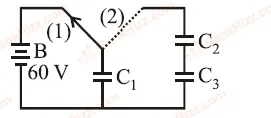
A capacitor C is charged up to a voltage V = 60 V by connecting it to battery B through switch (1). Now C is disconnected from battery and connected to a circuit consisting of two uncharged capacitors C = 3.0F and C = 6.0F through a switch (2) as shown in the figure. The sum of final charges on C and C is:
36C
20C
54C
40C
A capacitance of 2 μF is required in an electrical circuit across a potential difference of 1.0 kV. A large number of 1 μF capacitors are available which can withstand a potential difference of not more than 300 V. The minimum number of capacitors required to achieve this is:
32
2
16
24
The energy stored in the electric field produced by a metal sphere is 4.5 J. If the sphere contains 4 C charge, its radius will be:
32 mm
16 mm
28 mm
20 mm
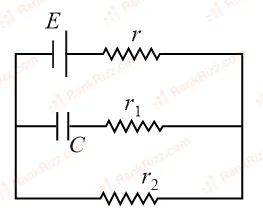
In the given circuit diagram, when the current reaches a steady-state in the circuit, the charge on the capacitor of capacitance will be:
A combination of parallel plate capacitors is maintained at a certain potential difference.
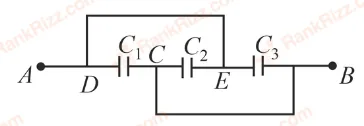
When a 3 mm thick slab is introduced between all the plates, in order to maintain the same potential difference, the distance between the plates is increased by 2.4 mm. Find the dielectric constant of the slab.
6
4
3
5
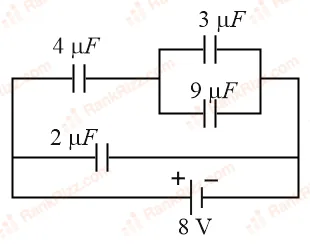
A combination of capacitors is set up as shown in the figure. The magnitude of the electric field, due to a point charge Q (having a charge equal to the sum of the charges on the 4 F and 9 F capacitors), at a point distant 30 m from it, would equal:
420 N/C
480 N/C
240 N/C
360 N/C
Three capacitors each of 4 F are to be connected in such a way that the effective capacitance is 6 F. This can be done by connecting them
all in series
all in parallel
two in parallel and one in series
two in series and one in parallel
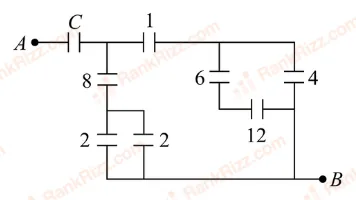
The figure shows a network of capacitors where the number indicates capacitances in micro Farad. The value of capacitance C if the equivalent capacitance between point A and B is to be 1 is:
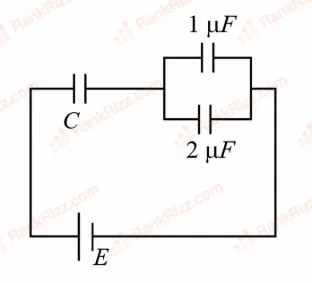
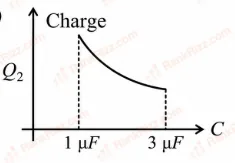
In the given circuit, charge on the 2 F capacitor changes as C is varied from 1 F to 3 F. as a function of 'C' is given properly by: (figures are drawn schematically and are not to scale)
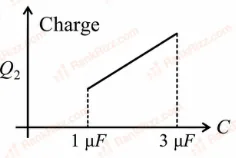
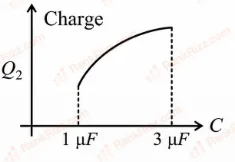
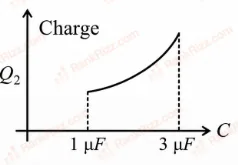
In the figure is shown a system of four capacitors connected across a 10 V battery. The charge that will flow from switch S when it is closed is:
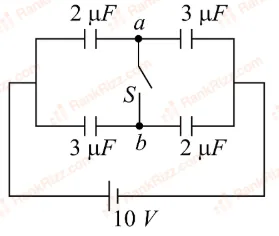
Zero
20 C from a to b
5 C from b to a
5 C from a to b
A parallel plate capacitor is made of two circular plates separated by a distance of 5 mm and with a dielectric of dielectric constant 2.2 between them. When the electric field in the dielectric is V/m, the charge density of the positive plate will be close to:
C/m
C/m
C/m
C/m
Three capacitances, each of 3 F, are provided. These cannot be combined to provide the resultant capacitance of:
2 F
6 F
4.5 F
1 F
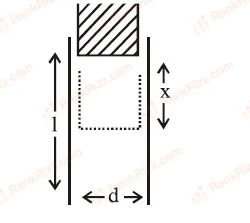
A parallel plate capacitor is made of two plates of length l, width w and separated by a distance d. A dielectric slab (dielectric constant K) that fits exactly between the plates is held near the edge of the plates. It is pulled into the capacitor by a force , where U is the energy of the capacitor when dielectric is inside the capacitor up to distance x (see the figure). If the charge on the capacitor is Q then the force on the dielectric when it is near the edge is:
The space between the plates of a parallel plate capacitor is filled with a 'dielectric' whose 'dielectric constant' varies with distance as per the relation: ( = a constant). The capacitance C, of the capacitor, would be related to its vacuum capacitance C for the relation:
The gap between the plates of a parallel plate capacitor of area A and distance between plates d, is filled with a dielectric whose relative permittivity varies linearly from at one plate to at the other. The capacitance of the capacitor is:
The circuit shown here has two batteries of 8.0 V and 16.0 V and three resistors 3, 9 and 9 and a capacitor of 5.0 F. How much is the current I in the circuit in steady state?
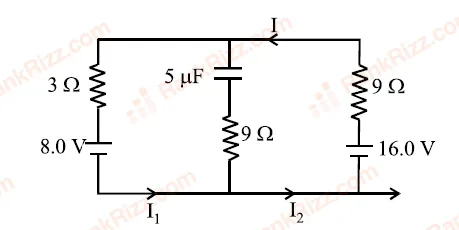
1.6 A
0.67 A
2.5 A
0.25 A
In an LCR circuit shown below, both the switches are open initially. Now switch is closed, kept open. (q is charge on the capacitor and = RC is capacitive time constant). Which of the following statement is correct?
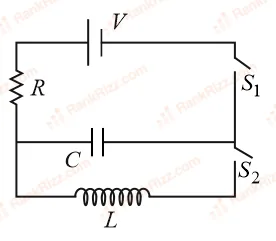
At ,
At ,
Work done by the battery is half of the energy dissipated in the resistor
At ,
Two capacitors and are charged to 120 V and 200 V respectively. It is found that by connecting them together the potential on each one can be made zero. Then:
OTHER PHYSICS CHAPTERS