JEE MAIN 2021 · 26 AUG S1Organ pipes and resonance columnsTRANSCRIBED
Two travelling waves produces a standing wave represented by equation.
. The node closest to the origin in the region x > 0 will be at = _________ (in cm).
Every Waves question JEE Main has set, grouped by the idea it tests rather than the order of the syllabus. 169 questions across 6 distinct ideas. Free to read, answer key on every one.
Questions
169
Distinct ideas
6
Share of marks
2.2%
Difficulty
MEDIUM
A chapter is not one subject — it is a handful of procedures the examiner reuses. These are the ones Waves questions actually test.
81–100 OF 169 · NEWEST FIRST
Two travelling waves produces a standing wave represented by equation.
. The node closest to the origin in the region x > 0 will be at = _________ (in cm).
The amplitude of wave disturbance propagating in the positive -direction is given by at time and at s, where and are in metres. The shape of wave does not change during the propagation. The velocity of the wave will be ___ m s.
A source and a detector move away from each other in absence of wind with a speed of 20 m s, with respect to the ground. If the detector detects a frequency of 1800 Hz of the sound coming from the source, then the original frequency of source considering the speed of sound in the air 340 m s will be _________ Hz.
A closed organ pipe of length and an open organ pipe contain gases of densities and respectively. The compressibility of gases are equal in both the pipes. Both the pipes are vibrating in their first overtone with same frequency. The length of the open pipe is , where is ________. (Round off to the Nearest Integer)
The frequency of a car horn encountered a change from 400 Hz to 500 Hz. When the car approaches a vertical wall. If the speed of sound is 330 m s. Then the speed of car is ___ km h.
Speed of a transverse wave on a straight wire (mass 6.0 g, length 60 cm and area of cross-section 1.0 mm) is 90 m s. If the Young's modulus of wire is N m, the extension of wire over its natural length is:
0.03 mm
0.02 mm
0.04 mm
0.01 mm
A uniform thin rope of length 12 m and mass 6 kg hangs vertically from a rigid support and a block of mass 2 kg is attached to its free end. A transverse short wave train of wavelength 6 cm is produced at the lower end of the rope. What is the wavelength of the wave train (in cm) when it reaches the top of the rope?
3
6
12
9
Three harmonic waves having equal frequency and same intensity , have phase angles , and respectively. When they are superimposed the intensity of the resultant wave is close to:
A driver in a car, approaching a vertical wall notices that the frequency of his car horn has changed from Hz to Hz, when it gets reflected from the wall. If the speed of sound in air is , then the speed of the car is:
A stationary observer receives sound from two identical tuning forks, one of which approaches and the other one recedes with the same speed (much less than the speed of sound). The observer hears 2 beats/sec. The oscillation frequency of each tuning fork is Hz and the velocity of sound in air is 350 m/s. The speed of each tuning fork is close to:
m/s
1 m/s
m/s
m/s
A sound source S is moving along a straight track with speed , and is emitting sound of frequency . An observer is standing at a finite distance, at the point O, from the track. The time variation of frequency heard by the observer is best represented by: ( represents the instant when the distance between the source and observer is minimum)
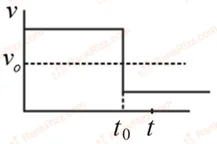
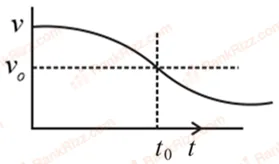
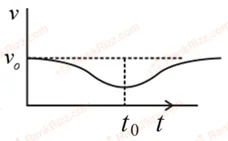
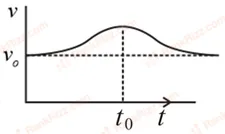
For a transverse wave travelling along a straight line, the distance between two peaks (crests) is 5 m, while the distance between one crest and one trough is 1.5 m. The possible wavelengths (in m) of the waves are:
1, 3, 5
1, 2, 3, ....
Assume that the displacement (s) of air is proportional to the pressure difference created by a sound wave. Displacement (s) further depends on the speed of sound (v), density of air () and the frequency (f). If , , , , then will be of the order of (take the multiplicative constant to be 1):
A transverse wave travels on a taut steel wire with a velocity of when tension in it is N. When the tension is changed to T, the velocity changed to . The value of T is close to:
N
N
N
N
In a resonance tube experiment when the tube is filled with water up to a height of , from bottom, it resonates with a given tuning fork. When the water level is raised the next resonance with the same tuning fork occurs at a height of . If the velocity of sound in air is , the tuning fork frequency is:
A wire of length and mass per unit length kg m is put under tension of 540 N. Two consecutive frequencies that it resonates at are: 420 Hz and 490 Hz. Then in meters is:
2.1 m
1.1 m
8.1 m
5.1 m
Two identical strings X and Z made of same material have tension and in them. If their fundamental frequencies are 450 Hz and 300 Hz, respectively, then the ratio is:
2.25
0.44
1.25
1.5
The driver of bus approaching a big wall notices that the frequency of his bus's horn changes from 420 Hz to 490 Hz when he hears it after it gets reflected from the wall. Find the speed of the bus if speed of the sound is 330 ms:
91 kmh
81 kmh
61 kmh
71 kmh
Two coherent sources of sound, and , produce sound waves of the same wavelength are in phase. and are placed apart (see fig). A listener, located at L, directly in front of , finds that the intensity is at a minimum when he is away from . The listener moves away from , keeping the distance from fixed. The adjacent maximum of intensity is observed when the listener is at a distance from . Then is:
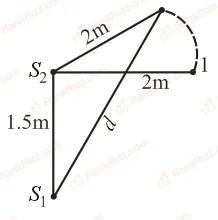
12 m
5 m
2 m
3 m
A one metre long (both ends open) organ pipe is kept in a gas that has double the density of air at STP. Assuming the speed of sound in air at STP is 300 m/s, the frequency difference between the fundamental and second harmonic of this pipe is __________ Hz.
OTHER PHYSICS CHAPTERS