RankRizzStart free

Wave Optics — JEE Main Previous Year Questions

Every Wave Optics question JEE Main has set, grouped by the idea it tests rather than the order of the syllabus. 198 questions across 6 distinct ideas. Free to read, answer key on every one.

Questions

198

Distinct ideas

6

Share of marks

4.8%

Difficulty

MEDIUM

The ideas inside Wave Optics

A chapter is not one subject — it is a handful of procedures the examiner reuses. These are the ones Wave Optics questions actually test.

01Wavefronts and Huygens' principleset 50×
02Young's double slit experiment: fringe width and intensityset 68×
03YDSE with slabs, white light and modified setupsset 1×
04Single slit diffractionset 29×
05Resolving power of microscopes and telescopesset 12×
06Polarisation: Malus's law and Brewster's lawset 38×

Every Wave Optics question

181–198 OF 198 · NEWEST FIRST

JEE MAIN 2012YDSE with slabs, white light and modified setupsTRANSCRIBED

In a Young's double slit experiment with light of wavelength , fringe pattern on the screen has fringe width . When two thin transparent glass (refractive index ) plates of thickness and (t_1 > t_2) are placed in the path of the two beams respectively, the fringe pattern will shift by a distance

  1. A

  2. B

  3. C

  4. D

JEE MAIN 2012Polarisation: Malus's law and Brewster's lawTRANSCRIBED

Two polaroids have their polarizing directions parallel so that the intensity of a transmitted light is maximum. The angle through which either polaroid must be turned if the intensity is to drop by one-half is

  1. A

  2. B

  3. C

  4. D

JEE MAIN 2012Resolving power of microscopes and telescopesTRANSCRIBED

A telescope of aperture m diameter is focused on a window at 80 m distance fitted with a wire mesh of spacing m. Given: m, which of the following is true for observing the mesh through the telescope?

  1. A

    Yes, it is possible with the same aperture size.

  2. B

    Possible also with an aperture half the present diameter.

  3. C

    No, it is not possible.

  4. D

    Given data is not sufficient.

JEE MAIN 2012Young's double slit experiment: fringe width and intensityTRANSCRIBED

In Young's double slit interference experiment, the slit widths are in the ratio . Then the ratio of intensity at the maxima and minima in the interference pattern is

  1. A

  2. B

  3. C

  4. D

JEE MAIN 2012Young's double slit experiment: fringe width and intensityTRANSCRIBED

In Young's double slit experiment, the two slits act as coherent sources of equal amplitude A and wavelength  . In another experiment with the same setup the two slits are sources of equal amplitude A and wavelength  but are incoherent. The ratio of the intensity of light at the midpoint of the screen in the first case to that in the second case is

  1. A

    1:1

  2. B

    2:1

  3. C

    4:1

  4. D

    1:4

JEE MAIN 2012Single slit diffractionTRANSCRIBED

The first diffraction minimum due to the single slit diffraction is seen at for a light of wavelength falling perpendicularly on the slit. The width of the slit is

  1. A

    cm

  2. B

    cm

  3. C

    cm

  4. D

    cm

JEE MAIN 2012Young's double slit experiment: fringe width and intensityTRANSCRIBED

The maximum number of possible interference maxima for slit separation equal to , where is the wavelength of light used, in a Young's double slit experiment is

  1. A

    zero

  2. B

  3. C

    infinite

  4. D

JEE MAIN 2011Young's double slit experiment: fringe width and intensityTRANSCRIBED

Direction: The question has a paragraph followed by two statements, Statement-1 and Statement-2. Of the given four alternatives after the statements, choose the one that describes the statements. A thin air film is formed by putting the convex surface of a plane-convex lens over a plane glass plate. With monochromatic light, this film gives an interference pattern due to light reflected from the top (convex) surface and the bottom (glass plate) surface of the film. Statement-1: When light reflects from the air-glass plate interface, the reflected wave suffers a phase change of . Statement-2: The centre of the interference pattern is dark.

  1. A

    Statement-1 is true, Statement-2 is true; Statement-2 is the correct explanation of Statement-1.

  2. B

    Statement-1 is true, Statement-2 is true; Statement-2 is not the correct explanation of Statement-1.

  3. C

    Statement-1 is false. Statement-2 is true.

  4. D

    Statement-1 is true, Statement-2 is false.

JEE MAIN 2010Wavefronts and Huygens' principleTRANSCRIBED

An initially parallel cylindrical beam travels in a medium of refractive index , where and are positive constants and is the intensity of the light beam. The intensity of the beam is decreasing with increasing radius. The initial shape of the wave front of the beam is

  1. A

    convex

  2. B

    concave

  3. C

    convex near the axis and concave near the periphery

  4. D

    planar

JEE MAIN 2009Young's double slit experiment: fringe width and intensityTRANSCRIBED

A mixture of light, consisting of wavelength nm and an unknown wavelength, illuminates Young's double slit and gives rise to two overlapping interference patterns on the screen. The central maximum of both lights coincide. Further, it is observed that the third bright fringe of known light coincides with the bright fringe of the unknown light. From this data, the wavelength of the unknown light is

  1. A

    nm

  2. B

    nm

  3. C

    nm

  4. D

    nm

JEE MAIN 2008Single slit diffractionTRANSCRIBED

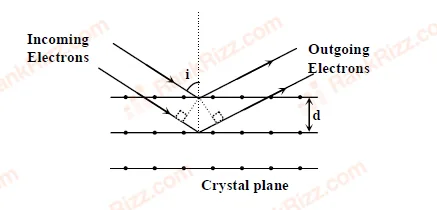
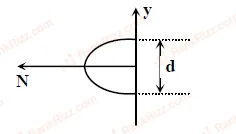
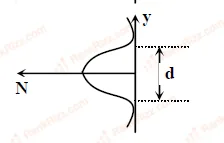
Paragraph: Wave property of electrons implies that they will show diffraction effects. Davisson and Germer demonstrated this by diffracting electrons from crystals. The law governing the diffraction from a crystal is obtained by requiring that electron waves reflected from the planes of atoms in a crystal interfere constructively (see in figure).
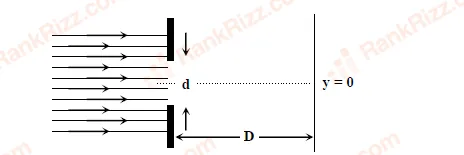
Question: In an experiment, electrons are made to pass through a narrow slit of width '' comparable to their de Broglie wavelength. They are detected on a screen at a distance '' from the slit (see figure).
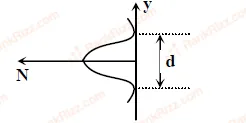
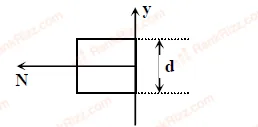
Which of the following graph can be expected to represent the number of electrons '' detected as a function of the detector position '' ( corresponds to the middle of the slit)?

  1. A
  2. B
  3. C
  4. D
JEE MAIN 2007Young's double slit experiment: fringe width and intensityTRANSCRIBED

In a Young's double slit experiment the intensity at a point where the path difference is ( being the wavelength of the light used) is . If denotes the maximum intensity, is equal to

  1. A

  2. B

  3. C

  4. D

JEE MAIN 2005Young's double slit experiment: fringe width and intensityTRANSCRIBED

A Young's double slit experiment uses a monochromatic source. The shape of the interference fringes formed on a screen is

  1. A

    hyperbola

  2. B

    circle

  3. C

    straight line

  4. D

    parabola

JEE MAIN 2005Resolving power of microscopes and telescopesTRANSCRIBED

Two point white dots are mm apart on a black paper. They are viewed by eye of pupil diameter mm. Approximately, what is the maximum distance at which these dots can be resolved by the eye? [Take wavelength of light nm]

  1. A

    m

  2. B

    m

  3. C

    m

  4. D

    m

JEE MAIN 2005Polarisation: Malus's law and Brewster's lawTRANSCRIBED

When an unpolarized light of intensity is incident on a polarizing sheet, the intensity of the light which does not get transmitted is

  1. A

  2. B

  3. C

    zero

  4. D

JEE MAIN 2005Single slit diffractionTRANSCRIBED

If is the intensity of the principal maximum in the single slit diffraction pattern, then what will be its intensity when the slit width is doubled?

  1. A

  2. B

  3. C

  4. D

JEE MAIN 2004Polarisation: Malus's law and Brewster's lawTRANSCRIBED

The angle of incidence at which reflected light totally polarized for reflection from air to glass (refractive index ), is

  1. A

  2. B

  3. C

  4. D

JEE MAIN 2004Young's double slit experiment: fringe width and intensityTRANSCRIBED

The maximum number of possible interference maxima for slit-separation equal to twice the wavelength in Young's double-slit experiment is

  1. A

    infinite

  2. B

    five

  3. C

    three

  4. D

    zero