JEE MAIN 2023 · 24 JAN S1Stress, strain, Hooke's law and Young's modulusTRANSCRIBED
A 100 m long wire having cross-sectional area m and Young's modulus is N m is subjected to a load of 250 N, then the elongation in the wire will be:
- A
m
- B
m
- C
m
- D
m
Every Mechanical Properties of Solids question JEE Main has set, grouped by the idea it tests rather than the order of the syllabus. 126 questions across 6 distinct ideas. Free to read, answer key on every one.
Questions
126
Distinct ideas
6
Share of marks
3.4%
Difficulty
EASY
A chapter is not one subject — it is a handful of procedures the examiner reuses. These are the ones Mechanical Properties of Solids questions actually test.
41–60 OF 126 · NEWEST FIRST
A 100 m long wire having cross-sectional area m and Young's modulus is N m is subjected to a load of 250 N, then the elongation in the wire will be:
m
m
m
m
The Young's modulus of a steel wire of length m and cross-sectional area mm, is N/m. The wire is suspended from its support on a given planet. A block of mass kg is attached to the free end of the wire. The acceleration due to gravity on the planet is of its value on the earth. The elongation of wire is (Take on the earth m/s):
cm
mm
mm
cm
Under the same load, wire A having length 5.0 m and cross section m stretches uniformly by the same amount as another wire B of length 6.0 m and a cross section of m stretches. The ratio of the Young's modulus of wire A to that of wire B will be:
1 : 4
1 : 1
1 : 10
1 : 2
A force is applied to a steel wire , rigidly clamped at one end. As a result elongation in the wire is mm. If same force is applied to another steel wire of double the length and a diameter times that of the wire , the elongation in the wire will be (wires having uniform circular cross sections)
mm
mm
mm
mm
Young's moduli of the material of wires and are in the ratio of 1 : 4, while its area of cross sections are in the ratio of 1 : 3. If the same amount of load is applied to both the wires, the amount of elongation produced in the wires A and B will be in the ratio of [Assume length of wires A and B are same]
12 : 1
1 : 36
36 : 1
1 : 12
Choose the correct relationship between Poisson ratio , bulk modulus and modulus of rigidity of a given solid object:
A wire of length and radius is clamped rigidly at one end. When the other end of the wire is pulled by a force , its length increases by . Another wire of same material of length and radius is pulled by a force . Then the increase in its length will be:
Given below are two statements: one is labelled as Assertion A and the other is labelled as Reason R
Assertion (A): Steel is used in the construction of buildings and bridges.
Reason (R): Steel is more elastic and its elastic limit is high.
In the light of above statements, choose the most appropriate answer from the options given below
Both and are correct and is the correct explanation of
Both and are correct but is NOT the correct explanation of
is correct but is not correct
is not correct but is correct
Under isothermal condition, the pressure of a gas is given by , where is a constant and is the volume of the gas. The bulk modulus at constant temperature is equal to
An aluminium rod with Young's modulus N m undergoes elastic strain of 0.04%. The energy per unit volume stored in the rod in SI unit
2800
11200
5600
8400
The elastic potential energy stored in a steel wire of length m stretched through cm is J. The cross sectional area of the wire is _____ mm. (Given, N m)
A steel rod of length 1 m and cross-sectional area m is heated from 0C to 200C without being allowed to extend or bend. The compressive tension produced in the rod is _______ N. (Given Young's modulus of steel N m, coefficient of linear expansion K)
A metal block of mass is suspended from a rigid support through a metal wire of diameter 14 mm. The tensile stress developed in the wire under equilibrium state is N m. The value of mass is ______ kg.
(Take m s and )
A certain pressure 'P' is applied to 1 litre of water and 2 litre of a liquid separately. Water gets compressed to 0.01% whereas the liquid gets compressed to 0.03%. The ratio of Bulk modulus of water to that of the liquid is . The value of is _____.
Two wires each of radius 0.2 cm and negligible mass, one made of steel and the other made of brass are loaded as shown in the figure. The elongation of the steel wire is _______ m. [Young's modulus for steel N m and m s]
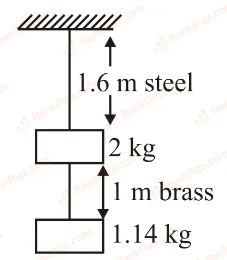
A thin rod having a length of 1 m and area of cross-section m is suspended vertically from one end. The rod is cooled from 210°C to 160°C. After cooling, a mass is attached at the lower end of the rod such that the length of rod again becomes 1 m. Young's modulus and coefficient of linear expansion of the rod are N m and K, respectively. The value of is ______ kg. (Take m s)
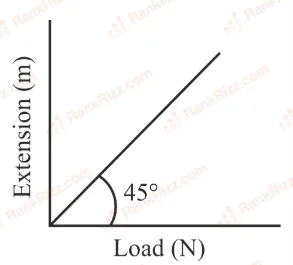
As shown in the figure, in an experiment to determine Young's modulus of a wire, the extension-load curve is plotted. The curve is a straight line passing through the origin and makes an angle of 45° with the load axis. The length of the wire is 62.8 cm and its diameter is 4 mm. The Young's modulus is found to be N m. The value of is _____.
A steel rod has a radius of 20 mm and a length of 2.0 m. A force of 62.8 kN stretches it along its length. Young's modulus of steel is N m. The longitudinal strain produced in the wire is ______ .
The length of a wire becomes and when 100 N and 120 N tension are applied respectively. If , then the natural length of wire will be . Here the value of is _______
The area of cross section of the rope used to lift a load by a crane is . The maximum lifting capacity of the crane is 10 metric tons. To increase the lifting capacity of the crane to 25 metric tons, the required area of cross section of the rope should be (take )
OTHER PHYSICS CHAPTERS