At any instant the velocity of a particle of mass 500 g is m s. If the force acting on the particle at s is N. Then the value of will be:
- A
3
- B
4
- C
2
- D
6
Every Laws of Motion & Friction question JEE Main has set, grouped by the idea it tests rather than the order of the syllabus. 151 questions across 5 distinct ideas. Free to read, answer key on every one.
Questions
151
Distinct ideas
5
Share of marks
3%
Difficulty
MEDIUM
A chapter is not one subject — it is a handful of procedures the examiner reuses. These are the ones Laws of Motion & Friction questions actually test.
61–80 OF 151 · NEWEST FIRST
At any instant the velocity of a particle of mass 500 g is m s. If the force acting on the particle at s is N. Then the value of will be:
3
4
2
6
An object of mass kg is thrown vertically upwards from the ground. The air resistance produces a constant retarding force of N throughout the motion. The ratio of time of ascent to the time of descent will be equal to : [Use m s]
A person is standing in an elevator. In which situation, he experiences weight loss?
When the elevator moves upward with constant acceleration
When the elevator moves downward with constant acceleration
When the elevator moves upward with uniform velocity
When the elevator moves downward with uniform velocity
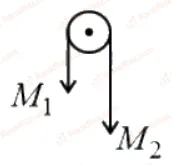
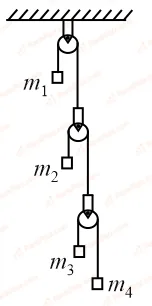
In the arrangement shown in figure and are the accelerations of masses and respectively. Which of the following relation is true for this arrangement?

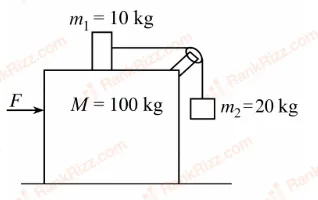
Three masses , and are arranged in a system as shown in figure. All the surfaces are frictionless and strings are inextensible and weightless. The pulleys are also weightless and frictionless. A force is applied on the system so that the mass moves upward with an acceleration of . The value of is (Take )

Two masses and are tied together at the two ends of a light inextensible string that passes over a frictionless pulley. When the mass is twice that of , the acceleration of the system is . When the mass is thrice that of , the acceleration of the system is . The ratio will be

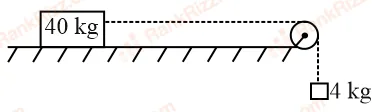
A block of mass 40 kg slides over a surface, when a mass of 4 kg is suspended through an inextensible massless string passing over frictionless pulley as shown below. The coefficient of kinetic friction between the surface and block is 0.02. The acceleration of block is: (Given m s.)

m s
1 m s
m s
m s
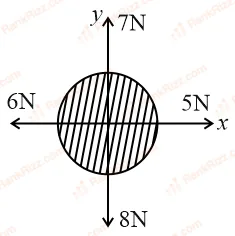
For a free body diagram shown in the figure, the four forces are applied in the '' and '' directions. What additional force must be applied and at what angle with positive -axis so that the net acceleration of body is zero?

A monkey of mass climbs on a rope which can withstand the tension () of . If monkey initially climbs down with an acceleration of and then climbs up with an acceleration of . Choose the correct option ()
while climbing upward
while going downward
Rope will break while climbing upward
Rope will break while going downward
A bag is gently dropped on a conveyor belt moving at a speed of . The coefficient of friction between the conveyor belt and bag is . Initially, the bag slips on the belt before it stops due to friction. The distance travelled by the bag on the belt during slipping motion is: [Take ]
A balloon has mass of 10 g in air. The air escapes from the balloon at a uniform rate with velocity 4.5 cm s. If the balloon shrinks in 5 s completely. Then, the average force acting on that balloon will be (in dyne).
3
9
12
18
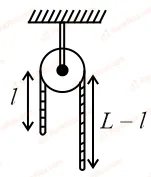
A uniform metal chain of mass and length passes over a massless and frictionless pulley. It is released from rest with a part of its length is hanging on one side and rest of its length is hanging on the other side of the pulley. At a certain point of time, when , the acceleration of the chain is . The value of is

6
2
1.5
4
A block of mass kg starts sliding on a surface with an initial velocity of ms. The coefficient of friction between the surface and block is . The distance covered by the block before coming to rest is : [use ms]
9.8 m
4.9 m
12.5 m
19.6 m
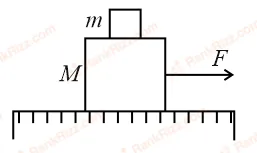
A system of two blocks of masses kg and kg is placed on a smooth table as shown in figure. The coefficient of static friction between two blocks is . The maximum horizontal force that can be applied to the block of mass so that the blocks move together will be m s

N
N
N
N
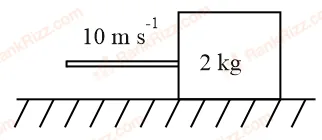
A block of metal weighing 2 kg is resting on a frictionless plane (as shown in figure). It is struck by a jet releasing water at a rate of 1 kg s and at a speed of 10 m s. Then, the initial acceleration of the block, in m s, will be
3
6
5
4
A block of mass placed inside a box descends vertically with acceleration . The block exerts a force equal to one-fourth of its weight on the floor of the box. The value of '' will be
A block of mass slides down on a rough inclined plane with constant velocity. The angle made by the incline plane with horizontal is . The magnitude of the contact force will be :
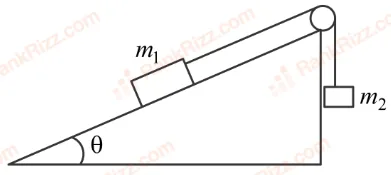
Two bodies of masses kg and kg are connected by a light string going over a smooth light pulley on a smooth inclined plane as shown in the figure. The system is at rest. The force exerted by the inclined plane on the body of mass will be: [Take m s]

30 N
40 N
50 N
60 N
A block takes 2 s to slide down a frictionless incline of and length , kept inside a lift going up with uniform velocity . If the incline is changed to , the time taken by the block, to slide down the incline, will be approximately:
2.66 s
0.83 s
1.68 s
0.70 s
A uniform chain of m length is placed on a table such that a part of its length is hanging over the edge of the table. The system is at rest. The co-efficient of static friction between the chain and the surface of the table is , the maximum length of the chain hanging from the table is ______ m.
OTHER PHYSICS CHAPTERS