JEE MAIN 2025 · 04 APR S2IUPAC nomenclature of organic compoundsTRANSCRIBED
The IUPAC name of the following compound is :
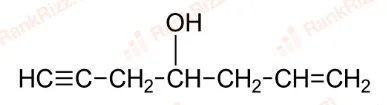
- A
4-Hydroxyhept-1-en-6-yne
- B
4-Hydroxyhept-6-en-1-yne
- C
Hept-6-en-1-yn-4-ol
- D
Hept-1-en-6-yn-4-ol
Every General Organic Chemistry question JEE Main has set, grouped by the idea it tests rather than the order of the syllabus. 258 questions across 12 distinct ideas. Free to read, answer key on every one.
Questions
258
Distinct ideas
12
Share of marks
5.7%
Difficulty
MEDIUM
A chapter is not one subject — it is a handful of procedures the examiner reuses. These are the ones General Organic Chemistry questions actually test.
41–60 OF 258 · NEWEST FIRST
The IUPAC name of the following compound is :
4-Hydroxyhept-1-en-6-yne
4-Hydroxyhept-6-en-1-yne
Hept-6-en-1-yn-4-ol
Hept-1-en-6-yn-4-ol
Which of the following is the correct IUPAC name of given organic compound (X)?
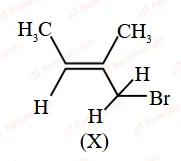
2-Bromo-2-methylbut-2-ene
3-Bromo-3-methylprop-2-ene
1-Bromo-2-methylbut-2-ene
4-Bromo-3-methylbut-2-ene
What is the correct IUPAC name of
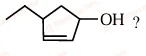
4-Ethyl-1-hydroxycyclopent-2-ene
1-Ethyl-3-hydroxycyclopent-2-ene
1-Ethylcyclopent-2-en-3-ol
4-Ethylcyclopent-2-en-1-ol
Total number of sigma () and pi() bonds respectively present in hex-1-en-4-yne are :
3 and 13
11 and 3
13 and 3
14 and 3
How many different stereoisomers are possible for the given molecule?
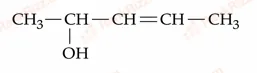
2
1
4
3
Which one of the carbocations from the following is most stable?
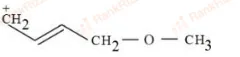
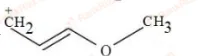
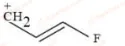
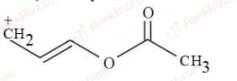
Given below are two statements:
Statement I: Hyperconjugation is not a permanent effect.
Statement II: In general, greater the number of alkyl groups attached to a positively charged C-atom, greater is the hyperconjugation interaction and stabilization of the cation.
In the light of above statements, Choose the correct answer from the options given below :
Statement I is true and Statement II is false
Both Statement I and Statement II are false
Statement I is false but Statement II is true
Both Statement I and Statement II are true
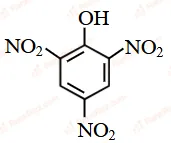
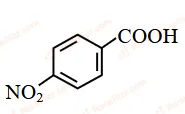
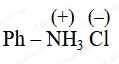
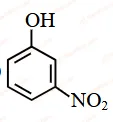
Which of the following compounds is least likely to give effervescence of in presence of aq. NaHCO?
The number of optically active products obtained from the complete ozonolysis of the given compound is :
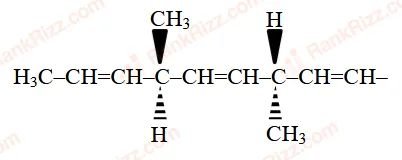
2
0
1
4
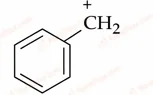
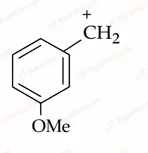
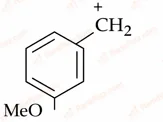
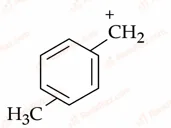
The most stable carbocation from the following is :
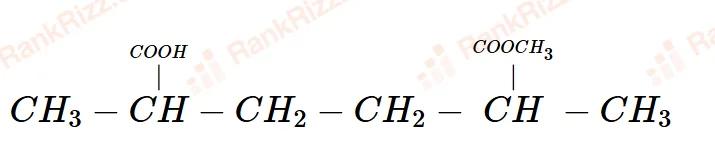
The IUPAC name of the following compound is :
Methyl-6-carboxy-2,5-dimethylhexanoate.
2-Carboxy-5-methoxycarbonylhexane.
6-Methoxycarbonyl-2,5-dimethylhexanoic acid.
Methyl-5-carboxy-2-methylhexanoate.
Match the LIST-I with LIST-II
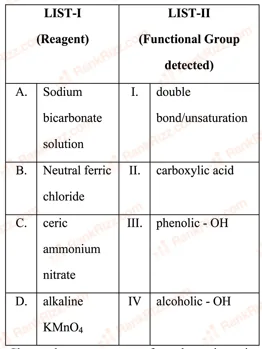
Choose the correct answer from the options given below :
A-II, B-III, C-IV, D-I
A-II, B-III, C-I, D-IV
A-III, B-II, C-IV, D-I
A-II, B-IV, C-III, D-I
Consider the following compound (X):
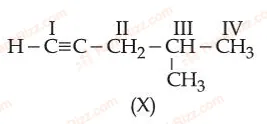
The most stable and least stable carbon radicals, respectively, produced by homolytic cleavage of corresponding C-H bond are:
II, IV
III, II
I, IV
II, I
The least acidic compound, among the following is:
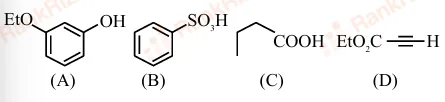
D
A
B
C
What is the correct IUPAC name of the following compound?
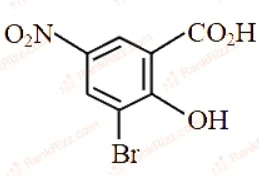
3-Bromo-2-hydroxy-5-nitrobenzoic acid
3-Bromo-4-hydroxy-1-nitrobenzoic acid
2-Hydroxy-3-bromo-5-nitrobenzoic acid
5-Nitro-3-bromo-2-hydroxybenzoic acid
The correct stability order of the following species/molecules is:
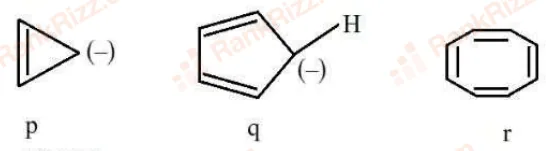
q > r > p
r > q > p
q > p > r
p > q > r
The sum of sigma and pi bonds in Hex-1,3-dien-5-yne is _______.
The possible number of stereoisomers for 5-phenylpent -4-en-2-ol is
The hydrocarbon with molar mass and carbon has degree of unsaturation.
The total number of structural isomers possible for the substituted benzene derivatives with the molecular formula is ________.
OTHER CHEMISTRY CHAPTERS