General Principles and Processes of Isolation of Metals — JEE Main Previous Year Questions
Every General Principles and Processes of Isolation of Metals question JEE Main has set, grouped by the idea it tests rather than the order of the syllabus. 120 questions across 5 distinct ideas. Free to read, answer key on every one.
The ideas inside General Principles and Processes of Isolation of Metals
A chapter is not one subject — it is a handful of procedures the examiner reuses. These are the ones General Principles and Processes of Isolation of Metals questions actually test.
01Occurrence of metals: minerals and oresset 23×
02Concentration of ores, calcination and roastingset 19×
03Thermodynamic principles and Ellingham diagramset 20×
04Extraction of Fe, Cu, Zn, Al, Ag and Auset 35×
05Refining of metalsset 23×
Every General Principles and Processes of Isolation of Metals question
1–20 OF 120 · NEWEST FIRST
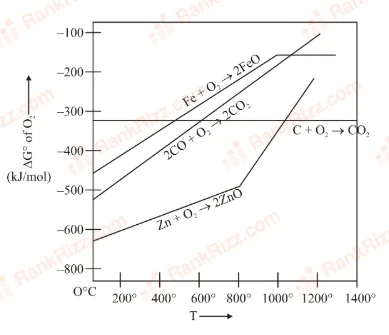
JEE MAIN 2023 · 10 APR S2Thermodynamic principles and Ellingham diagramTRANSCRIBED
Gibbs energy vs T plot for the formation of oxides is given below. For the given diagram, the correct statement is-
JEE MAIN 2023 · 31 JAN S1Concentration of ores, calcination and roastingTRANSCRIBED
The methods NOT involved in concentration of ore are (A) Liquation (B) Leaching (C) Electrolysis (D) Hydraulic washing (E) Froth floatation Choose the correct answer from the options given below:
JEE MAIN 2023 · 01 FEB S1Thermodynamic principles and Ellingham diagramTRANSCRIBED
Given below are two statements: Assertion A: In an Ellingham diagram, the oxidation of carbon to carbon monoxide shows a negative slope with respect to temperature. Reason R: CO tends to get decomposed at higher temperature.
A
Both A and R are correct and R is the correct explanation of A
B
A is not correct but R is correct
C
Both A and R are correct but R is NOT the correct explanation of A
JEE MAIN 2023 · 24 JAN S1Extraction of Fe, Cu, Zn, Al, Ag and AuTRANSCRIBED
Match List I with List II. List I List II A. Reverberatory furnace I. Pig iron B. Electrolytic cell II. Aluminium C. Blast furnace III. Silicon D. Zone refining furnace IV. Copper
JEE MAIN 2023 · 25 JAN S2Concentration of ores, calcination and roastingTRANSCRIBED
Given below are two statements:- Statement I: In froth floatation method a rotating paddle agitates the mixture to drive air out of it. Statement II: Iron pyrites are generally avoided for extraction of iron due to environmental reasons. In the light of the above statements, choose the correct answer:
JEE MAIN 2023 · 11 APR S1Extraction of Fe, Cu, Zn, Al, Ag and AuTRANSCRIBED
In the extraction process of copper, the product obtained after carrying out the reactions (i) 2Cu2S+3O2→2Cu2O+2SO2 (ii) 2Cu2O+Cu2S→6Cu+SO2 is called
JEE MAIN 2023 · 11 APR S2Concentration of ores, calcination and roastingTRANSCRIBED
Given below are two statements: Statement I: In the metallurgy process, sulphide ore is converted to oxide before reduction. Statement II: Oxide ores in general are easier to reduce. In the light of the above statements, choose the most appropriate answer from the options below:
A
Statement I is correct but Statement II is incorrect
B
Both Statement I and Statement II are incorrect
C
Statement I is incorrect but Statement II is correct
JEE MAIN 2023 · 13 APR S2Thermodynamic principles and Ellingham diagramTRANSCRIBED
Given below are two statements related to Ellingham diagram : Statement I : Ellingham diagrams can be constructed for formation of oxides, sulphides and halides of metals. Statement II : It consists of plots of ΔH° vs T for formation of oxides of elements. In the light of the above statements, choose the most appropriate answer from the options given below :
A
Both Statement I and Statement II are correct
B
Both Statement I and Statement II are incorrect
C
Statement I is correct but Statement II is incorrect
D
Statement I is incorrect but Statement II is correct
JEE MAIN 2023 · 30 JAN S2Refining of metalsTRANSCRIBED
Given below are two statements: Statement I: During Electrolytic refining, the pure metal is made to act as anode and its impure metallic form is used as cathode. Statement II: During the Hall-Heroult electrolysis process, purified Al2O3 is mixed with Na3AlF6 to lower the melting point of the mixture. In the light of the above statements, choose the most appropriate answer from the options given below:
A
Statement I is incorrect but Statement II is correct
B
Both Statement I and Statement II are incorrect
C
Statement I is correct but Statement II is incorrect
JEE MAIN 2023 · 12 APR S1Thermodynamic principles and Ellingham diagramTRANSCRIBED
Given below are two statements: one is labelled as Assertion A and the other is labelled as Reason R Assertion A: In the Ellingham diagram, a sharp change in slope of the line is observed from Mg → MgO at ~1120°C Reason R: There is a large change of entropy associated with the change of state In the light of the above statements, choose the correct answer from the options given below
A
Both A and R are true but R is NOT the correct explanation of A
B
A is false but R is true
C
Both A and R are true and R is the correct explanation of A