JEE MAIN 2019 · 12 APR S1Acidity and basicity of organic compoundsTRANSCRIBED
The increasing order of the pK of the following compound is:
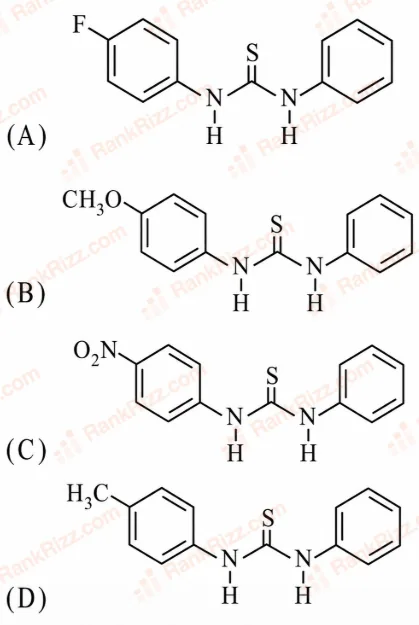
- A
(B) < (D) < (C) < (A)
- B
(B) < (D) < (A) < (C)
- C
(C) < (A) < (D) < (B)
- D
(A) < (C) < (D) < (B)
Every General Organic Chemistry question JEE Main has set, grouped by the idea it tests rather than the order of the syllabus. 258 questions across 12 distinct ideas. Free to read, answer key on every one.
Questions
258
Distinct ideas
12
Share of marks
5.7%
Difficulty
MEDIUM
A chapter is not one subject — it is a handful of procedures the examiner reuses. These are the ones General Organic Chemistry questions actually test.
201–220 OF 258 · NEWEST FIRST
The increasing order of the pK of the following compound is:
(B) < (D) < (C) < (A)
(B) < (D) < (A) < (C)
(C) < (A) < (D) < (B)
(A) < (C) < (D) < (B)
In the following skew conformation of ethane, H' - C - C - H'' dihedral angle is:
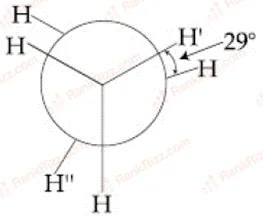
58°
120°
149°
151°
Which of these factors does not govern the stability of a conformation in acyclic compounds?
Steric interactions
Angle strain
Torsional strain
Electrostatic forces of interaction
In the following compound, the favourable site/s for protonation is/are:
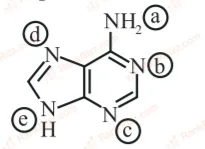
(a) and (e)
(b), (c) and (d)
(a) and (d)
(a)
Acid strength given below the correct decreasing order will be:
NO_2CH_2COOH > FCH_2COOH > CNCH_2COOH > ClCH_2COOH
FCH_2COOH > NCCH_2COOH > NO_2CH_2COOH > ClCH_2COOH
CNCH_2COOH > O_2NCH_2COOH > FCH_2COOH > ClCH_2COOH
O_2NCH_2COOH > FCH_2COOH > ClCH_2COOH > NCCH_2COOH
The increasing basicity order of the following compounds is:
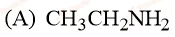

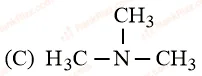
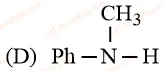
(D) < (C) < (B) < (A)
(D) < (C) < (A) < (B)
(A) < (B) < (C) < (D)
(A) < (B) < (D) < (C)
The total number of optically active compounds formed in the following reaction is:
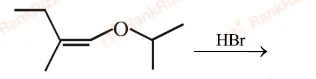
Zero
Six
Four
Two
The IUPAC name of the following compound is: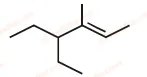
3-ethyl-4-methylhex-4-ene
4,4-diethyl-3-methylbut-2-ene
4-methyl-3-ethylhex-4-ene
4-ethyl-3-methylhex-2-ene
Among the following compounds, the compound which shows the highest dipole-moment is

(II)
(IV)
(III)
(I)
Which of the following molecules is least resonance stabilized?


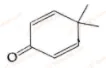

Which of the following compounds is most reactive to an aqueous solution of sodium carbonate?


The IUPAC name of the following compound is: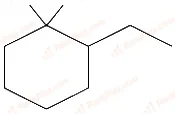
2-Ethyl-1, 1-dimethyl cyclohexane
1, 1-Dimethyl-2-ethyl cyclohexane
2, 2-Dimethyl-1-1-ethyl cyclohexane
1-Ethyl-2, 2-dimethyl cyclohexane
In the following structure, the double bonds are marked as I, II, III and IV.
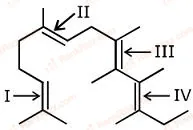
Geometrical isomerism is not possible at the site(s):
I and III
III
I
III and IV
A mixture containing the following four compounds is extracted with 1 M HCl. The compound that goes to aqueous layer is:
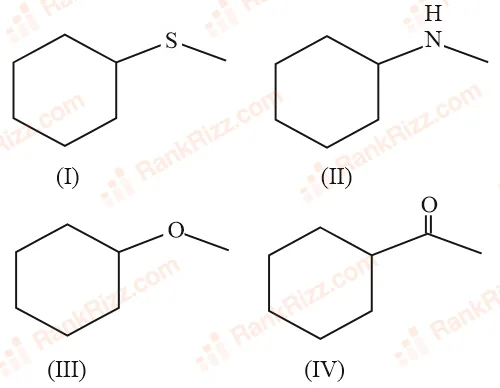
IV
II
I
III
The absolute configuration of

is:
(2S, 3S)
(2R, 3R)
(2R, 3S)
(2S, 3R)
The hydrocarbon with seven carbon atoms containing a neopentyl and a vinyl group is:
2,2-dimethyl-4-pentene
4,4-dimethylpent-1-ene
Isopropyl-2-butene
2,2-dimethyl-3-pentene
Which of the following compounds will exhibit geometrical isomerism?
1, 1 - Diphenyl - 1 - propane
1 - Phenyl - 2 - butene
3 - Phenyl - 1 - butene
2 - Phenyl - 1 - butene
The number of structural isomers for is:
4
5
6
3
The optically inactive compound from the following is:
2-chloropropanal
2-chloro-2-methylbutane
2-chlorobutane
2-chloropentane
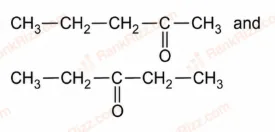
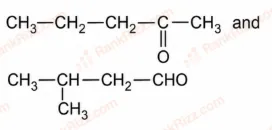
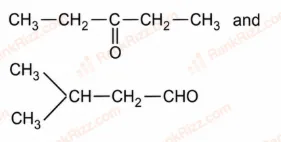
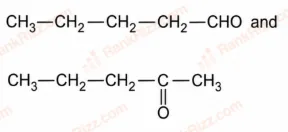
Which of the following pairs of compounds are positional isomers?
OTHER CHEMISTRY CHAPTERS