JEE MAIN 2024 · 06 APR S1Electrical and magnetic properties of solidsTRANSCRIBED
Which of the following material is not a semiconductor.
- A
Silicon
- B
Copper oxide
- C
Germanium
- D
Graphite
Every Solid State question JEE Main has set, grouped by the idea it tests rather than the order of the syllabus. 78 questions across 6 distinct ideas. Free to read, answer key on every one.
Questions
78
Distinct ideas
6
Share of marks
0%
Difficulty
EASY
A chapter is not one subject — it is a handful of procedures the examiner reuses. These are the ones Solid State questions actually test.
1–20 OF 78 · NEWEST FIRST
Which of the following material is not a semiconductor.
Silicon
Copper oxide
Germanium
Graphite
Which one of the following pairs is an example of polar molecular solids?
SO(s), CO(s)
SO(s), NH(s)
MgO(s), SO(s)
HCl(s), AlN(s)
Which of the following represents the lattice structure of AO containing A, A and O ions?

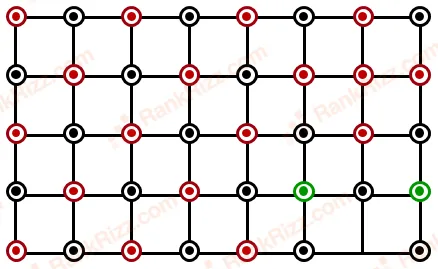
B and C only
B only
A and B only
A only
A cubic solid is made up of two elements X and Y. Atoms of X are present on every alternate corner and one at the center of cube. Y is at rd of the total faces. The empirical formula of the compound is
XY
XY
XY
XY
A compound is formed by two elements X and Y. The element Y forms cubic close packed arrangement and those of element X occupy one third of the tetrahedral voids. What is the formula of the compound?
XY
XY
XY
XY
Which of the following expressions is correct in case of a CsCl unit cell (edge length 'a')?
The correct relationships between unit cell edge length 'a' and radius of sphere 'r' for face-centred and body-centred cubic structures respectively are:
and
and
and
and
A metal M crystallizes into two lattices: face centred cubic (fcc) and body centred cubic (bcc) with unit cell edge length of and respectively. The ratio of densities of lattices fcc to bcc for the metal M is ______ (Nearest integer)
1
2
3
4
Iron oxide FeO, crystallises in a cubic lattice with a unit cell edge length of . If density of the FeO in the crystal is g cm, then the number of FeO units present per unit cell is ______ (Nearest integer)
Given: Molar mass of Fe and O is 56 and 16 g mol respectively.
N mol
Number of crystal systems from the following where body centred unit cell can be found, is ______.
Cubic, tetragonal, orthorhombic, hexagonal, rhombohedral, monoclinic, triclinic
An atomic substance A of molar mass 12 g mol has a cubic crystal structure with edge length of 300 pm. The no. of atoms present in one unit cell of A is _______ (Nearest integer)
Given the density of A is 3.0 g m m and NA = mol
A metal M forms hexagonal close-packed structure. The total number of voids in mol of it is ______ (Nearest integer)
(Given N)
Sodium metal crystallises in a body centred cubic lattice with unit cell edge length of A. The radius of sodium atom is _____ A. (Nearest integer)
The incorrect statement about the imperfections in solids is
Schottky defect decreases the density of the substance.
Frenkel defect does not alter the density of the substance.
Interstitial defect increases the density of the substance.
Vacancy defect increases the density of the substance.
Metal deficiency defect is shown by . In the crystal, some cations are missing and loss of positive charge is compensated by the presence of ions. The percentage of ions in the crystals is ______ (Nearest integer)
Atoms of element X form hcp lattice and those of element Y occupy of its tetrahedral voids. The percentage of element X in the lattice is (Nearest integer) ______
An element M crystallises in a body centred cubic unit cell with a cell edge of 300 pm. The density of the element is 6.0 g cm. The number of atoms present in 180 g of the element is _____ . (Nearest integer)
Ionic radii of cation and anion are 102 and 181 pm respectively. These ions are allowed to crystallize into an ionic solid. This crystal has cubic close packing for . is present in all octahedral voids. The edge length of the unit cell of the crystal AB is _____ pm.
In a solid AB, A atoms are in ccp arrangement and B atoms occupy all the octahedral sites. If two atoms from the opposite faces are removed, then the resultant stoichiometry of the compound is . The value of is ______ [nearest integer]
The distance between and ions in solid NaCl of density g cm is ______ m. (Nearest Integer)
(Given : mol)
OTHER CHEMISTRY CHAPTERS