JEE MAIN 2009Optical isomerism and chiralityTRANSCRIBED
The number of stereoisomers possible for a compound of the molecular formula is :
- A
- B
- C
- D
Every General Organic Chemistry question JEE Main has set, grouped by the idea it tests rather than the order of the syllabus. 258 questions across 12 distinct ideas. Free to read, answer key on every one.
Questions
258
Distinct ideas
12
Share of marks
5.7%
Difficulty
MEDIUM
A chapter is not one subject — it is a handful of procedures the examiner reuses. These are the ones General Organic Chemistry questions actually test.
241–258 OF 258 · NEWEST FIRST
The number of stereoisomers possible for a compound of the molecular formula is :
The IUPAC name of neopentane is
2-methylbutane
2,2-dimethylpropane
2-methylpropane
2,2-dimethylbutane
The correct decreasing order of priority for the functional groups of organic compounds in the IUPAC system of nomenclature is
Which of the following molecules is expected to rotate the plane of plane polarized light?
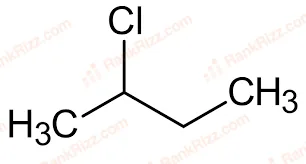
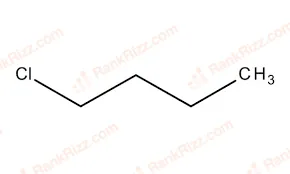
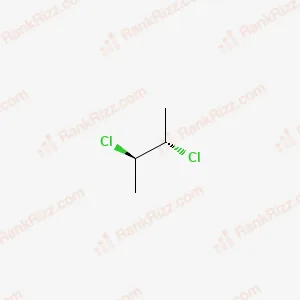
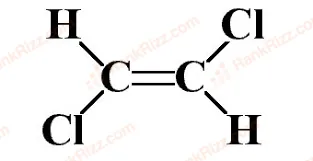
Which one of the following conformation of cyclohexane is chiral?
Twist boat
Rigid
Chair
Boat
The IUPAC name of
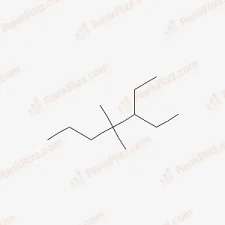
is
-diethyl--dimethylpentane
-dimethyl--diethylpentane
-diethyl--diemthylpentane
-ethyl--dimethylheptane
The IUPAC name of the compound shown below is
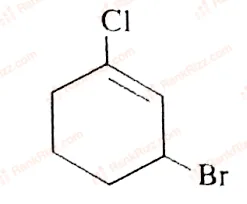
2-bromo-6-chlorocyclohex-1-ene
6-bromo-2-chlorocyclohexene
3-bromo-1-chlorocyclohexene
1-bromo-3-chlorocyclohexene
The increasing order of stability of the following free radicals is
(CH_3)_2\dot{C}H < (CH_3)_3\dot{C} < (C_6H_5)_2\dot{C}H < (C_6H_5)_3\dot{C}
(C_6H_5)_3\dot{C} < (C_6H_5)_2\dot{C}H < (CH_3)_3\dot{C} < (CH_3)_2\dot{C}H
(C_6H_5)_2\dot{C}H < (C_6H_5)_3\dot{C} < (CH_3)_3\dot{C} < (CH_3)_2\dot{C}H
(CH_3)_2\dot{C}H < (CH_3)_3\dot{C} < (C_6H_5)_3\dot{C} < (C_6H_5)_2\dot{C}H
Increasing order of stability among the three main conformations (i.e. Eclipse, Anti, Gauche) of 2-fluoroethanol is
Eclipse, Gauche, Anti
Gauche, Eclipse, Anti
Eclipse, Anti, Gauche
Anti, Gauche, Eclipse
Due to the presence of an unpaired electron, free radicals are:
Chemically reactive
Chemically inactive
Anions
Cations
Consider the nucleophiles:
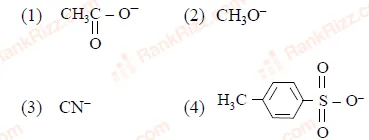
The decreasing order of nucleophilicity among the nucleophiles is
1,2,3,4
4,3,2,1
2,3,1,4
3,2,1,4
Which types of isomerism is shown by 2,3-dichlorobutane?
Diastereo
Optical
Geometric
Structural
Which one the following does not have hybridized carbon?
Acetone
Acetamide
Acetonitrile
Acetic acid
For which of the following parameters the structural isomers and would be expected to have the same values? (Assume ideal behaviour)
Heat of vaporization
Gaseous densities at the same temperature and pressure
Boiling points
Vapour pressure at the same temperature
The IUPAC name of the compound
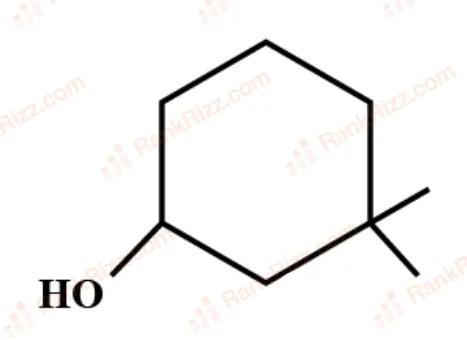
3,3-dimethyl-1-hydroxy cyclohexane
1,1-dimethyl-3-cyclohexanol
3,3-dimethyl-1-cyclohexanol
1,1-dimethyl-3-hydroxy cyclohexane
Which of the following will have meso-isomer also?
2-chlorobutane
2-hydroxypropanoic acid
2,3-dichloropentane
2,3-dichlorobutane
Amongst the following compounds, the optically active alkane having lowest molecular mass is
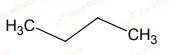
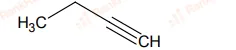
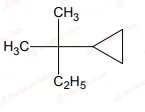
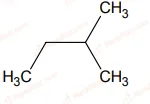
Which of the following compound is not chiral?
1-chloropentane
3-chloro-2-methyl pentane
1-chloro-2-methyl pentane
2-chloropentane
OTHER CHEMISTRY CHAPTERS