Consider the following equation:
kJ.
The number of factors which will increase the yield of SO at equilibrium from the following is ______.
A. Increasing temperature
B. Increasing pressure
C. Adding more SO
D. Adding more O
E. Addition of catalyst
Every Chemical and Ionic Equilibrium question JEE Main has set, grouped by the idea it tests rather than the order of the syllabus. 274 questions across 10 distinct ideas. Free to read, answer key on every one.
Questions
274
Distinct ideas
10
Share of marks
5.7%
Difficulty
MEDIUM
A chapter is not one subject — it is a handful of procedures the examiner reuses. These are the ones Chemical and Ionic Equilibrium questions actually test.
81–100 OF 274 · NEWEST FIRST
Consider the following equation:
kJ.
The number of factors which will increase the yield of SO at equilibrium from the following is ______.
A. Increasing temperature
B. Increasing pressure
C. Adding more SO
D. Adding more O
E. Addition of catalyst
The dissociation constant of acetic acid is . When 25 mL of 0.2 M solution is mixed with 25 mL of 0.02 M solution, the pH of the resultant solution is found to be equal to 5. The value of x is _____.
The dissociation constant of acetic is . When 25 mL of 0.2 M CHCOONa solution is mixed with 25 mL of 0.02 M CHCOOH solution, the pH of the resultant solution is found to be equal to 5. The value of is _____.
Consider the following reaction approaching equilibrium at C and 1 atm pressure
The standard Gibb's energy change at C is ______ kJ mol. (Nearest integer).
(Given: R J K mol and )
mL of M NaOH is added to mL of M acetic acid solution. The pH of the resulting solution is _____ . (Nearest integer) Given : pKa CHCOOH
log 2 = 0.30
log 3 = 0.48
600 mL of 0.01 M HCl is mixed with 400 mL of 0.01 M HSO. The pH of the mixture is ______ . (Nearest integer)
[Given log2 = 0.30, log3 = 0.48, log5 = 0.69, log7 = 0.84, log11 = 1.04]
A mixture of one mole of HO and 1 mole of CO is taken in a 10 litre container and heated to 725 K. At equilibrium 40% of water by mass reacts with carbon monoxide according to the equation:
The equilibrium constant for the reaction is _______ (Nearest integer)
For reaction: at 27°C and 1 atm pressure. The for the same reaction is ______ . (Nearest integer)
(Given L atm K mol)
An analyst wants to convert L HCl of pH to a solution of HCl of pH . The volume of water needed to do this dilution is _____ mL. (Nearest integer)
Water decomposes at 2300 K
The percent of water decomposing at 2300 K and 1 bar is ______ (Nearest integer). Equilibrium constant for the reaction is at 2300 K
If the pKa of lactic acid is 5, then the pH of 0.005 M calcium lactate solution at 25°C is _____ (Nearest integer)
mL of M Ba(NO) is mixed with mL of M NaF. K of BaF is at 298K. The ratio of and K is _____.
At 298 K, the solubility of silver chloride in water is g L. The value of for silver chloride is
(Given mass of Ag is 107.9 g mol, and mass of Cl is 35.5 g mol)
The equilibrium composition for the reaction
at 298 K is given below:
[PCl] = 0.2 mol L, [Cl] = 0.1 mol L, [PCl] = 0.40 mol L
If 0.2 mol of Cl is added at the same temperature, the equilibrium concentrations of PCl is ______ mol L
Given: K for the reaction at 298 K is 20
(i) X(g) Y(g) + Z(g) K = 3
(ii) A(g) 2B(g) K = 1
If the degree of dissociation and initial concentration of both the reactants X(g) and A(g) are equal, then the ratio of the total pressure at equilibrium is equal to x : 1. The value of x is (Nearest integer)
For the given reaction, if the initial pressure is 450 mmHg and the pressure at time t is 720 mmHg at a constant temperature T and constant volume V. The fraction of A(g) decomposed under these conditions is . The value of x is (nearest integer) _______
Millimoles of calcium hydroxide required to produce 100 mL of the aqueous solution of pH 12 is . The value of is ______ (Nearest integer). Assume complete dissociation.
4.5 moles each of hydrogen and iodine is heated in a sealed ten litre vessel. At equilibrium, 3 moles of HI were found. The equilibrium constant for is _______
The number of correct statement/s involving equilibria in physical processes from the following is _______.
(A) Equilibrium is possible only in a closed system at a given temperature.
(B) Both the opposing processes occur at the same rate.
(C) When equilibrium is attained at a given temperature, the value of all its parameters became equal
(D) For dissolution of solids in liquids, the solubility is constant at a given temperature.
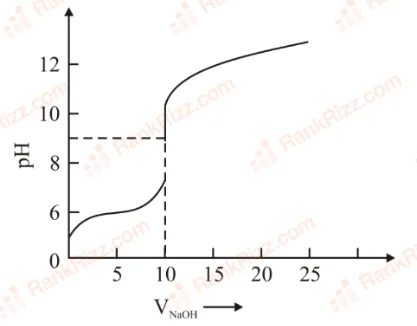
The titration curve of weak acid vs. strong base with phenolphthalein as indicator is shown below. The
Given:
The number of following statement/s which is/are correct about phenolphthalein is ______
A. It can be used as an indicator for the titration of weak acid with weak base.
B. It begins to change colour at pH = 8.4
C. It is a weak organic base
D. It is colourless in acidic medium
OTHER CHEMISTRY CHAPTERS