JEE MAIN 2006Law of mass action and equilibrium constants Kc and KpTRANSCRIBED
The equilibrium constant for the reaction $SO_3(g) \rightleftharpoons SO_2(g) + \frac{1}{2}O_2(g)$ will be
- A
416
- B
- C
- D
Every Chemical and Ionic Equilibrium question JEE Main has set, grouped by the idea it tests rather than the order of the syllabus. 274 questions across 10 distinct ideas. Free to read, answer key on every one.
Questions
274
Distinct ideas
10
Share of marks
5.7%
Difficulty
MEDIUM
A chapter is not one subject — it is a handful of procedures the examiner reuses. These are the ones Chemical and Ionic Equilibrium questions actually test.
261–274 OF 274 · NEWEST FIRST
The equilibrium constant for the reaction $SO_3(g) \rightleftharpoons SO_2(g) + \frac{1}{2}O_2(g)$ will be
416
Which of the following statements is true?
is a stronger acid than
In aqueous medium HF is a stronger acid than HCl
is a weaker acid than
is a stronger acid than
The exothermic formation of ClF is represented by the equation: kJ. Which of the following will increase the quantity of ClF in an equilibrium mixture of Cl, F and ClF?
Increasing the temperature
Removing Cl
Increasing the volume of the container
Adding F
For the reaction , , . When and are compared at C, it is found that
is greater than
is less than
Whether is greater than, less than or equal to depends upon the total gas pressure
A schematic plot of versus inverse of temperature for a reaction is shown below. The reaction must be
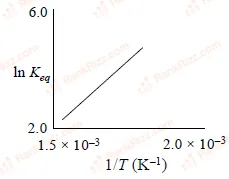
exothermic
endothermic
one with negligible enthalpy change
highly spontaneous at ordinary temperature
An amount of solid NHHS is placed in a flask already containing ammonia gas at a certain temperature and atm pressure. Ammonium hydrogen sulphide decomposes to yield NH and HS gases in the flask. When the decomposition reaction reaches equilibrium, the total pressure in the flask rises to atm. The equilibrium constant for NHHS decomposition at this temperature is
The solubility product of a salt having general formula , in water is . The concentration of M ions in the aqueous solution of the salt is
M
M
M
M
Hydrogen ion concentration in mol/L in a solution of pH will be
What is the conjugate base of OH?
O
HO
O
O
What is the equilibrium expression for the reaction ?
For the reaction, the is equal to
The equilibrium constant for the reaction at temperature is . The value of for the reaction at the same temperature is
The conjugate base of is
The molar solubility product is . '' is given in terms of by the relation
OTHER CHEMISTRY CHAPTERS