RankRizzStart free

Chemical and Ionic Equilibrium — JEE Main Previous Year Questions

Every Chemical and Ionic Equilibrium question JEE Main has set, grouped by the idea it tests rather than the order of the syllabus. 274 questions across 10 distinct ideas. Free to read, answer key on every one.

Questions

274

Distinct ideas

10

Share of marks

5.7%

Difficulty

MEDIUM

The ideas inside Chemical and Ionic Equilibrium

A chapter is not one subject — it is a handful of procedures the examiner reuses. These are the ones Chemical and Ionic Equilibrium questions actually test.

01Law of mass action and equilibrium constants Kc and Kpset 93×
02Reaction quotient, degree of dissociation and equilibrium calculationsset 12×
03Le Chatelier's principle and factors affecting equilibriumset 24×
04Arrhenius, Bronsted-Lowry and Lewis acid-base conceptsset 8×
05Ionisation of weak electrolytes and Ostwald's dilution lawset 17×
06pH of acids, bases and their mixturesset 60×
07Buffer solutionsset 1×
08Hydrolysis of saltsset 7×
09Acid-base indicators and titration curvesset 1×
10Solubility product and common ion effectset 51×

Every Chemical and Ionic Equilibrium question

181–200 OF 274 · NEWEST FIRST

JEE MAIN 2019 · 10 APR S2Le Chatelier's principle and factors affecting equilibriumTRANSCRIBED

For the reaction,
2SOg + Og 2SO g,
ΔH = -57.2 kJ mol and K = .
Which of the following statements is incorrect?

  1. A

    The equilibrium constant is large suggestive of reaction going to completion and so, no catalyst is required.

  2. B

    The equilibrium will shift in forward direction as the pressure increases.

  3. C

    The equilibrium constant decreases as the temperature increases.

  4. D

    The addition of inert gas at constant volume will not affect the equilibrium constant.
JEE MAIN 2019 · 10 JAN S1Solubility product and common ion effectTRANSCRIBED

A mixture of 100 m mol of and 2 g of sodium sulphate was dissolved in water and the volume was made up to 100 mL. What is the mass of calcium sulphate formed and the concentration of in resulting solution, respectively? (Molar mass of , and are 74, 143 and 136 g mol, respectively; of is )

  1. A

    1.9 g, 0.14 mol L

  2. B

    13.6 g, 0.28 mol L

  3. C

    1.9 g, 0.28 mol L

  4. D

    13.6 g, 0.14 mol L

JEE MAIN 2019 · 12 JAN S1Law of mass action and equilibrium constants Kc and KpTRANSCRIBED

In a chemical reaction, , the initial concentration of B was 1.5 times the concentration of A, but the equilibrium concentrations of A and B were found to be equal. The equilibrium constant (K) for the chemical reaction is:

  1. A

    1

  2. B

    4

  3. C

  4. D

    16

JEE MAIN 2019 · 09 APR S2pH of acids, bases and their mixturesTRANSCRIBED

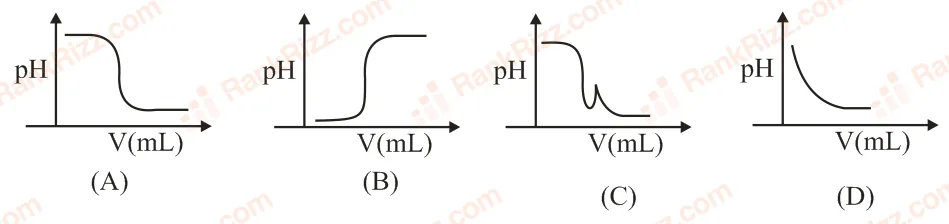
In an acid-base titration, 0.1 M HCl solution was added to the NaOH solution of unknown strength. Which of the following correctly shows the change of pH of the titration mixture in this experiment?

  1. A

    A

  2. B

    B

  3. C

    D

  4. D

    C

JEE MAIN 2019 · 12 APR S2Solubility product and common ion effectTRANSCRIBED

The molar solubility of Cd(OH) is M in water. The expected solubility of Cd(OH) in a buffer solution of pH = 12 is:

  1. A

    M

  2. B

    M

  3. C

    M

  4. D

    M

JEE MAIN 2019 · 09 JAN S1pH of acids, bases and their mixturesTRANSCRIBED

20 ml of 0.1 M solution is added to 30 mL of 0.2 M solution. The pH of the resultant mixture is: ( of )

  1. A

    5.0

  2. B

    5.2

  3. C

    9.4

  4. D

    9.0

JEE MAIN 2019 · 10 APR S1pH of acids, bases and their mixturesTRANSCRIBED

Consider the following statements
(a) The pH of a mixture containing 400 mL of 0.1 M HSO and 400 mL of 0.1 M NaOH will be approximately 1.3.
(b) Ionic product of water is temperature dependent.
(c) A monobasic acid with K = 10 has a pH = 5. The degree of dissociation of this acid is 50%.
(d) The Le Chatelier's principle is not applicable to common-ion effect.
The correct statements are:

  1. A

    (b) and (c)

  2. B

    (a), (b) and (d)

  3. C

    (a) and (b)

  4. D

    (a), (b) and (c)

JEE MAIN 2019 · 08 APR S2Law of mass action and equilibrium constants Kc and KpTRANSCRIBED

For the following reaction, equilibrium constants are given:


The equilibrium constant for the reaction, is:

  1. A

  2. B

  3. C

  4. D

JEE MAIN 2019 · 10 APR S2Hydrolysis of saltsTRANSCRIBED

The pH of a 0.02 M NHCl solution will be [Given: K NHOH = 10 and log 2 = 0.301]

  1. A

    4.65

  2. B

    2.65

  3. C

    4.35

  4. D

    5.35

JEE MAIN 2019 · 12 JAN S1Law of mass action and equilibrium constants Kc and KpTRANSCRIBED

Two solids dissociate as follows: ; atm, ; atm. The total pressure when both the solids dissociate simultaneously is:

  1. A

    atm

  2. B

    atm

  3. C

    (x + y) atm

  4. D

    atm

JEE MAIN 2019 · 12 APR S1Solubility product and common ion effectTRANSCRIBED

What is the molar solubility of Al(OH) in 0.2 M NaOH solution? Given that, solubility product of Al(OH) = :

  1. A

  2. B

  3. C

  4. D

JEE MAIN 2019 · 09 JAN S2pH of acids, bases and their mixturesTRANSCRIBED

The pH of rain water is approximately:

  1. A

    5.6

  2. B

    6.5

  3. C

    7.5

  4. D

    7.0

JEE MAIN 2019 · 12 JAN S2Solubility product and common ion effectTRANSCRIBED

If of is , the molar solubility of in 0.1 M is:

  1. A

    M

  2. B

    M

  3. C

    M

  4. D

    M

JEE MAIN 2019 · 09 JAN S2Law of mass action and equilibrium constants Kc and KpTRANSCRIBED

Consider the following reversible chemical reactions:
 
 
The relation between and is:

  1. A

  2. B

  3. C

  4. D

JEE MAIN 2018 · 08 APR OFFLINELe Chatelier's principle and factors affecting equilibriumTRANSCRIBED

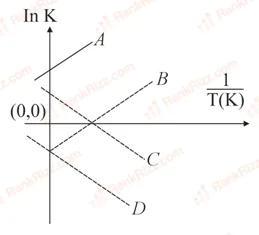
Which of the following lines correctly show the temperature dependence of equilibrium constant K, for an exothermic reaction?

  1. A

    A & D

  2. B

    A & B

  3. C

    B & C

  4. D

    C & D

JEE MAIN 2018 · 08 APR OFFLINELe Chatelier's principle and factors affecting equilibriumTRANSCRIBED

An aqueous solution contains 0.10 M HS and 0.20 M HCl. If the equilibrium constant for the formation of HS from HS is and that of S from HS ions is , then the concentration of S ions in the aqueous solution is:

  1. A

  2. B

  3. C

  4. D

JEE MAIN 2018 · 15 APR S2Law of mass action and equilibrium constants Kc and KpTRANSCRIBED

At a certain temperature in a 5L vessel, 2 moles of carbon monoxide and 3 moles of chlorine were allowed to reach equilibrium according to the reaction, CO + Cl COCl. At equilibrium, if one mole of CO is present then equilibrium constant (K) for the reaction is:

  1. A

    2.5

  2. B

    4

  3. C

    2

  4. D

    3

JEE MAIN 2018 · 16 APR ONLINEReaction quotient, degree of dissociation and equilibrium calculationsTRANSCRIBED

At 320 K, a gas A is 20% dissociated to A(g). The standard Gibbs free energy change at 320 K and 1 atm in J mol is approximately: (R = 8.314 J K mol; ln 2 = 0.693; ln 3 = 1.098)

  1. A

    1844

  2. B

    2068

  3. C

    4281

  4. D

    4763

JEE MAIN 2018 · 08 APR OFFLINELe Chatelier's principle and factors affecting equilibriumTRANSCRIBED

An aqueous solution contains an unknown concentration of Ba. When 50 mL of a 1 M solution of NaSO is added, BaSO just begins to precipitate. The final volume is 500 mL. The solubility product of BaSO is . What is the original concentration of Ba?

  1. A

    M

  2. B

    M

  3. C

    M

  4. D

    M

JEE MAIN 2018 · 15 APR S2pH of acids, bases and their mixturesTRANSCRIBED

Following four solutions are prepared by mixing different volumes of NaOH and HCl of different concentrations, pH of which one of them will be equal to 1?

  1. A

    55 mL HCl + 45 mL NaOH

  2. B

    75 mL HCl + 25 mL NaOH

  3. C

    100 mL HCl + 100 mL NaOH

  4. D

    60 mL HCl + 40 mL NaOH