RankRizzStart free

Chemical Bonding and Molecular Structure — JEE Main Previous Year Questions

Every Chemical Bonding and Molecular Structure question JEE Main has set, grouped by the idea it tests rather than the order of the syllabus. 316 questions across 11 distinct ideas. Free to read, answer key on every one.

Questions

316

Distinct ideas

11

Share of marks

4.8%

Difficulty

MEDIUM

The ideas inside Chemical Bonding and Molecular Structure

A chapter is not one subject — it is a handful of procedures the examiner reuses. These are the ones Chemical Bonding and Molecular Structure questions actually test.

01Ionic bonding, lattice energy and Born-Haber cycleset 1×
02Fajans' rules, polarisation and covalent characterset 15×
03Lewis structures, formal charge and coordinate bondsset 10×
04Resonance and bond parametersset 17×
05VSEPR theory and shapes of molecules and ionsset 118×
06Hybridisation and bond anglesset 8×
07Valence bond theory, orbital overlap and sigma/pi bondsset 5×
08Dipole moment and molecular polarityset 29×
09Molecular orbital theory of diatomic speciesset 79×
10Hydrogen bonding and intermolecular forcesset 31×
11Back bonding and electron-deficient bondingset 3×

Every Chemical Bonding and Molecular Structure question

261–280 OF 316 · NEWEST FIRST

JEE MAIN 2014 · 11 APR ONLINEVSEPR theory and shapes of molecules and ionsTRANSCRIBED

In allene (CH), the type(s) of hybridization of the carbon atoms is (are):

  1. A

    sp and sp

  2. B

    sp and sp

  3. C

    only sp

  4. D

    sp and sp

JEE MAIN 2014 · 12 APR ONLINEValence bond theory, orbital overlap and sigma/pi bondsTRANSCRIBED

Which of the following molecules has two sigma () and two pi () bonds?

  1. A

    CH

  2. B

    N F

  3. C

    CHCl

  4. D

    HCN

JEE MAIN 2014 · 19 APR ONLINEFajans' rules, polarisation and covalent characterTRANSCRIBED

Amongst LiCl, RbCl, BeCl and MgCl the compounds with the greatest and the least ionic character, respectively are:

  1. A

    MgCl and BeCl

  2. B

    RbCl and MgCl

  3. C

    LiCl and RbCl

  4. D

    RbCl and BeCl

JEE MAIN 2014 · 11 APR ONLINEVSEPR theory and shapes of molecules and ionsTRANSCRIBED

Shapes of certain interhalogen compounds are stated below. Which one of them is not correctly stated?

  1. A

    IF: pentagonal bipyramid

  2. B

    BrF: trigonal bipyramid

  3. C

    BrF: planar T-shaped

  4. D

    ICl: planar dimeric

JEE MAIN 2014 · 19 APR ONLINEHydrogen bonding and intermolecular forcesTRANSCRIBED

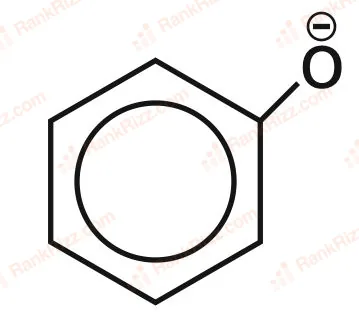
Which one of the following substituents at para-position is most effective in stabilizing the phenoxide ion?
  1. A

    -CH

  2. B

    -OCH

  3. C

    -COCH

  4. D

    -CHOH

JEE MAIN 2013 · 09 APR ONLINEDipole moment and molecular polarityTRANSCRIBED

Which one of the following molecules is polar?

  1. A

  2. B

  3. C

  4. D

JEE MAIN 2013 · 09 APR ONLINEMolecular orbital theory of diatomic speciesTRANSCRIBED

In which of the following ionization processes the bond energy has increased and also the magnetic behaviour has changed from paramagnetic to diamagnetic?

  1. A

  2. B

  3. C

  4. D

JEE MAIN 2013 · 23 APR ONLINEVSEPR theory and shapes of molecules and ionsTRANSCRIBED

The shape of is :

  1. A

    Trigonally distorted octahedron

  2. B

    Pyramidal

  3. C

    Octahedral

  4. D

    Square antiprism

JEE MAIN 2013 · 22 APR ONLINEMolecular orbital theory of diatomic speciesTRANSCRIBED

Bond order normally gives idea of stability of a molecular species. All the molecules viz. , and have the same bond order yet they are not equally stable. Their stability order is :

  1. A

  2. B

  3. C

  4. D

    None of these

JEE MAIN 2013 · 23 APR ONLINEDipole moment and molecular polarityTRANSCRIBED

Bond distance in HF is m. Dipole moment of HF is Cm. The percentage ionic character in HF will be : (electron charge = C)

  1. A

    61.0%

  2. B

    38.0%

  3. C

    35.5%

  4. D

    41.5%

JEE MAIN 2013 · 23 APR ONLINEHydrogen bonding and intermolecular forcesTRANSCRIBED

The correct order of viscosity of the following liquids will be :

  1. A

    Water < methyl alcohol < dimethyl ether < glycerol

  2. B

    methyl alcohol < glycerol < water < dimethyl ether

  3. C

    dimethyl ether < methyl alcohol < water < glycerol

  4. D

    glycerol < dimethyl ether < water < methyl alcohol

JEE MAIN 2013 · 25 APR ONLINEVSEPR theory and shapes of molecules and ionsTRANSCRIBED

In which of the following sets, all the given species are isostructural?

  1. A

    , , ,

  2. B

    , , ,

  3. C

    , , ,

  4. D

    , , ,

JEE MAIN 2013 · 07 APR ONLINEMolecular orbital theory of diatomic speciesTRANSCRIBED

Stability of the species , and increases in the order of

  1. A

    Li_2 &lt; Li_2^- &lt; Li_2^+

  2. B

    Li_2^- &lt; Li_2 &lt; Li_2^+

  3. C

    Li_2 &lt; Li_2^+ &lt; Li_2^-

  4. D

    Li_2^- &lt; Li_2^+ &lt; Li_2

JEE MAIN 2013 · 25 APR ONLINEMolecular orbital theory of diatomic speciesTRANSCRIBED

The internuclear distances in O-O bonds for , , and respectively are :

  1. A

    1.30 , 1.49 , 1.12 , 1.21

  2. B

    1.49 , 1.21 , 1.12 , 1.30

  3. C

    1.21 , 1.12 , 1.49 , 1.30

  4. D

    1.12 , 1.21 , 1.30 , 1.49

JEE MAIN 2013 · 07 APR ONLINEMolecular orbital theory of diatomic speciesTRANSCRIBED

Which one of the following molecules is expected to exhibit paramagnetic behaviour?

  1. A

  2. B

  3. C

  4. D

JEE MAIN 2013 · 07 APR ONLINEMolecular orbital theory of diatomic speciesTRANSCRIBED

In which of the following pairs of molecules/ions, both the species are not likely to exist?

  1. A

    ,

  2. B

    ,

  3. C

    ,

  4. D

    ,

JEE MAIN 2013 · 23 APR ONLINEVSEPR theory and shapes of molecules and ionsTRANSCRIBED

Which has trigonal bipyramidal shape?

  1. A

    XeOF

  2. B

    XeO

  3. C

    XeOF

  4. D

    XeOF

JEE MAIN 2013 · 09 APR ONLINEVSEPR theory and shapes of molecules and ionsTRANSCRIBED

Trigonal bipyramidal geometry is shown by:

  1. A

  2. B

  3. C

    FXeOSOF

  4. D

JEE MAIN 2012VSEPR theory and shapes of molecules and ionsTRANSCRIBED

The molecule having smallest bond angle is :

  1. A

  2. B

  3. C

  4. D

JEE MAIN 2012VSEPR theory and shapes of molecules and ionsTRANSCRIBED

In which of the following pairs the two species are not isostructural?

  1. A

    and

  2. B

    and

  3. C

    and

  4. D

    and