RankRizzStart free

Chemical Thermodynamics — JEE Main Previous Year Questions

Every Chemical Thermodynamics question JEE Main has set, grouped by the idea it tests rather than the order of the syllabus. 229 questions across 6 distinct ideas. Free to read, answer key on every one.

Questions

229

Distinct ideas

6

Share of marks

4.6%

Difficulty

MEDIUM

The ideas inside Chemical Thermodynamics

A chapter is not one subject — it is a handful of procedures the examiner reuses. These are the ones Chemical Thermodynamics questions actually test.

01System, surroundings and state functionsPractice questions coming soon
02First law: work, heat and internal energyset 55×
03Heat capacity and calorimetryset 24×
04Enthalpies of reaction and Hess's lawset 75×
05Bond enthalpy, atomisation, phase-change and solution enthalpiesset 12×
06Entropy and the second lawset 9×
07Gibbs energy and spontaneityset 54×

Every Chemical Thermodynamics question

141–160 OF 229 · NEWEST FIRST

JEE MAIN 2021 · 27 AUG S2Gibbs energy and spontaneityTRANSCRIBED

Data given for the following reaction is as follows:
FeO + C Fe + CO
Substance                (kJ mol)                               (J mol K)
FeO                                          -266.3                                        57.49
C                                  0                                              5.74
Fe                                              0                                               27.28
CO                                           -110.5                                         197.6
The minimum temperature in K at which the reaction becomes spontaneous is _________. (Integer answer)
JEE MAIN 2021 · 17 MAR S1Enthalpies of reaction and Hess's lawTRANSCRIBED

The standard enthalpies of formation of and CaO are kJ mol and kJ mol respectively. For the reaction the standard reaction enthalpy = ________ kJ. (Round off to the Nearest Integer).

JEE MAIN 2021 · 01 SEP S2Gibbs energy and spontaneityTRANSCRIBED

For the reaction 2NO(g) NO(g), when J K and kJ mol the magnitude of at 298 K for the reaction is _________ kJ mol. (Nearest integer)

JEE MAIN 2021 · 27 AUG S1Enthalpies of reaction and Hess's lawTRANSCRIBED

200 mL of 0.2 M HCl is mixed with 300 mL of 0.1 M NaOH. The molar heat of neutralization of this reaction is -57.1 kJ. The increase in temperature in °C of the system on mixing is . The value of x is _________. (Nearest integer)
[Given: Specific heat of water = 4.18 J g K
Density of water = 1.00 g cm]
(Assume no volume change on mixing)

JEE MAIN 2020 · 09 JAN S2Entropy and the second lawTRANSCRIBED

The true statement amongst the following is:

  1. A

    Both and are functions of temperature.

  2. B

    Both and are not functions of temperature

  3. C

    is not a function of temperature but is a function of temperature

  4. D

    is a function of temperature but is not a function of temperature

JEE MAIN 2020 · 09 JAN S1Enthalpies of reaction and Hess's lawTRANSCRIBED

If enthalpy of atomization for is kJ/mol and bond enthalpy for is kJ/mol, the relation between them:

  1. A

    is

  2. B

    does not exist

  3. C

    is x > y

  4. D

    is x < y

JEE MAIN 2020 · 05 SEP S2Enthalpies of reaction and Hess's lawTRANSCRIBED

Lattice enthalpy and enthalpy of solution of NaCl are and , respectively. The hydration enthalpy of is:

  1. A

  2. B

  3. C

  4. D

JEE MAIN 2020 · 04 SEP S1Heat capacity and calorimetryTRANSCRIBED

For one mole of an ideal gas, which of these statements must be true?
(a) Internal energy (U) and enthalpy (H) each depends on temperature.
(b) Compressibility factor Z is not equal to 1
(c)
(d) for any process

  1. A

    (a) and (c)

  2. B

    (b), (c) and (d)

  3. C

    (c) and (d)

  4. D

    (a), (c) and (d)

JEE MAIN 2020 · 04 SEP S2First law: work, heat and internal energyTRANSCRIBED

Five moles of an ideal gas at 1 bar and 298 K is expanded into vacuum to double the volume. The work done is:

  1. A

  2. B

  3. C

  4. D

    Zero

JEE MAIN 2020 · 07 JAN S1Gibbs energy and spontaneityTRANSCRIBED

For the reaction:
A(l) 2B(g)
kcal, cal K at 300K.
Hence in kcal is

JEE MAIN 2020 · 05 SEP S2Gibbs energy and spontaneityTRANSCRIBED

For a dimerization reaction,

at 298K, , , then the will be .....J.

JEE MAIN 2020 · 07 JAN S2Enthalpies of reaction and Hess's lawTRANSCRIBED

The standard heat of formation of ethane (in kJ/mol), if the heat of combustion of ethane, hydrogen and graphite are , and kJ/mol, respectively is

JEE MAIN 2020 · 02 SEP S1Enthalpies of reaction and Hess's lawTRANSCRIBED

The internal energy change (in J) when 90 g of water undergoes complete evaporation at 100C is ___________.
(Given: for water at 373 K kJ/mol, R J K mol)

JEE MAIN 2020 · 08 JAN S1First law: work, heat and internal energyTRANSCRIBED

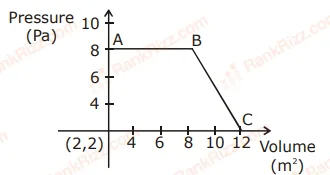
The magnitude of work done by a gas that undergoes a reversible expansion along the path ABC shown in the figure is __________.

image
JEE MAIN 2020 · 08 JAN S2First law: work, heat and internal energyTRANSCRIBED

At constant volume, 4 mol of an ideal gas when heated from 300K to 500K changes its internal energy by 5000J. The molar heat capacity at constant volume is

JEE MAIN 2020 · 02 SEP S2Enthalpies of reaction and Hess's lawTRANSCRIBED

The heat of combustion of ethanol into carbon dioxides and water is Kcal at constant pressure. The heat evolved (in cal) at constant volume at 27C (if all gases behave ideally) is cal mol K ___________.

JEE MAIN 2019 · 08 APR S1First law: work, heat and internal energyTRANSCRIBED

Which one of the following equations does not correctly represent the first law of thermodynamics for the given processes involving an ideal gas? (Assume non-expansion work is zero)

  1. A

    Isochoric process:

  2. B

    Isochoric process:

  3. C

    Cyclic process:

  4. D

    Adiabatic process:

JEE MAIN 2019 · 10 JAN S2Entropy and the second lawTRANSCRIBED

The process with negative entropy change is:

  1. A

    Synthesis of ammonia from N and H.

  2. B

    Dissolution of iodine in water.

  3. C

    Dissociation of CaSO (s) to CaO (s) and SO (g).

  4. D

    Sublimation of dry ice.

JEE MAIN 2019 · 08 APR S1Enthalpies of reaction and Hess's lawTRANSCRIBED

For silver, (J K mol) = 23 + 0.01T. If the temperature T of 3 moles of silver is raised from 300 K to 1000 K at 1 atm pressure, the value of will be close to:

  1. A

    16 kJ

  2. B

    62 kJ

  3. C

    13 kJ

  4. D

    21 kJ

JEE MAIN 2019 · 11 JAN S1Entropy and the second lawTRANSCRIBED

Two blocks of the same metal having same mass and at temperature , and , respectively, are brought in contact with each other and allowed to attain thermal equilibrium at constant pressure. The change in entropy, , for this process is:

  1. A

  2. B

  3. C

  4. D