1 mole of ideal gas is allowed to expand reversibly and adiabatically from a temperature of C. The work done is kJ mol. The final temperature of the gas is ______ K (Nearest integer). Given J mol K
Every Chemical Thermodynamics question JEE Main has set, grouped by the idea it tests rather than the order of the syllabus. 229 questions across 6 distinct ideas. Free to read, answer key on every one.
Questions
229
Distinct ideas
6
Share of marks
4.6%
Difficulty
MEDIUM
A chapter is not one subject — it is a handful of procedures the examiner reuses. These are the ones Chemical Thermodynamics questions actually test.
81–100 OF 229 · NEWEST FIRST
1 mole of ideal gas is allowed to expand reversibly and adiabatically from a temperature of C. The work done is kJ mol. The final temperature of the gas is ______ K (Nearest integer). Given J mol K
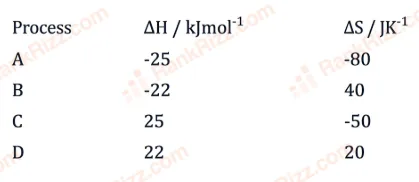
For independent process at 300 K.
The number of non-spontaneous process from the following is _____.
For independent process at 300 K.
| Process | / kJmol | / JK |
|---|---|---|
| A | -25 | -80 |
| B | -22 | 40 |
| C | 25 | -50 |
| D | 22 | 20 |
When 2 litre of ideal gas expands isothermally into vacuum to a total volume of 6 litre, the change in internal energy is ______ J. (Nearest integer)
kJ of heat is required to melt one mole of sodium chloride and the entropy change at the melting point is J K mol at 1 atm. The melting point of sodium chloride is _____ K (Nearest Integer)
Solid fuel used in rocket is a mixture of FeO and Al (in ratio 1 : 2). The heat evolved (kJ) per gram of the mixture is _______
Given AlO = -1700 kJ mol
FeO = -840 kJ mol
Molar mass of Fe, Al and O are 56, 27 and 16 g mol respectively
The enthalpy change for the conversion of Cl(g) to Cl(aq) is (-) ______ kJmol (Nearest integer)
Given: kJmol
kJmol
kJmol
One mole of an ideal gas at K is in a L vessel of thermally conducting walls, which are in contact with the surroundings. It undergoes isothermal reversible expansion from L to L against a constant pressure of atm. The change in entropy of the surroundings () is _____ J K (Nearest integer)
Given: J K mol.
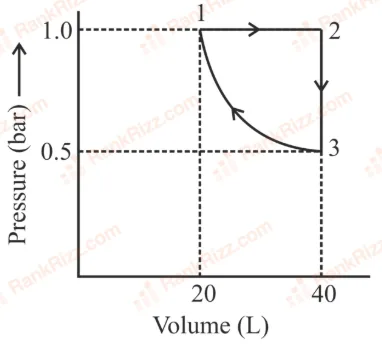
One mole of an ideal monoatomic gas is subjected to changes as shown in the graph. The magnitude of the work done (by the system or on the system) is _____ J (nearest integer)
Given: log 2 = 0.3, ln 10 = 2.3
A + B 2AB. kJ mol
AB, A and B are diatomic molecules. If the bond enthalpies of A, B and AB are in the ratio 1 : 0.5 : 1, then the bond enthalpy of A is _____ kJ mol (Nearest integer)
Enthalpies of formation of CCl(g), HO(g), CO(g) and HCl are -105, -242, -394 and -92 kJ mol respectively. The magnitude of enthalpy of the reaction given below is kJmol. (nearest integer)
28.0 L of CO is produced on complete combustion of 16.8 L gaseous mixture of ethene and methane at 25°C and 1 atm. Heat evolved during the combustion process is _____ kJ
Given: (CH) = -900 kJ mol
(CH) = -1400 kJ mol.
Consider the following data
Heat of combustion of H(g) = -241.8 kJ mol
Heat of combustion of C(s) = -393.5 kJ mol
Heat of combustion of CHOH(l) = -1234.7 kJ mol
The heat of formation of CHOH(l) is (-) ______ kJ mol (Nearest integer)
At 25°C, the enthalpy of the following processes are given:
H(g) + O(g) 2OH(g) H = 78 kJ mol
H(g) + 1/2O(g) HO(g) H = -242 kJ mol
H(g) 2H(g) H = 436 kJ mol
1/2O(g) O(g) H = 249 kJ mol
HO(g) Hg + OHg H = X kJmol
What would be the value of X for the following reaction? (Nearest integer)
g of ethane undergoes combustion at C in a bomb calorimeter. The temperature of calorimeter system (including the water) is found to rise by C. The heat evolved during combustion of ethane at constant pressure is ______ kJ mol. (Nearest integer)
[Given: The heat capacity of the calorimeter system is kJ K, R JK mol. Assume ideal gas behaviour. Atomic mass of C and H are 12 and 1 g mol respectively]
The value of log K for the reaction A B at 298 K is ______. (Nearest integer)
Given: kJ mol, J K mol
(Taken )
The total number of intensive properties from the following is _______
Volume, Molar heat capacity, molarity, , Gibbs free energy change, Molar mass, Mole
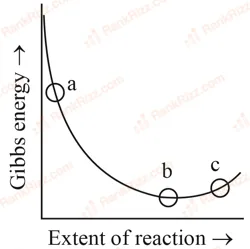
Consider the graph of Gibbs free energy G vs extent of reaction. The number of statement/s from the following which are true with respect to points (a), (b) and (c) is ______
A. Reaction is spontaneous at (a) and (b)
B. Reaction is at equilibrium at point (b) and non-spontaneous at point (c)
C. Reaction is spontaneous at (a) and non-spontaneous at (c)
D. Reaction is non-spontaneous at (a) and (b)
When a 60 W electric heater is immersed in a gas for 100 s in a constant volume container with adiabatic walls, the temperature of the gas rises by 5°C. The heat capacity of the given gas is JK (Nearest integer)
The number of endothermic process/es from the following is _______.
A.
B.
C.
D.
E. Dissolution of ammonium chloride in water
OTHER CHEMISTRY CHAPTERS