JEE MAIN 2019 · 12 JAN S1Classification, preparation and types of colloidsTRANSCRIBED
Given
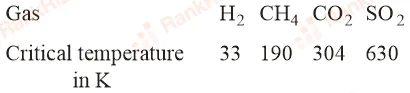
On the basis of data given above, predict which of the following gases shows the least adsorption on a definite amount of charcoal?
- A
CH
- B
CO
- C
SO
- D
H
Every Surface Chemistry question JEE Main has set, grouped by the idea it tests rather than the order of the syllabus. 123 questions across 4 distinct ideas. Free to read, answer key on every one.
Questions
123
Distinct ideas
4
Share of marks
0%
Difficulty
EASY
A chapter is not one subject — it is a handful of procedures the examiner reuses. These are the ones Surface Chemistry questions actually test.
81–100 OF 123 · NEWEST FIRST
Given
On the basis of data given above, predict which of the following gases shows the least adsorption on a definite amount of charcoal?
CH
CO
SO
H
For coagulation of arsenious sulphide sol, which of the following salt solutions will be most effective?
The haemoglobin and the gold sol are examples of:
positively charged sols
negatively and positively charged sols, respectively
negatively charged sols
positively and negatively charged sols, respectively
A gas undergoes physical adsorption on a surface and follows the given Freundlich adsorption isotherm equation
Adsorption of the gas increases with:
Decrease in p and increase in T
Increase in p and decrease in T
Increase in p and increase in T
Decrease in p and decrease in T
Among the colloids cheese (C), milk (M) and smoke (S), the correct combination of the dispersed phase and dispersion medium, respectively is:
C : liquid in solid; M : liquid in solid; S : solid in gas
C : liquid in solid; M : liquid in liquid; S : solid in gas
C : solid in liquid; M : liquid in liquid; S : gas in solid
C : solid in liquid; M : solid in liquid; S : solid in gas
The aerosol is a kind of colloid in which:
solid is dispersed in gas.
liquid is dispersed in water.
gas is dispersed in solid.
gas is dispersed in liquid.
Among the following, the false statement is:
Latex is a colloidal solution of rubber particles which are positively charged
Tyndall effect can be used to distinguish between a colloidal solution and a true solution.
It is possible to cause artificial rain by throwing electrified sand carrying charge opposite to the one on clouds from an aeroplane.
Lyophilic sols can be coagulated by adding an electrolyte.
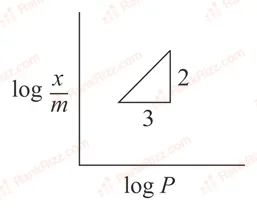
Adsorption of a gas follows Freundlich adsorption isotherm. x is the mass of the gas adsorbed on mass m of the adsorbent. The plot of vs is shown in the given graph. is proportional to:
An example of solid sol is:
Paint
Gem stones
Butter
Hair cream
Among the following, the incorrect statement about colloids is:
They are larger than small molecules and have high molar mass.
They can scatter light.
The osmotic pressure of a colloidal solution is of higher order than the true solution at the same concentration.
The range of diameters of colloidal particles is between 1 and 1000 nm.
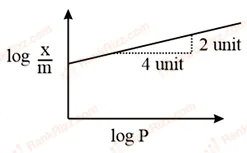
Adsorption of a gas follows Freundlich adsorption isotherm. In the given plot, is the mass of the gas adsorbed on mass of the adsorbent at pressure P. is proportional to:
The correct option among the following is.
Brownian motion in colloidal solution is faster if the viscosity of the solution is very high.
Colloidal particles in lyophobic sols can be precipitated by electrophoresis.
Colloidal medicines are more effective because they have small surface area.
Addition of alum to water makes it unfit for drinking.
Which of the following is not an example of heterogeneous catalysis reaction?
Combustion of Coal
Hydrogenation of Vegetable oils
Ostwald's process
Haber's process
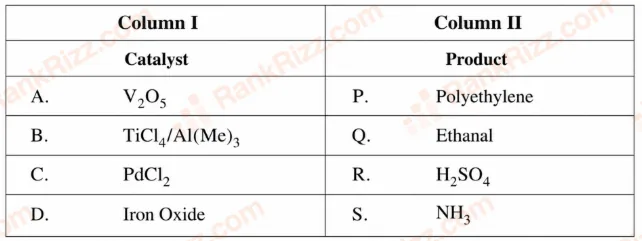
Match the catalysts (Column I) with products (Column II)
(A)-(S); (B)-(R); (C)-(Q); (D)-(P)
(A)-(R); (B)-(S); (C)-(P); (D)-(Q)
(A)-(Q); (B)-(R); (C)-(P); (D)-(S)
(A)-(R); (B)-(P); (C)-(Q); (D)-(S)
Peptization is a:
Process of converting a colloidal solution into precipitate
Process of converting soluble particles to form colloidal solution
Process of bringing colloidal molecule into solution
Process of converting precipitate into colloidal solution
Which one of the following is not a property of physical adsorption?
Higher the pressure, more the adsorption
Greater the surface area, more the adsorption
Lower the temperature, more the adsorption
Unilayer adsorption occurs
If x gram of gas is adsorbed by m gram of adsorbent at pressure P the plot of log versus log P is linear. The slope of the plot is: (m and k are constants and n > 1)
log k
2k
n
Which of the following statements about colloids is false?
When silver nitrate solution is added to potassium iodide solution, a negatively charged colloidal solution is formed
Freezing point of colloidal solution is lower than true solution at same concentration of a solute
Colloidal particles can pass through ordinary filter paper
When excess of electrolyte is added to colloidal solution, colloidal particle will be precipitated
The Tyndall effect is observed only when the following conditions are satisfied,
i. The diameter of the dispersed particles is much smaller than the wavelength of the light used.
ii. The diameter of the dispersed particle is not much smaller than the wavelength of the light used.
iii. The refractive indices of the dispersed phase and dispersion medium are almost similar in magnitude.
iv. The refractive indices of the dispersed phase and dispersion medium differ greatly in magnitude.
ii and iv
i and iii
ii and iii
i and iv
Among the following, the correct statement is:
sols of metal sulphides are lyophilic.
Brownian movement is more pronounced for smaller particles than for bigger particles.
one would expect charcoal to adsorb chlorine more than hydrogen sulphide.
Hardy Schulze law states that bigger the size of the ions, the greater is its coagulating power.
OTHER CHEMISTRY CHAPTERS