JEE MAIN 2022 · 27 JUN S2Adsorption and adsorption isothermsTRANSCRIBED
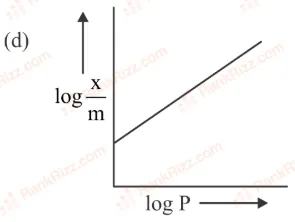
A Freundlich adsorption isotherm graph is shown.
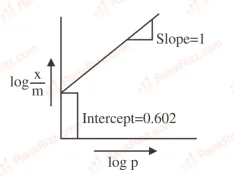
If the initial pressure of a gas is atm, the mass of the gas adsorbed per gram of the adsorbent is ______ g
Every Surface Chemistry question JEE Main has set, grouped by the idea it tests rather than the order of the syllabus. 123 questions across 4 distinct ideas. Free to read, answer key on every one.
Questions
123
Distinct ideas
4
Share of marks
0%
Difficulty
EASY
A chapter is not one subject — it is a handful of procedures the examiner reuses. These are the ones Surface Chemistry questions actually test.
41–60 OF 123 · NEWEST FIRST
A Freundlich adsorption isotherm graph is shown.
If the initial pressure of a gas is atm, the mass of the gas adsorbed per gram of the adsorbent is ______ g
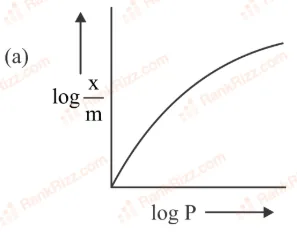
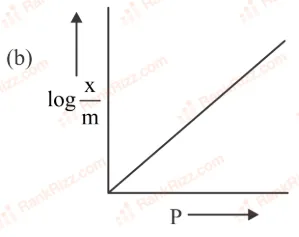
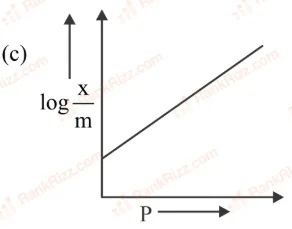
Among the following the number of curves not in accordance with Freundlich adsorption isotherm is
Lyophilic sols are more stable than lyophobic sols because:
the colloidal particles have no charge.
the colloidal particles have positive charge.
the colloidal particles are solvated.
there is a strong electrostatic repulsion between the negatively charged colloidal particles.
Tyndall effect is more effectively shown by:
lyophilic colloid
suspension
lyophobic colloid
true solution
The nature of charge on resulting colloidal particles when is added to excess of hot water is:
positive
sometimes positive and sometimes negative
neutral
negative
In Freundlich adsorption isotherm, slope of AB line is:
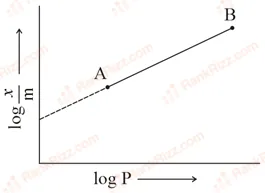
with to
with to
with n < 1
with n > 1
The INCORRECT statements below regarding colloidal solutions is:
A colloidal solution shows colligative properties.
An ordinary filter paper can stop the flow of colloidal particles.
The flocculation power of is more than that of .
A colloidal solution shows Brownian motion of colloidal particles.
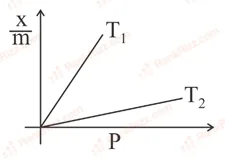
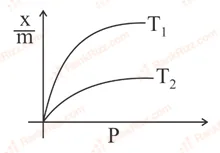
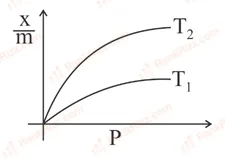
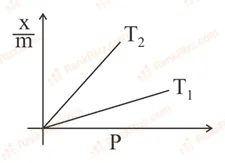
Select the graph that correctly describes the adsorption isotherms at two temperatures and (T_1 > T_2) for a gas:
( - mass of the gas adsorbed, - mass of adsorbent, - pressure)
Match List - I with List - II.
List-I (Colloid Preparation Method) List-II (Chemical Reaction)
(a) Hydrolysis (i) 2AuCl + 3HCHO + 3HO 2Au(sol) + 3HCOOH + 6HCl
(b) Reduction (ii) AsO + 3HS AsS(sol) + 3HO
(c) Oxidation (iii) SO + 2HS 3S(sol) + 2HO
(d) Double Decomposition (iv) FeCl + 3HO Fe(OH)(sol) + 3HCl
Choose the most appropriate answer from the options given below:
(a)-(i), (b)-(iii), (c)-(ii), (d)-(iv)
(a)-(iv), (b)-(i), (c)-(iii), (d)-(ii)
(a)-(i), (b)-(ii), (c)-(iv), (d)-(iii)
(a)-(iv), (b)-(ii), (c)-(iii), (d)-(i)
Most suitable salt which can be used for efficient clotting of blood will be?
The conditions given below are in the context of observing Tyndall effect in colloidal solutions:
(A) The diameter of the colloidal particles is comparable to the wavelength of light used.
(B) The diameter of the colloidal particles is much smaller than the wavelength of light used.
(C) The diameter of the colloidal particles is much larger than the wavelength of light used.
(D) The refractive indices of the dispersed phase and the dispersion medium are comparable.
(E) The dispersed phase has a very different refractive index from the dispersion medium. Choose the most appropriate conditions from the options given below:
(A) and (E) only
(C) and (D) only
(A) and (D) only
(B) and (E) only
Which one of the following statements is FALSE for hydrophilic sols?
These sols are reversible in nature.
Their viscosity is of the order of that of .
The sols cannot be easily coagulated.
They do not require electrolytes for stability.
The sol given below with negatively charged colloidal particles is:
AgNO added to KI solution
KI added to AgNO solution
AlO xHO in water
FeCl added to hot water
Match List I with List II:
List-I (Example of colloids) List-II (Classification)
(a) Cheese (i) dispersion of liquid in liquid
(b) Pumice stone (ii) dispersion of liquid in gas
(c) Hair cream (iii) dispersion of gas in solid
(d) Cloud (iv) dispersion of liquid in solid
Choose the most appropriate answer from the options given below:
(a)-(iv), (b)-(iii), (c)-(ii), (d)-(i)
(a)-(iv), (b)-(i), (c)-(iii), (d)-(ii)
(a)-(iii), (b)-(iv), (c)-(i), (d)-(ii)
(a)-(iv), (b)-(iii), (c)-(i), (d)-(ii)
A colloidal system consisting of a gas dispersed in a solid is called a/an:
solid sol
gel
aerosol
foam
Given below are two statement: one is labelled as Assertion A and the other is labelled as Reason R.
Assertion A : SO(g) is adsorbed to a large extent than H(g) on activated charcoal.
Reason R : SO(g) has a higher critical temperature than H(g)
In the light of the above statements, choose the most appropriate answer from the options given below.
Both A and R are correct but R is not the correct explanation for A
Both A and R are correct and R is the correct explanation of A.
A is not correct but R is correct.
A is correct but R is not correct.
Which one of the following is correct for the adsorption of a gas at a given temperature on a solid surface?
\Delta H > 0, \Delta S > 0
\Delta H < 0, \Delta S > 0
\Delta H > 0, \Delta S < 0
\Delta H < 0, \Delta S < 0
For the coagulation of a negative sol, the species below, that has the highest flocculating power is:
The charges on the colloidal CdS sol and TiO sol are, respectively :
positive and positive
positive and negative
negative and negative
negative and positive
In Freundlich adsorption isotherm at moderate pressure, the extent of adsorption is directly proportional to . The value of is:
zero
1
OTHER CHEMISTRY CHAPTERS